AI Compute Capex Cycle Research: Cloud Provider Capex Guidance and Semiconductor Supply Chain Transmission
How cloud capex guidance leads semis? Big 4 cloud capex trends, transmission to equipment, foundry, OSAT, memory; benefit order, metrics, risks, data links.
AI Compute Capex Cycle Research: Cloud Provider Capex Guidance and Semiconductor Supply Chain Transmission
⚠ This article is U.S. stock/industry research and does not constitute investment advice. Investing involves risk; please assess on your own.
The AI compute capex cycle is a core theme in current semiconductor and tech stock investing. This article focuses on the capital expenditure guidance of major North American cloud providers (Amazon, Microsoft, Google, Meta), breaks down the transmission path to semiconductor equipment, wafer manufacturing, OSAT, and memory, and provides a tracking framework for investors.
#Core Conclusion
Cloud provider capex guidance is a leading indicator for AI compute investment. Earnings guidance releases signals earlier than actual spending, and semiconductor equipment orders typically lag by 1-2 quarters. Tracking quarterly capex changes of the Big 4 North American cloud providers can help identify semiconductor cycle turning points in advance. However, be wary of inventory and valuation risks caused by overheating capital expenditure.
#Key Data and Current Status
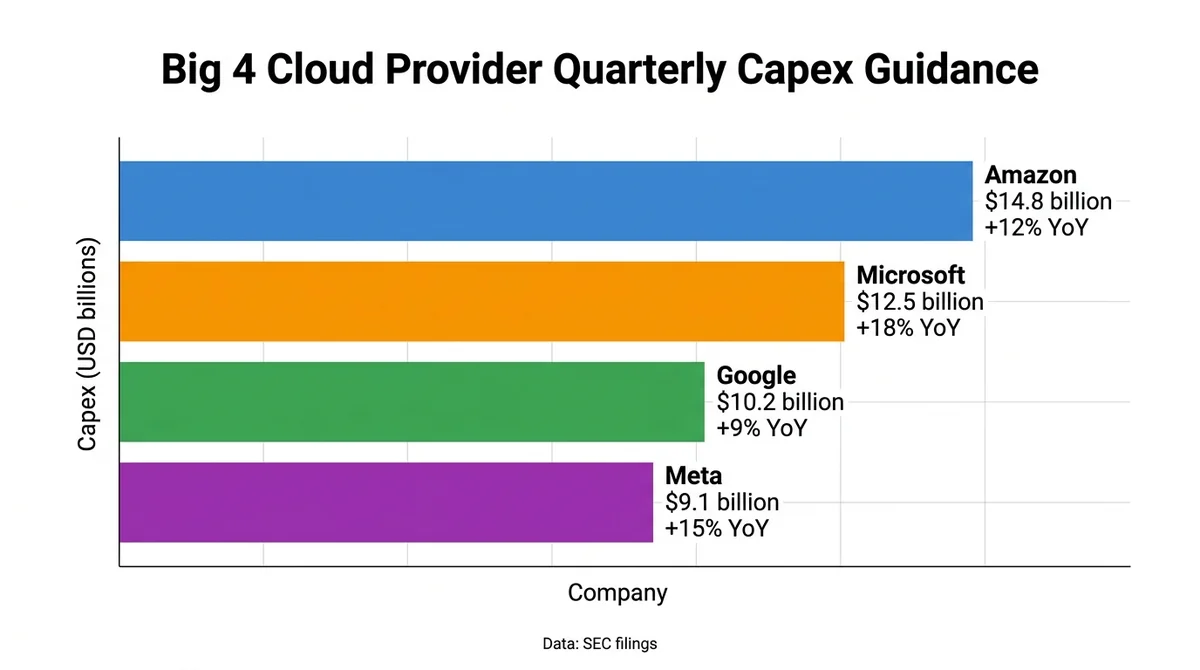
According to multiple sell-side research reports and company earnings calls, the Big 4 North American cloud providers have recently continued to raise quarterly capital expenditure guidance, with data centers and AI servers being the main investment areas. Specific amounts and year-over-year changes can be found in each company's SEC filings (links at the end of this article). Semiconductor equipment orders and wafer foundry capacity utilization are improving simultaneously, and memory prices are showing signs of recovery driven by AI demand. The views in this article are based on public information and do not constitute investment advice.
#Core Drivers and Key Industry Players
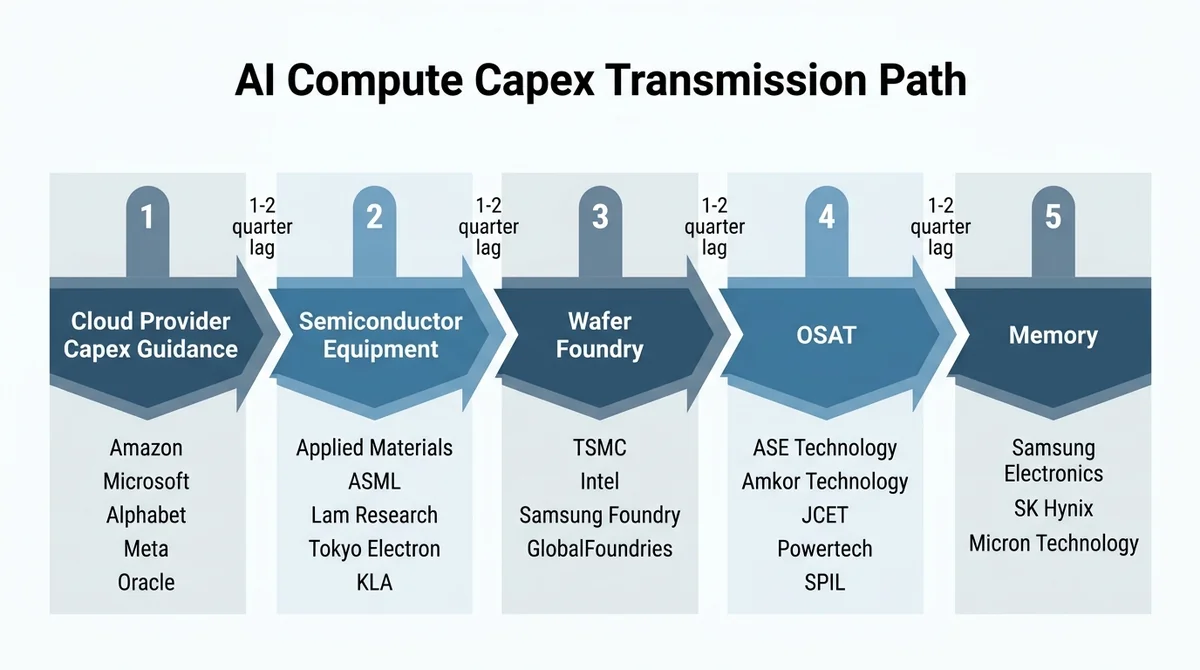
The AI compute capex cycle is driven by the following factors:
- Cloud providers' expectations for future AI training and inference compute demand;
- Equipment procurement cycles brought by new data center construction and retrofit;
- Supply-demand gaps for high-end logic chips and high-bandwidth memory (HBM);
- Cyclical amplification effects from semiconductor supply chain lead times and inventory.
Key industry companies (listed for factual reference only, not buy/sell recommendations):
- Cloud providers: Amazon, Microsoft, Google, Meta.
- Semiconductor equipment: ASML, Applied Materials, Lam Research.
- Wafer foundry: TSMC, Samsung Foundry.
- Memory: Micron, SK Hynix.
#Risks and Disagreements
The bear case argues that cloud provider capex guidance may be revised downward, AI training demand growth may slow, and combined with high semiconductor inventories, the cycle could stage a temporary peak. Additionally, power and cooling constraints may limit data center expansion speed. These risks need continuous monitoring, not one-sided bets.
#What to Watch Next
Investors can regularly track the following metrics:
| Metric | Data Source | Update Frequency |
|---|---|---|
| Cloud provider quarterly capex | Company earnings, SEC filings | Quarterly |
| Semiconductor equipment orders | SEMI, company announcements | Monthly |
| Wafer foundry monthly revenue | TSMC, Samsung | Monthly |
| DRAM/NAND spot prices | TrendForce (JiBang Consulting) | Weekly/Monthly |
Authoritative data links:
- SEC EDGAR Search: https://www.sec.gov/edgar/search/
- Microsoft Investor Relations: https://www.microsoft.com/en-us/investor
- Amazon Investor Relations: https://ir.aboutamazon.com/
- Alphabet Investor Relations: https://abc.xyz/investor/overview/
- Meta Investor Relations: https://investor.atmeta.com/
#FAQ
#1. Why is cloud provider capex a leading indicator?
Cloud provider capex is a leading indicator because earnings guidance releases signals earlier than actual spending, and semiconductor equipment orders typically lag by 1-2 quarters. This logic has been validated across multiple cycles.
#2. Which segment of the semiconductor supply chain benefits first?
The semiconductor equipment segment sees orders first, followed by transmission to wafer manufacturing, OSAT, and memory. Equipment orders are the first signal of cycle startup.
#3. How to determine if the capital expenditure cycle may peak?
Watch whether cloud provider capex guidance is revised downward, whether AI demand growth slows, and whether semiconductor inventory and price signals deteriorate. When all three indicators resonate, caution is needed.
#4. What is the difference in transmission rhythm between memory and logic chips?
Memory price cycles have greater elasticity, while logic chip demand relies more on advanced process nodes and AI accelerator orders. Memory price increases in magnitude and speed usually lead logic chips.
#5. How can ordinary investors track these metrics?
Regularly review cloud provider earnings calls, SEMI equipment shipment data, DRAM/NAND spot prices, and follow the authoritative data links listed at the end of this article. Pay attention to data release lags and definitional differences.
#6. Why do we need to monitor both cloud provider capex and semiconductor inventory?
Cloud provider capex reflects demand expectations, while semiconductor inventory reflects supply status. When the two diverge, it often creates a cycle turning point; combining both can improve the win rate.
FAQ
Why is cloud provider capex a leading indicator?
Logically, capex reflects cloud providers' expectations for future compute demand, and earnings guidance releases signals earlier than actual spending, but this logic needs historical data validation.
Which segment of the semiconductor supply chain benefits first?
According to industry practice, the semiconductor equipment segment tends to see orders first, followed by transmission to wafer manufacturing, OSAT, and memory, but the specific time lag varies by cycle.
How to determine if the capital expenditure cycle may peak?
Pay attention to whether cloud provider capex guidance is revised downward, whether AI demand growth slows, and semiconductor inventory and price signals, but a comprehensive judgment should combine multiple indicators.
What is the difference in transmission rhythm between memory and logic chips?
Typically, memory price cycles have greater elasticity, while logic chip demand relies more on advanced process nodes and AI accelerator orders, but this difference requires specific data support.
How can ordinary investors track these metrics?
Regularly review cloud provider earnings calls, SEMI equipment shipment data, DRAM/NAND spot prices, but pay attention to data release lags and definitional differences.
Related Terms
Ready to try? Test the strategy on MSX with small positions. Educational content only — not investment advice.