Bitcoin Spot Cross-Exchange Spreads and Limits to Arbitrage: Price Discovery Efficiency Study (2026)
Bitcoin spot cross-exchange spreads persist due to liquidity gaps, withdrawal friction, and arbitrage costs. We examine mechanisms, not investment advice.
#Bitcoin Spot Cross-Exchange Spreads and Limits to Arbitrage: Price Discovery Efficiency Study (2026)
⚠ This article is a digital asset multi-asset research piece and does not constitute investment advice. Investing involves risk; please make decisions prudently.
Core conclusion: Bitcoin spot cross-exchange spreads are not abnormal or the sole evidence of inefficiency; they are a market phenomenon that can converge but does not go to zero, jointly determined by market-making inventory, withdrawal friction, and arbitrage costs. Because key cost parameters and order book tick data are not publicly available, this article only discusses mechanisms and does not predict the direction of spreads.
#Asset Covered and Business Line Definition
Research subject: Bitcoin spot cross-exchange spreads, i.e., the price deviation between BTC/USD, BTC/USDT, and other trading pairs on different compliant or offshore exchanges at the same moment. Business line boundary: This article focuses on spot market microstructure, order books, and limits to arbitrage; it does not cover the question of how does perpetual futures funding rate work, options volatility surfaces, or tokenized stocks. Data comes from public disclosures/market quotes, but key empirical data (order book tick data and detailed arbitrage costs) have not been made public as of this writing, so this article primarily provides mechanism analysis.
#Why Do Bitcoin Spot Cross-Exchange Spreads Persist?
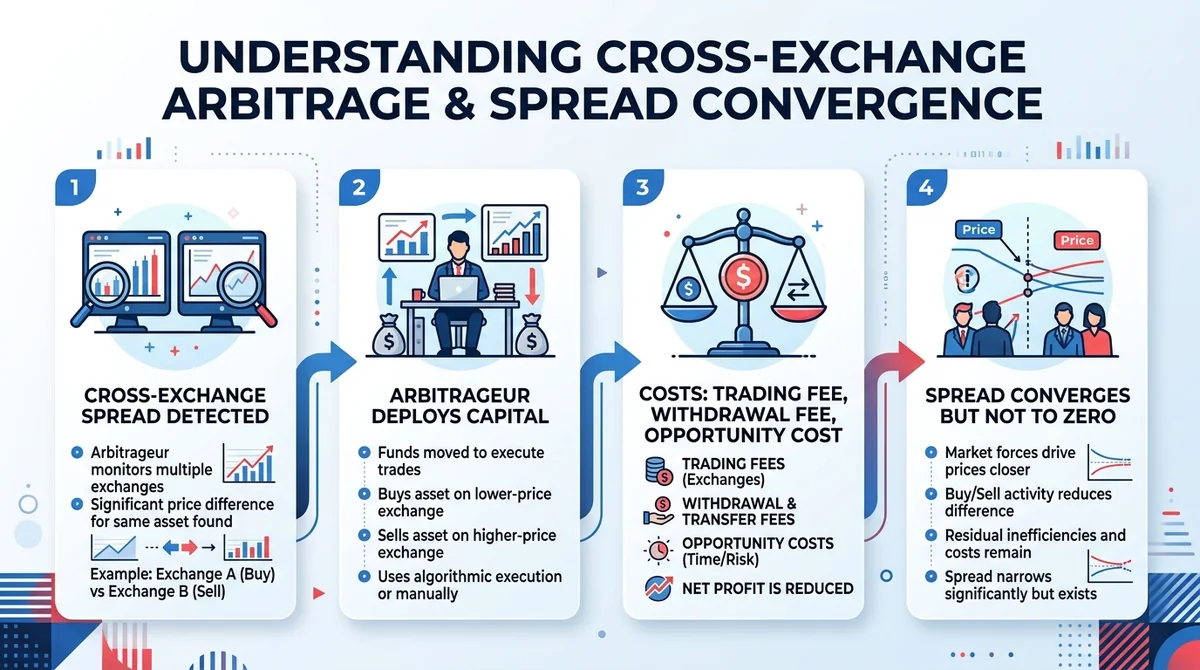
Conclusion first: The persistent existence of spreads is a normal market friction state, not mispricing by any single exchange; it reflects an equilibrium result under cross-exchange arbitrage costs and capital constraints. Main frictions: liquidity differences across exchanges, withdrawal time and network congestion, market maker inventory risk, and fiat deposit/withdrawal restrictions. These factors mean spread convergence requires time and capital, and convergence is often incomplete. Data note: Specific spread levels and convergence speed data are not publicly available; this article does not cite unverified figures. Any subsequent empirical research should rely on exchange public APIs or third-party market data.
#How Does Order Book Imbalance Affect Cross-Exchange Spreads?
Conclusion first: Order book imbalance is a direct trigger for short-term spread widening, but it is not the only source of long-term spreads. Mechanism: Differences in bid/ask depth, large market order impact, and spread widening when liquidity dries up; cross-exchange arbitrageurs passively absorb imbalances but are constrained by their own capacity. Order book data is not public, so this cannot be quantified.
#How Do Arbitrage Costs Limit Spread Convergence and Price Discovery Efficiency?
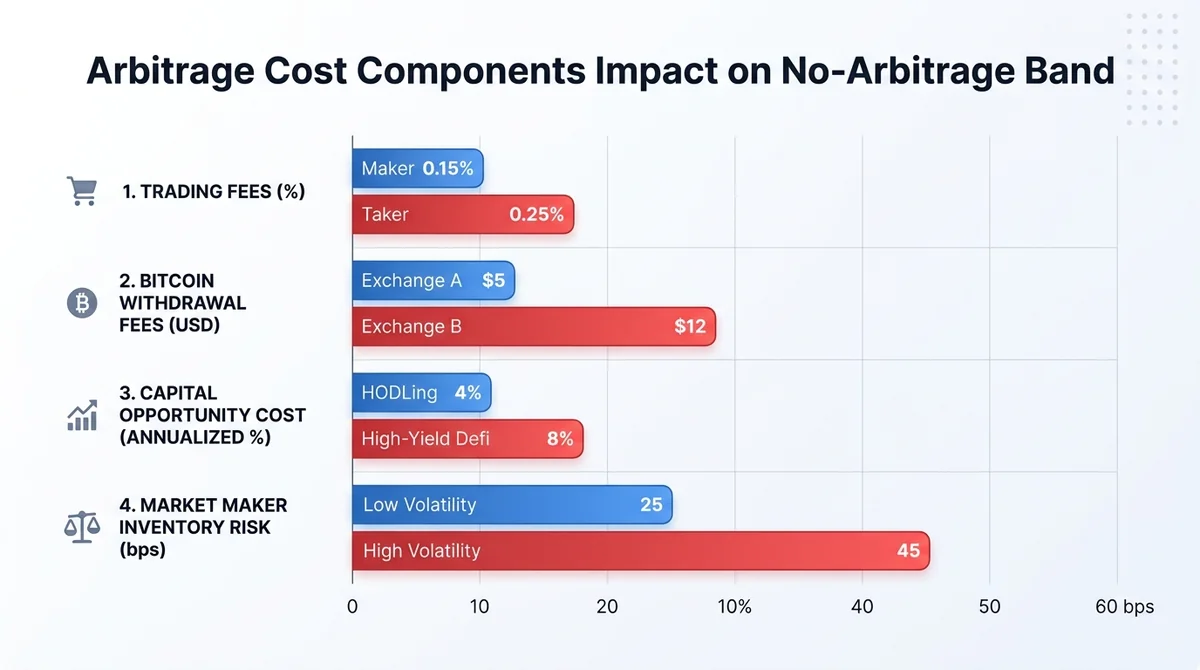
Conclusion first: Arbitrage costs determine the width of the no-arbitrage band; the higher the costs, the longer spreads can deviate and the lower the price discovery efficiency. Cost components: trading fees, withdrawal network fees and confirmation time, and opportunity cost of capital. These cost parameters are not publicly available, so no specific no-arbitrage band can be given. Price discovery efficiency measures: Commonly used indicators include spread persistence and half-life, but this article does not provide specific values; it only emphasizes the mechanism: the higher the costs, the longer the half-life.
#What Metrics and Debates Should Price Discovery Efficiency Research Focus on Next?
Trackable metrics: spread standard deviation and half-life, arbitrage capital inflow speed, changes in inter-exchange withdrawal delays, and institutional market maker participation. Existing debates: There are two views on whether efficiency improves over time: one holds that infrastructure and market-making improvements have raised efficiency; the other holds that rising arbitrage costs in new assets/markets offset some of the improvement. Unconverged spreads should be interpreted cautiously—unconverged spreads do not equal arbitrage opportunities.
#Core Drivers
- Liquidity stratification and order book depth differences across exchanges;
- Time cost of withdrawal friction and network congestion;
- Market maker inventory risk and capital constraints;
- Availability and speed of arbitrage capital.
#Key Participants
- Exchanges: Provide trading platforms and matching; different exchange rules, listing timing, and liquidity policies affect spreads.
- Market makers: Quote both sides simultaneously, bear inventory risk, and are direct suppliers of spreads.
- Cross-exchange arbitrageurs: Buy low and sell high across venues and transfer via withdrawals, pushing spreads to converge, but they face capital and operational constraints.
- Institutional investors: Influence order books through block/OTC or proprietary trading, though some trades do not enter public order books.
- Custody and wallet services: Withdrawal speed and network confirmation time affect arbitrage execution risk.
#Risks and Debates
- Execution risk: Withdrawal delays, exchange suspension of withdrawals, and network congestion can turn spread arbitrage into losses.
- Liquidity risk: Spreads may not converge for a long time, forcing arbitrageurs to hold exposure.
- Data deficiency risk: Order book tick data and cost parameters are not public; any conclusions based on publicly aggregated data may underestimate frictions.
- Debate: Whether spreads represent market inefficiency or reasonable friction compensation remains unresolved; the trend of efficiency improvement also lacks consensus.
#What to Watch Next
- Changes in the standard deviation and half-life of spreads across major exchanges;
- Speed and scale of cross-exchange arbitrage capital inflows;
- Changes in inter-exchange withdrawal delays;
- Changes in institutional market maker participation in spot markets;
- Whether more standardized spread/arbitrage cost disclosures emerge.
#FAQ
Does this article constitute investment advice?: No. This article is multi-asset research and only discusses mechanisms and risks; it does not provide buy or sell advice. What are the data sources and limitations?: Data comes from public disclosures/market quotes, but key order book and arbitrage cost data are not public; this article does not cite specific figures and only provides mechanism analysis. Do unconverged spreads equal arbitrage opportunities?: Not necessarily. Unconverged spreads may reflect withdrawal friction, capital constraints, or exchange restrictions; actual execution may be unprofitable or even loss-making. What do arbitrage costs include?: They include trading fees, withdrawal network fees and confirmation time, opportunity cost of capital, plus possible slippage and inventory risk. How is price discovery efficiency measured?: Commonly used indicators include spread persistence, half-life, and arbitrage capital inflow speed, but this article does not provide specific values.
FAQ
Does this article constitute investment advice?
No. This article is multi-asset research and only discusses mechanisms and risks; it does not provide buy or sell advice.
What are the data sources and limitations?
Data comes from public disclosures/market quotes, but key order book and arbitrage cost data are not public; this article does not cite specific figures and only provides mechanism analysis.
Do unconverged spreads equal arbitrage opportunities?
Not necessarily. Unconverged spreads may reflect withdrawal friction, capital constraints, or exchange restrictions; actual execution may be unprofitable or even loss-making.
What do arbitrage costs include?
They include trading fees, withdrawal network fees and confirmation time, opportunity cost of capital, plus possible slippage and inventory risk.
How is price discovery efficiency measured?
Commonly used indicators include spread persistence, half-life, and arbitrage capital inflow speed, but this article does not provide specific values.
Related Terms
Ready to try? Test the strategy on MSX with small positions. Educational content only — not investment advice.