2026 Cross-Chain Bridge Asset Security and Risk Contagion Research: Bridge Protocol Vulnerabilities, Attack Cases, and Cross-Chain Liquidity Impact
Cross-chain bridges lock assets and rely on validation, creating concentrated risk. See vulnerabilities, attacks, liquidity contagion and security practices.
⚠ This article is a multi-asset digital asset research piece and does not constitute investment advice. Investing involves risk; please make decisions prudently.
The core risk of cross-chain bridge asset security may not be just a single technical vulnerability, but a positive feedback loop among centralized custody, complex cross-chain message validation, and liquidity panic. Public attack reviews show that signature/multi-sig management and contract logic flaws are common attack paths, and liquidity risk can propagate along cross-chain paths; specific cases and statistics should be based on on-chain records and professional security reports.
#Why Are Cross-Chain Bridges a High-Risk Area for On-Chain Asset Security?
Cross-chain bridge definition: A cross-chain bridge is infrastructure that connects different blockchain networks and enables asset or message interoperability. In this research, cross-chain bridge assets refer to locked assets that users deposit into bridge contracts to mint mapped assets on another chain.
Core risk sources: Concentrated custody of multi-chain assets generally amplifies single-point risk; high contract interaction complexity increases the attack surface; and cross-chain message validation and signature mechanisms are common weak points. These factors make cross-chain bridges one of the most concentrated areas of on-chain asset security risk.
#What Are the Core Vulnerability Types in Bridge Protocols?
Signature and multi-sig management vulnerabilities: If validator or relayer signatures are forged, private keys leaked, or multi-sig thresholds set too low, attackers may forge cross-chain messages. Contract logic flaws: Reentrancy, integer overflow, or state inconsistency in business logic may lead to excessive asset minting. Oracle manipulation: When relying on external price data, attackers may manipulate oracles to influence cross-chain asset pricing. Upgrade permissions and backdoors: If admin keys or proxy contract upgrade permissions are abused, user assets may be directly transferred.
#Which Design Flaws Are Most Easily Exploited by Attackers?
Centralized validator networks: A small number of validators hold cross-chain message confirmation authority; once compromised, the entire system may fail. Lack of safety circuit breakers: If pause mechanisms are poorly designed or delayed in triggering, attacks may not be stopped in time. Overly concentrated upgrade permissions: A single admin may modify contract logic, creating a backdoor.
#What Are the Main Vulnerability Types and Representative Attack Methods in Bridge Protocols?
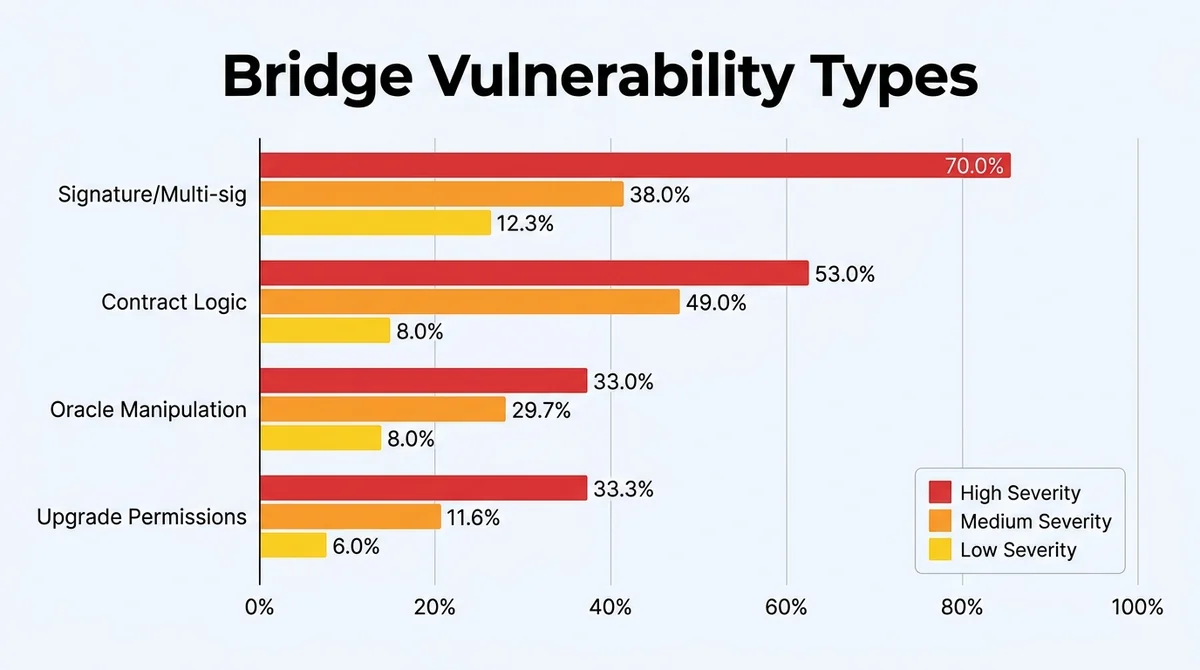
Vulnerability classification: By attack surface, they can be grouped into four categories: signature/multi-sig management, contract business logic, oracle data, and permission management. Different attack methods correspond to different risk patterns; specific distributions should be based on public event reviews.
#How Are Signature and Multi-Sig Management Vulnerabilities Exploited?
Forging cross-chain messages: Attackers steal or forge validator signatures and submit fake deposit proofs to the target chain, triggering excessive minting. Bypassing multi-sig thresholds: If the number of signers is insufficient or key distribution is not diverse enough, attackers may control a few signatures to pass validation.
#What Is the Difference Between Contract Logic Flaws and Oracle Manipulation?
Contract logic flaws: These are code implementation errors, such as reentrancy attacks, token transfers without checking return values, and incorrect state update ordering, directly leading to fund losses. Oracle manipulation: This is not an error in the code itself, but malicious influence on external data sources, for example using flash loans to manipulate decentralized exchange prices and mislead cross-chain asset valuations.
#Are Upgrade Permissions and Backdoor Risks Worth Vigilance?
High danger: Proxy contract upgrade permissions allow logic modification. If admin keys are leaked or act maliciously, security audits can be easily bypassed. Public incident reviews show that upgrade permission abuse is one of the common risk factors in bridge attacks, but specific cases and causal relationships should be based on on-chain records.
#How Do Cross-Chain Attacks Affect Liquidity and Trigger Risk Contagion?
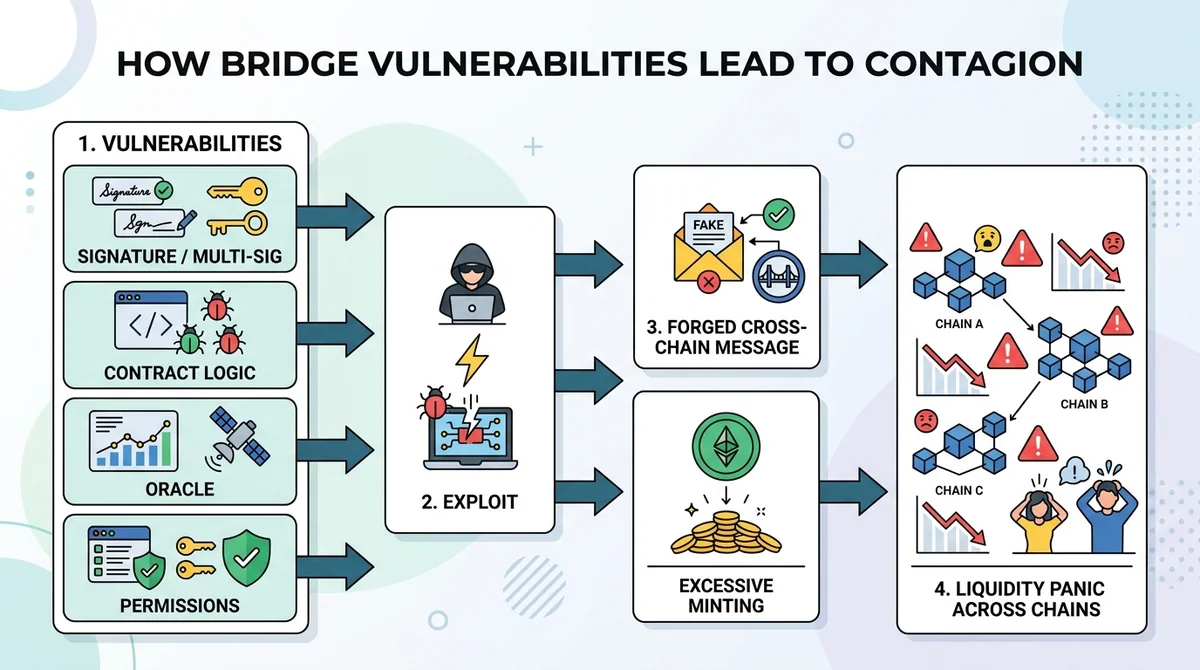
Risk contagion path: Attacks usually directly weaken the bridge's locked asset base, trigger user redemptions and liquidity contraction, and transmit risk to other on-chain protocols through cross-chain capital flows.
#How Does Bridge Liquidity Change After Assets Are Stolen?
Redemption wave: Users panic-unlock and withdraw assets, potentially reducing liquidity in the bridge. Mapped asset discount: Mapped assets on the target chain may trade at a discount due to insufficient reserves, further stimulating arbitrage and redemptions.
#What Secondary Risks Can Liquidity Contraction Trigger?
Increased slippage: Reduced liquidity pool depth increases slippage for large trades, similar to liquidity risk in crypto derivatives market structure; see the 2026 Crypto Derivatives Market Structure Research. Impermanent loss expansion: Liquidity providers may face larger losses. Liquidation cascades: If bridge assets are used as collateral, price fluctuations may trigger liquidations, forming a negative loop.
#How Does Risk Spread Along Cross-Chain Paths to Multiple Chains?
Cross-chain panic contagion: Users may lose confidence in protocols on related chains and withdraw funds. Liquidity interconnectedness: DeFi protocols deployed across multiple chains may face solvency pressure due to depreciation of cross-chain bridge assets. Current public research mostly shows that related chain TVL declines in the short term after cross-chain attacks, but the magnitude varies by event; specific data should be referenced from incident reports.
#How to Assess the Security and Risk Level of Cross-Chain Bridges?
Assessment framework: Comprehensively examine code audit quality, multi-sig governance structure, emergency pause mechanisms, and insurance coverage. A single indicator cannot fully reflect risk.
#What Risks Can Code Audits and Formal Verification Cover?
Audit report coverage: Checks for common and historical vulnerabilities, but cannot cover future upgrades or unknown attack vectors. Formal verification: Can verify mathematical properties of core logic, but usually only for local functions and requires continuous updates.
#Are Multi-Sig and Decentralized Governance Mechanisms Sufficiently Secure?
Multi-sig threshold and key distribution: Higher thresholds and more dispersed distribution reduce single-point failure probability, but governance efficiency declines. For multi-sig wallet security strategies, refer to the 2026 Multi-Sig Wallet Security Strategy. Decentralized governance risks: Concentrated voting weight or governance token manipulation may lead to malicious upgrades.
#How Much Buffer Can Insurance and Emergency Pause Mechanisms Provide?
Insurance payouts: Coverage scope and claim conditions are limited and usually do not include full losses caused by smart contract vulnerabilities, but this depends on the specific terms of the insurance protocol. Pause switches: Can prevent further losses, but centralized pauses may also be abused, and triggering often lags.
#How Can Users and Developers Reduce Cross-Chain Bridge Usage and Development Risks?
Practical recommendations: Regular users should prioritize bridges that have undergone multiple audits and have good track records, and avoid bridging too many assets in a single transaction; developers need to continuously implement least privilege and security testing. For cross-chain liquidity changes, refer to the 2026 Crypto Market On-Chain Metrics and Price Relationship Research.
#What Security Information Should You Check Before Using a Cross-Chain Bridge?
Audit reports and attack history: Check whether the bridge has been audited by reputable firms and review historical vulnerabilities and incident records. Multi-sig and governance distribution: Look at the validator set, signing threshold, and emergency pause mechanisms.
#What Risk Isolation Strategies Can Be Used When Bridging Assets?
Diversify cross-chain activity: Avoid holding large amounts of assets in a single bridge; operations can be batched. Redeem promptly: After completing the cross-chain purpose, withdraw assets in a timely manner to shorten lock-up time.
#How Can Developers Reduce Vulnerabilities at the Design Level?
Least privilege: Restrict admin permissions and use time locks and multi-signature. Bug bounty programs: Open white-hat incentives and continuously conduct fuzzing and formal verification.
#What to Watch Next
- Bridge protocol security audit updates: Monitor whether major cross-chain bridges release new audits or vulnerability fixes.
- Cross-chain liquidity metrics: Track total value locked (TVL) in each bridge and changes in deposit/withdrawal flows.
- Attack incident review reports: Focus on cases related to signature management, upgrade permissions, and oracle manipulation.
- Insurance and compensation plans: Track insurance payout progress and user asset recovery after bridge attacks.
#FAQ
What is the biggest risk to cross-chain bridge asset security? The chain-reaction amplification effect formed by concentrated custody, complex cross-chain message validation, and liquidity panic, rather than a single technical vulnerability.
What vulnerabilities have historical cross-chain bridge attacks mainly exploited? Signature/multi-sig management vulnerabilities, contract logic flaws, oracle manipulation, and upgrade permission abuse are common types.
Can cross-chain attacks lead to a liquidity crisis? They may weaken the locked asset base, trigger redemption waves, increase slippage and impermanent loss, and spread to other protocols along cross-chain paths.
How can regular users reduce the risk of using cross-chain bridges? Prioritize bridges with good audit records, few historical incidents, and transparent multi-sig distribution; avoid bridging too many assets in a single transaction; and redeem promptly.
Which cross-chain bridge vulnerabilities should developers focus on preventing? Least privilege, multi-sig governance, reentrancy protection, oracle data validation, and emergency pause mechanisms.
FAQ
What is the biggest risk to cross-chain bridge asset security?
The chain-reaction amplification effect formed by concentrated custody, complex cross-chain message validation, and liquidity panic, rather than a single technical vulnerability.
What vulnerabilities have historical cross-chain bridge attacks mainly exploited?
Signature/multi-sig management vulnerabilities, contract logic flaws, oracle manipulation, and upgrade permission abuse are common types.
Can cross-chain attacks lead to a liquidity crisis?
They may weaken the locked asset base, trigger redemption waves, increase slippage and impermanent loss, and spread to other protocols along cross-chain paths.
How can regular users reduce the risk of using cross-chain bridges?
Prioritize bridges with good audit records, few historical incidents, and transparent multi-sig distribution; avoid bridging too many assets in a single transaction; and redeem promptly.
Which cross-chain bridge vulnerabilities should developers focus on preventing?
Least privilege, multi-sig governance, reentrancy protection, oracle data validation, and emergency pause mechanisms.
Related Terms
Ready to try? Test the strategy on MSX with small positions. Educational content only — not investment advice.