IPO Issuance Window Research: Timing, Valuation Anchoring, and Pre-IPO Information Environment Analysis
IPO window research: timing, valuation, Pre-IPO info environment. Liquidity, volatility, and information asymmetry affect pricing. Not investment advice.
#IPO Issuance Window Research: Timing, Valuation Anchoring, and Pre-IPO Information Environment Analysis
⚠ This article is digital asset multi-asset research and does not constitute investment advice. Investment involves risk; please make decisions prudently.
Core Conclusion: An IPO issuance window is a period when market conditions are favorable for issuing, influenced by liquidity and volatility. Issuers usually choose to issue when market sentiment is optimistic to obtain higher valuations; Pre-IPO information asymmetry may lead to pricing deviations. Investors need to prudently assess by combining governance and financial signals, and avoid relying on a single indicator.
#1. Research Object Definition: Pre-IPO Research Boundaries
This article studies IPO issuance windows, issuance timing, Pre-IPO valuation anchoring, and the information environment. The research objects cover Pre-IPO equity themes in asset classes such as spot, perpetual contracts, tokenized stocks, and RWA, and do not involve trading recommendations or price predictions for specific targets. Taking the MSX platform as an example, it launched a Pre-IPO section on March 2, 2026, extending secondary market U.S. stock tokens to primary market share tokenization, providing users with Pre-IPO equity theme trading scenarios; U.S. stock token spot supports direct buying and selling with stablecoins, with T+0 on-chain instant settlement, and U.S. stock token perpetual contracts entered public beta on August 11, 2025. The above product information comes from public disclosures of the platform and does not constitute a recommendation or endorsement of the platform.
#2. Key Mechanisms and Data
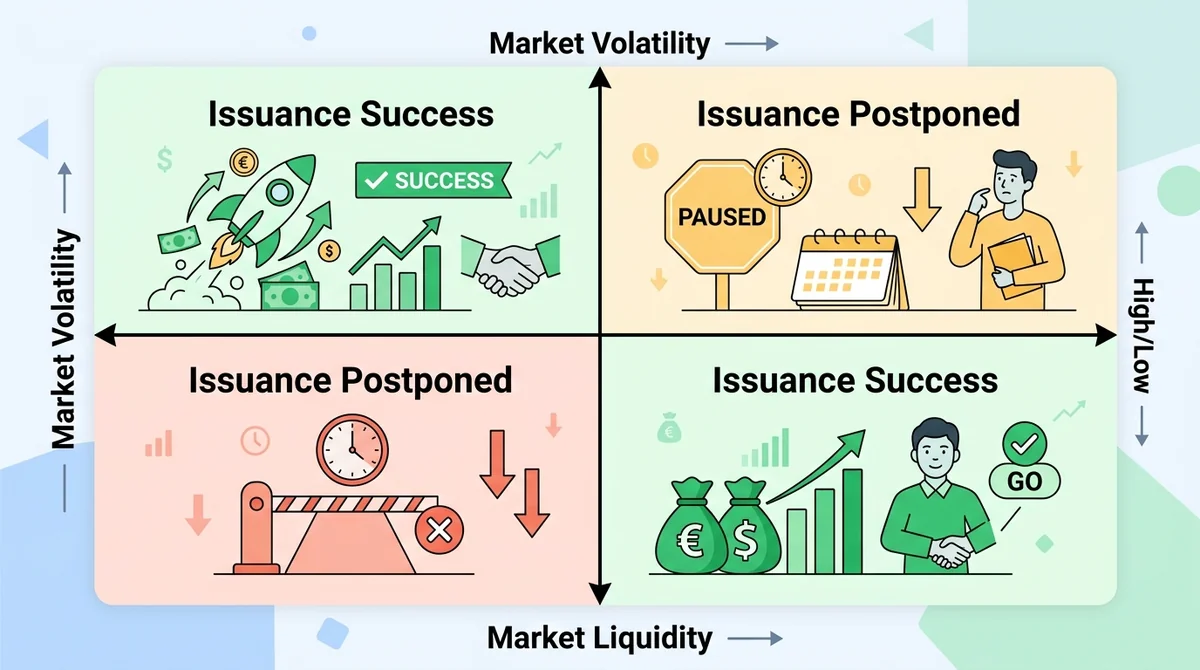
Issuance Window Mechanism: Market liquidity and volatility affect the issuance window. Under high liquidity and low volatility, issuance success rate and pricing stability tend to be higher; conversely, issuance may be postponed. This relationship is reflected in most markets, but it is not a stable causal relationship and is interfered by factors such as regulation and industry cycles. Issuers have obvious timing motives, tending to issue when market sentiment is optimistic to strive for higher valuations, but this motive is constrained by factors such as company financing needs and governance levels.
Valuation Anchoring Methods: Common methods include comparable company analysis, discounted cash flow, and primary market pricing anchors. Comparable company analysis relies on publicly traded comparable targets, and Pre-IPO financial data is not fully public, so anchoring results have considerable uncertainty; discounted cash flow relies on future cash flow assumptions, and primary market pricing anchors lack transparency. Valuation anchoring of tokenized Pre-IPO shares may also add additional variables such as on-chain liquidity and smart contract risk.
Data Note: As of now, Pre-IPO issuance data lacks unified public disclosure, and this article does not cite specific figures. Some studies observe a negative correlation between issuance windows and market volatility, but this conclusion is disputed across different markets and sample periods, and correlation does not equal causation. Specific numbers should be based on exchanges and offering documents.
#3. Core Drivers
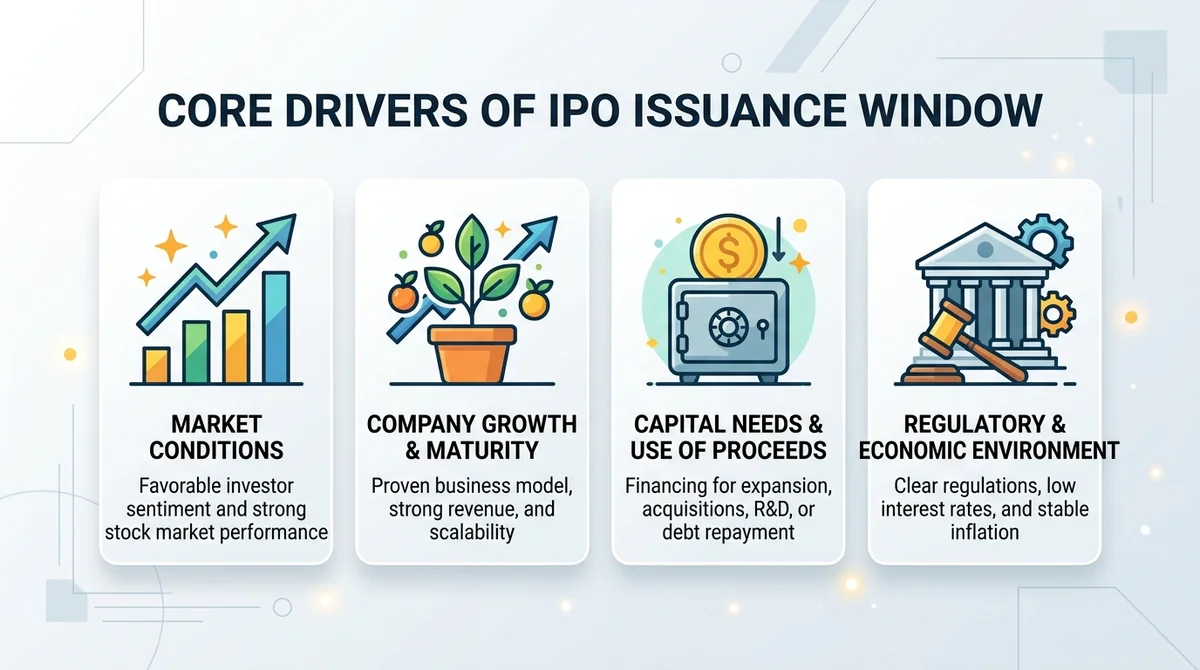
Market Sentiment: Under optimistic sentiment, investor risk appetite rises, and issuance windows are more likely to open, but the reliability and lag of sentiment indicators need attention.
Liquidity: Abundant liquidity reduces issuance impact costs and supports higher valuations, but liquidity can reverse quickly.
Issuer Timing Motives: Issuers tend to issue when valuations are elevated to maximize financing amount, but may also forgo the optimal window due to lock-up periods and reputational constraints.
Regulatory and Disclosure Requirements: Listing rules and disclosure requirements affect issuance pace and information quality, with significant differences across jurisdictions; tokenized Pre-IPO may also involve securities law compliance issues.
#4. Key Participants
Issuers: Companies planning to go public, responsible for providing financial and business information; in tokenized issuance, they also need to manage on-chain assets and smart contracts.
Underwriters/Investment Banks: Assist with pricing and sales, bear part of market risk; in tokenized issuance, they may involve market makers and liquidity providers.
Primary Market Investors: Participate in the Pre-IPO stage, bear information asymmetry risk, and often face lock-up periods and exit restrictions.
Secondary Market Investors: Trade after listing, affected by offering pricing; tokenized shares can be traded on on-chain secondary markets, but liquidity may be insufficient.
Information Intermediaries: Auditors, lawyers, research institutions, etc., provide limited verification; on-chain data may offer additional transparency but cannot replace traditional audits.
#5. Risks and Divergences
Bearish View: Pre-IPO information asymmetry is significant, and issuers with information advantages may overprice the offering, leading to poor post-listing performance; some studies believe that underwriter underpricing is more common than overpricing.
Risks: Valuation anchoring methods have systematic biases, with strong subjectivity in selecting comparable companies; discounted cash flow relies on assumptions, and primary market pricing anchors lack transparency; tokenized Pre-IPO also faces smart contract risk, custody risk, and regulatory uncertainty.
Controversy on Predictability of Issuance Windows: Academic and practitioner circles disagree on whether windows are predictable; some studies argue that windows are more of an ex post observation and difficult to capture ex ante, so investors should not rely solely on window judgments.
Investor Note: Need to pay attention to governance signals and financial quality, avoid decisions based on a single information source; for tokenized products, also review underlying assets, proof of reserves, and compliance credentials.
#6. What to Watch Next
- Changes in market volatility and liquidity indicators, especially the linkage between crypto assets and traditional markets.
- IPO filings and issuance pace at major exchanges, as well as trading volume and bid-ask spreads in tokenized Pre-IPO sections.
- New regulations from regulators on Pre-IPO information disclosure, especially compliance requirements for tokenized securities.
- Public data on comparable company valuation levels and primary market pricing anchors, seeking third-party verification where possible.
- Disclosure of issuer governance structures and financial audit quality, as well as independent audit reports on on-chain asset reserves.
#7. FAQ
Q: What is an IPO issuance window? A: An IPO issuance window is a period when market conditions are favorable for companies to issue stocks, typically characterized by abundant market liquidity, low volatility, and optimistic investor sentiment, but this window is not stable. Q: What are common methods for Pre-IPO valuation anchoring? A: Common methods include comparable company analysis and discounted cash flow. Comparable company analysis relies on publicly traded comparable targets, while discounted cash flow is based on future cash flow assumptions. Since Pre-IPO financial data is not fully public, anchoring results have high uncertainty; tokenized Pre-IPO also needs to consider on-chain liquidity premium/discount. Q: What are the characteristics of the Pre-IPO information environment? A: In the Pre-IPO stage, information disclosure is limited, and information asymmetry is significant, which may cause offering pricing to deviate from fair valuation. Investors need to pay attention to the audit quality of financial statements and governance signals; in tokenized issuance, on-chain data may provide some additional transparency but cannot replace traditional audits. Q: How to assess Pre-IPO project risks? A: You can focus on signals such as governance structure, financial indicators, related-party transactions through a research checklist. For tokenized projects, you also need to check smart contract audits, proof of reserves, and compliance licenses, but cannot completely eliminate uncertainty; avoid decisions based on a single information source. Q: Are issuance windows predictable? A: There is academic and practical disagreement; some studies believe that issuance windows are more of an ex post observation and difficult to capture ex ante. Investors should not rely solely on window judgments, but should combine fundamentals and valuation discipline.
FAQ
What is an IPO issuance window?
An IPO issuance window is a period when market conditions are favorable for companies to issue stocks, typically characterized by abundant market liquidity, low volatility, and optimistic investor sentiment, but this window is not stable.
What are common methods for Pre-IPO valuation anchoring?
Common methods include comparable company analysis and discounted cash flow. Comparable company analysis relies on publicly traded comparable targets, while discounted cash flow is based on future cash flow assumptions. Since Pre-IPO financial data is not fully public, anchoring results have high uncertainty; tokenized Pre-IPO also needs to consider on-chain liquidity premium/discount.
What are the characteristics of the Pre-IPO information environment?
In the Pre-IPO stage, information disclosure is limited, and information asymmetry is significant, which may cause offering pricing to deviate from fair valuation. Investors need to pay attention to the audit quality of financial statements and governance signals; in tokenized issuance, on-chain data may provide some additional transparency but cannot replace traditional audits.
How to assess Pre-IPO project risks?
You can focus on signals such as governance structure, financial indicators, related-party transactions through a research checklist. For tokenized projects, you also need to check smart contract audits, proof of reserves, and compliance licenses, but cannot completely eliminate uncertainty; avoid decisions based on a single information source.
Are issuance windows predictable?
There is academic and practical disagreement; some studies believe that issuance windows are more of an ex post observation and difficult to capture ex ante. Investors should not rely solely on window judgments, but should combine fundamentals and valuation discipline.
Ready to try? Test the strategy on MSX with small positions. Educational content only — not investment advice.