Research on the Relationship Between On-Chain Metrics and Prices in 2026: Exchange Net Flows, Miner Outflows, and Long-Term Holder Behavior
Analyzes the impact of exchange net flows, miner outflows, and long-term holder behavior on crypto prices, and explores combined methods and limitations.
⚠ This article is a multi-asset digital asset research and does not constitute investment advice. Investing involves risk; please make decisions prudently.
Core conclusion: Exchange net inflows are often associated with potential selling pressure, but not always; net outflows combined with long-term holder accumulation are more common in accumulation phases, but no single on-chain metric can independently predict prices, and it is necessary to combine miner outflows and market structure for a comprehensive judgment.
#Scope / Asset Class Definition
This study covers observable on-chain behavior in the cryptocurrency spot market, mainly analyzing exchange net flows, miner outflows, and long-term holder position changes for major assets such as Bitcoin and Ethereum. The research object is the on-chain data itself; it does not involve the direct pricing of perpetual futures funding rates (how does perpetual futures funding rate work), tokenized stocks, or RWA products, but these on-chain signals are often used to help assess the sentiment stage of the overall digital asset market.
#Key Mechanisms and Data
#Exchange Net Flows
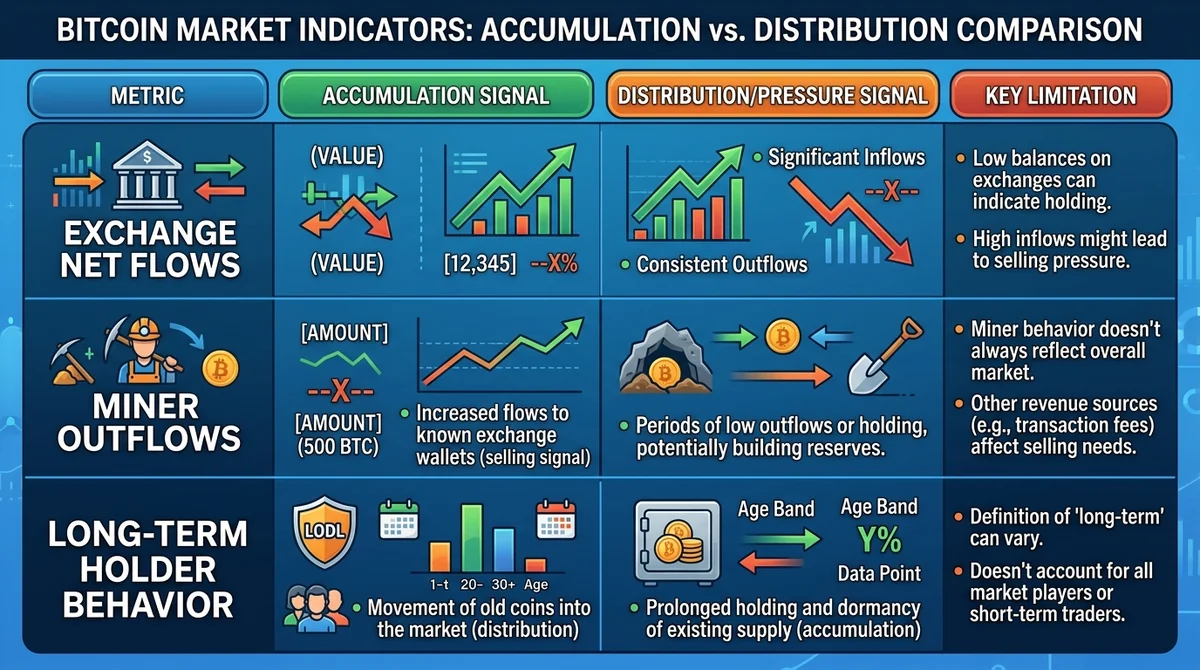
Exchange net flows measure the net amount of assets transferred into and out of exchanges over a specific period. Net inflows usually reflect assets being deposited to exchanges, and in some historical samples are more commonly associated with rising potential selling pressure or increased short-term trading willingness; net outflows may suggest holders moving assets to cold wallets, leaning more toward accumulation or long-term storage. In price cycles, sustained net inflows are often correlated with short-term pressure, while sustained net outflows are more common in accumulation phases near price bottoms, but neither is a deterministic signal. It is necessary to cross-validate with exchange balance changes and watch out for noise caused by exchange internal wallet reorganizations. Data come from public on-chain data platforms (such as Glassnode, CryptoQuant, etc.), with specific values subject to real-time disclosure by each platform.
#Miner Outflows
Miner outflows refer to the behavior of miner addresses transferring mined coins to exchanges or external addresses. Miners need to sell part of their output to cover mining costs, and outflows within normal ranges do not necessarily lead to price declines. However, when miner outflows are persistently abnormally elevated, they may increase market selling pressure, and this needs to be judged in combination with hash rate, mining production costs, and overall market sentiment. Historical statistics show that the relationship between miner outflows and price is not a stable linear one; panic selling and normal cost coverage need to be distinguished. Additionally, miners may sell via over-the-counter (OTC) transactions, so exchange outflow data may underestimate actual selling pressure. Data from public on-chain data and market data, as of the time of writing.
#Long-Term Holder Behavior
Long-term holders generally refer to address cohorts that have held assets beyond a certain period, but definitions vary across data platforms, with common thresholds including 155 days or 1 year. Their sustained accumulation is more commonly observed near price bottoms in historical statistics, while substantial distribution may occur in late bull markets, but could also stem from address consolidation changes or position restructuring, and should not be used as an independent top signal. Compared with short-term holder behavior, long-term holders are less affected by short-term price fluctuations, and their behavioral changes have reference value for judging market cycles. Address clustering biases, misclassification of exchange cold wallet addresses, etc. can affect the accuracy of indicators. Data from public on-chain data platforms.
#Core Drivers
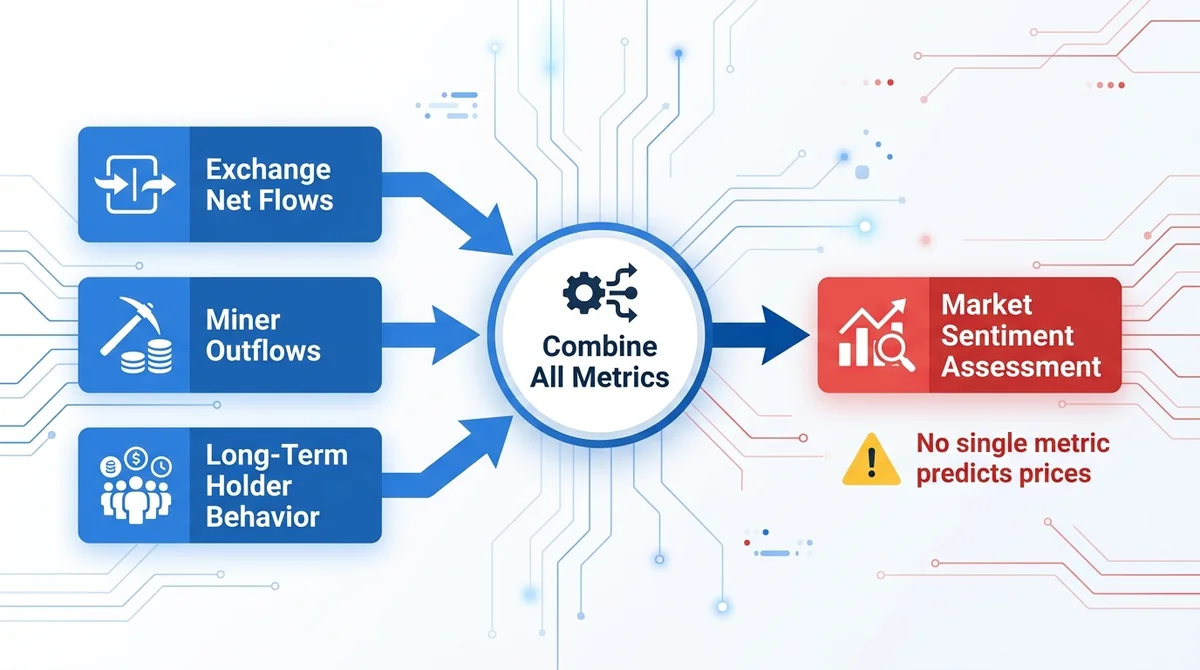
The core factors driving the impact of on-chain metrics on prices include:
- The combination of net outflows and long-term holder accumulation is more commonly seen in accumulation phases in historical samples, but out-of-sample performance may differ.
- Net inflows combined with increased miner outflows and long-term holder distribution tend to point to a rising risk phase, but exchange reorganizations and OTC interference need to be excluded.
- Market structure changes (such as exchange wallet consolidation rules, development of DeFi custody) may weaken the effectiveness of single indicators, so cross-validation is more important than relying on any single one.
- Macroeconomic and regulatory environments can alter holder behavior; for example, interest rate expectations or compliance events may cause on-chain capital reallocation.
When building an on-chain indicator analysis framework, it is recommended to first confirm the reliability of data sources and statistical calibers, then align the time windows of the three indicators, and finally combine price and trading volume to confirm signal strength, avoiding conclusions based on a single combination alone.
#Key Participants
- On-chain data service providers: Provide indicators such as exchange balances, miner outflows, and long-term holders; their address labels and consolidation rules directly affect data accuracy.
- Miners: Miners on PoW networks like Bitcoin need to sell output to cover electricity and hardware costs; their behavior is one of the important sources of on-chain selling pressure, but normal selling differs from panic dumping.
- Exchanges: Changes in exchange wallet address inflows and outflows do not equate to actual buying and selling, because internal transfers and cold/hot wallet reorganizations generate noise.
- Long-term holders and short-term holders: Behavioral differences between cohorts with different holding periods are an important dimension for judging cycles.
#Risks and Divergences
On-chain metrics are not a universal tool for price prediction. Main limitations include:
- Address clustering bias: Exchange or institutional address labels may lag or be incorrect, leading to distortion of net flow indicators.
- Market structure changes: With the rise of custody, DeFi, and tokenized assets, on-chain capital flow paths change, and historical patterns may no longer repeat.
- External interference: Non-on-chain factors such as regulatory policies, macro liquidity, and technological upgrades may override on-chain signals.
- Bearish view: Some researchers believe exchange net outflows may merely be internal wallet reorganizations rather than genuine accumulation; miner outflows may also be completed via OTC without passing through exchanges. Therefore, any one-sided interpretation requires caution.
#What to Watch Next
- Weekly trend changes in exchange BTC/ETH balances to confirm whether net flow direction persists.
- The relationship between miner outflows and hash rate, network-wide mining cost, to judge whether it is cost-driven normal selling.
- Inflection points in long-term holder position changes, especially whether long-term holder supply shifts from accumulation to distribution.
- Methodology updates from on-chain data service providers, to avoid sudden jumps in indicator readings due to consolidation rule changes.
#FAQ
1. Does exchange net inflow necessarily mean price will drop? Not necessarily. Net inflows may simply reflect rising short-term trading demand, and there may even be behavior of transferring to exchanges before a major move begins. Other indicators need to be considered.
2. Can increased miner outflows be used to short directly? No. Miner outflows need to distinguish between normal cost coverage and abnormal selling, and OTC transactions may not be reflected in exchange outflow data. Shorting directly is extremely risky.
3. Is long-term holder distribution necessarily a top signal? Historically, long-term holder distribution often appears in late bull markets, but it may also be caused by position restructuring or address consolidation changes, and should not be used as an independent top signal.
4. When combining the three indicators, which one should be primary? There is no fixed priority. A more reasonable approach is to first look at long-term holder behavior to judge the cycle background, then observe whether exchange net flows and miner outflows form a same-direction confirmation, and finally combine price and trading volume to filter noise.
5. How can ordinary researchers obtain these on-chain data? They can view relevant indicators through public on-chain data platforms (such as Glassnode, CryptoQuant, etc.), but need to note that address labels and statistical calibers may differ across platforms.
FAQ
Does exchange net inflow necessarily mean price will drop?
Not necessarily. Net inflows may simply reflect rising short-term trading demand, and there may even be behavior of transferring to exchanges before a major move begins. Other indicators need to be considered.
Can increased miner outflows be used to short directly?
No. Miner outflows need to distinguish between normal cost coverage and abnormal selling, and OTC transactions may not be reflected in exchange outflow data. Shorting directly is extremely risky.
Is long-term holder distribution necessarily a top signal?
Historically, long-term holder distribution often appears in late bull markets, but it may also be caused by position restructuring or address consolidation changes, and should not be used as an independent top signal.
When combining the three indicators, which one should be primary?
There is no fixed priority. A more reasonable approach is to first look at long-term holder behavior to judge the cycle background, then observe whether exchange net flows and miner outflows form a same-direction confirmation, and finally combine price and trading volume to filter noise.
How can ordinary researchers obtain these on-chain data?
They can view relevant indicators through public on-chain data platforms (such as Glassnode, CryptoQuant, etc.), but need to note that address labels and statistical calibers may differ across platforms.
Related Terms
Ready to try? Test the strategy on MSX with small positions. Educational content only — not investment advice.