Pre-IPO Company Research Framework: Information Asymmetry, Valuation Methods, and IPO Subscription Risks
Pre-IPO research framework: information asymmetry, valuation, and subscription risks. Methodology for multi-asset researchers; not investment advice.
⚠ This article is multi-asset research and does not constitute investment advice. Investing involves risk; please make decisions prudently.
The core of a Pre-IPO research framework is to acknowledge information asymmetry rather than to eliminate uncertainty. The following methodology is for research discussion only, and any company-specific research must be conducted cautiously on this basis.
#Core Conclusion
Pre-IPO research must treat information asymmetry as a first-order constraint: incomplete financial disclosures, opaque governance structures, and missing industry data mean that valuation and risk judgments can only be built on cross-validated assumptions. Researchers should not pursue "accurate predictions" but rather build an iterable, falsifiable negative list and uncertainty weights.
#Research Boundaries
The Pre-IPO research discussed in this article refers to the analysis of unlisted companies' business models, financial quality, governance structures, industry competition, and valuation reasonableness before their initial public offering (IPO), based on public filings and legally available information. It does not cover primary-market private placements, tokenized stocks, Pre-IPO contracts, or other tradable instruments, nor does it constitute any buy or sell recommendation.
#Key Mechanisms and Information Asymmetry
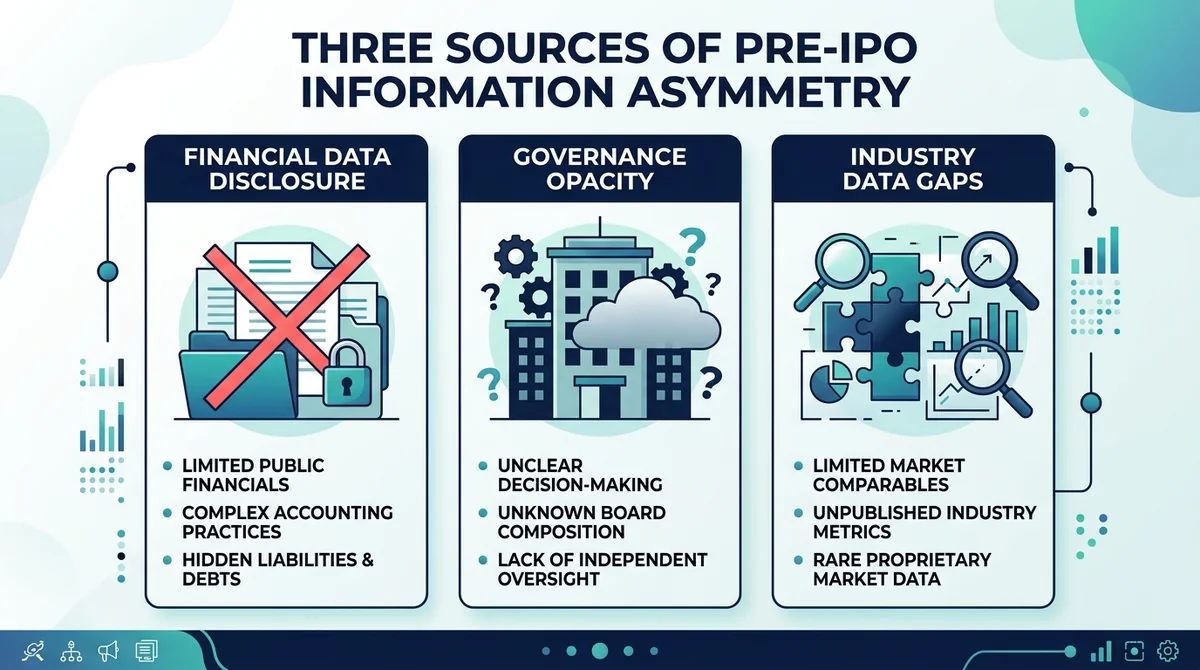
Pre-IPO information asymmetry mainly arises from three areas:
Insufficient financial data disclosure: In most markets, unlisted companies usually only need to disclose audited historical financial data in the prospectus, and the frequency of disclosure is far lower than that of listed companies. Key operating metrics (such as unit economics, customer retention, and cash flow breakdowns) may be missing or lagging.
Shareholder structure and corporate governance information: Governance information such as equity structure, voting rights arrangements, and related-party transactions of private companies may not be fully disclosed. Researchers need to review articles of association, shareholder agreements, board minutes, etc., but some documents are only available to institutional investors.
Industry and competitive data: Niche industry data often rely on third-party consulting reports or expert interviews, and sample bias and differences in statistical scope can amplify uncertainty in conclusions. Priority should be given to verifiable prospectus data and regulatory inquiry responses.
#Valuation Methods and Limitations
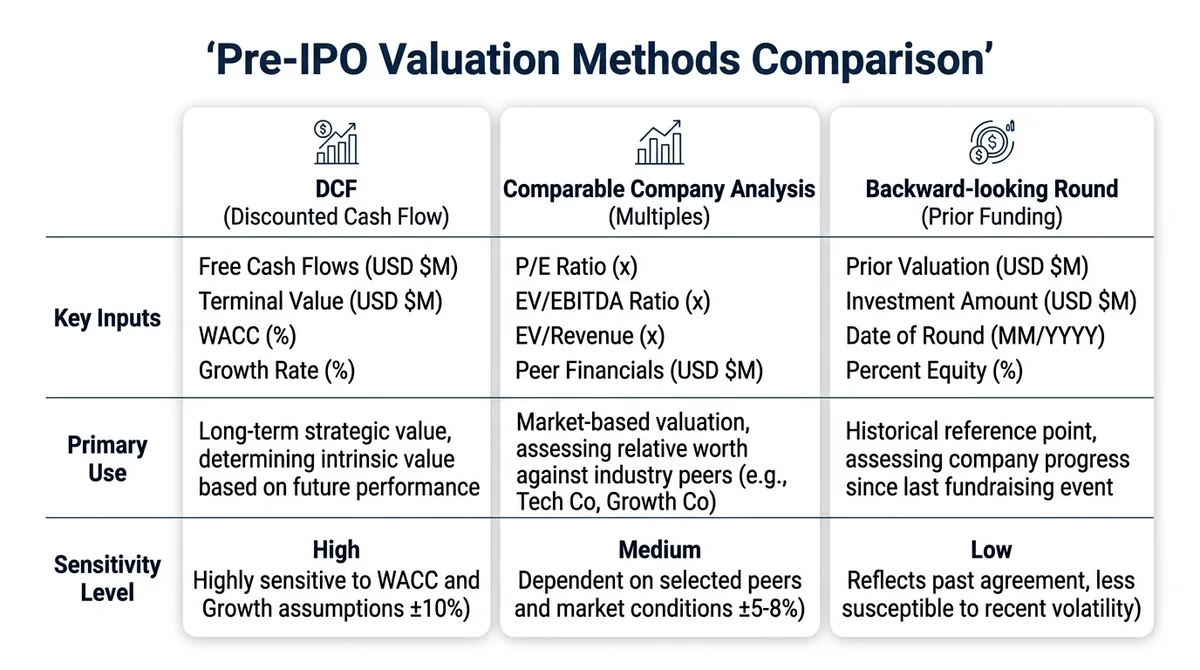
Comparable company analysis: Select listed comparable companies as anchors, but apply a liquidity discount and control premium adjustment to Pre-IPO companies. The difficulty lies in the subjectivity of comparable selection and mismatches in growth stage.
DCF model: It relies on assumptions about long-term revenue growth, profit margins, capital expenditure, and discount rates, and is extremely sensitive for growth companies in the investment phase; any slight adjustment to a ten-year assumption can cause large swings in valuation. Therefore, in most scenarios DCF is more suitable as a sensitivity analysis tool than as a pricing benchmark.
Backward-looking valuation from primary market rounds: Refer to the valuation and subscription multiple of the most recent private financing round, but that valuation reflects the bargaining power and market sentiment of specific investors at the time and may have significantly detached from current fundamentals.
#Core Drivers
- Regulatory policy and listing review pace: The issues raised in IPO review inquiry letters often expose a company's information weaknesses.
- Market sentiment and liquidity environment: During periods of rising risk appetite, the Pre-IPO valuation center tends to rise; when sentiment ebbs, high-valuation companies are more likely to fall below their IPO price.
- Company intrinsic quality and governance level: revenue quality, gross margin stability, cash flow improvement path, and management incentive arrangements.
- Liquidity discount and lock-up arrangements: The longer the lock-up period and the narrower the exit channels, the higher the theoretical discount should be.
#Key Participants
- Issuers: actual controllers, management, and pre-listing shareholders.
- Private equity / venture capital institutions: provide Pre-IPO round financing; their holding costs and exit demands affect post-listing selling pressure.
- Underwriters and auditors: responsible for pricing, underwriting, and financial audits; their reputation and boundary of responsibility affect information credibility.
- Secondary-market IPO subscribers: including institutional investors and qualified individuals, bear the risk of falling below the IPO price and lock-up risk.
- Regulators: review the completeness of information disclosure, set lock-up periods and issuance rules.
The above participants are listed only as a factual framework for research and do not constitute a recommendation or negative view on any specific company.
#Risks and Divergences
A common bearish view holds that in certain market phases, Pre-IPO subscriptions are more common in high-valuation environments, and the rate of falling below the IPO price may rise significantly when the market weakens; information opacity may systematically overestimate issue pricing, because issuers prefer to advance their listing during optimistic windows. At the same time, selling pressure after lock-up expiry usually may weigh on share price performance. In response, researchers should adhere to the "negative list" principle: when key financial metrics, governance arrangements, or industry data cannot be verified, they should lower the confidence of conclusions, or even abandon the research, rather than force a valuation.
#What to Watch Next
- Updated versions of the target company's prospectus and regulatory inquiry responses.
- The degree of deviation between the roadshow pricing range and the actual issue price.
- Recent changes in valuation multiples of comparable listed companies and sector sentiment.
- Pre-IPO lock-up expiry schedule and early shareholder reduction plans.
- Whether the first post-listing financial report delivers on prospectus guidance.
FAQ
What is the biggest risk in Pre-IPO research?
The biggest risk is information asymmetry. Unlisted companies have lower disclosure requirements, and financial and governance information is incomplete, which may cause research conclusions to deviate from true value. It is necessary to cross-validate through prospectuses, audit reports, and industry data, and acknowledge that some information is unavailable.
Why does the comparable company method need to adjust for a liquidity discount?
Pre-IPO shares usually have lock-up periods and lack continuous public market trading, making exit more difficult than for listed stocks. Therefore, when using listed comparable companies for valuation, a liquidity discount should be applied to the target company's market value or multiples to reflect the additional risk from illiquidity.
What are the limitations of the DCF model for growth companies?
DCF relies heavily on assumptions about long-term revenue growth, profit margins, and discount rates. Growth companies have short historical data and high operational volatility, and any slight adjustment to parameters can significantly change the valuation. Therefore, DCF is more suitable for mature companies with stable cash flows, and for Pre-IPO growth companies it only serves as a rough reference range.
What are the main factors that cause Pre-IPO subscriptions to fall below the IPO price?
Falling below the IPO price usually occurs when issue valuation is too high, market sentiment cools, company fundamentals fall short of expectations, or selling pressure is released intensively after lock-up expiry. A high-valuation issue without earnings support has a greater risk of first-day decline.
How should individual researchers obtain reliable Pre-IPO information?
Prioritize public filings (such as prospectuses and audit reports), regulatory disclosure platforms, and reputable industry research reports, and compare data from multiple sources. For non-public information, identify the reliability of the source; if it cannot be verified, mark it as "data not public".
Related Terms
Ready to try? Test the strategy on MSX with small positions. Educational content only — not investment advice.