2026 RWA Policy Event Study: Impact of Regulatory Implementation on Tokenized Asset Trading Volume and Volatility Transmission Pathways
Impact of 2026 RWA regulation on tokenized asset volume and volatility transmission, with compliance divergence across US, EU, HK, SG.
⚠ This article is a multi-asset digital asset research piece and does not constitute investment advice. Investing involves risk; please make decisions prudently.
Conclusion: RWA regulatory implementation may not be a one-way negative. Relevant markets often first experience trading volume suppression due to compliance uncertainty, and subsequently, if institutional access and infrastructure improve, trading volume may see a structural rebound. During this process, volatility may transmit along policy expectation gaps and liquidity conditions. This article is compiled based on public information, and some details have not been independently verified. Specific policy details are subject to the latest disclosures by regulators in each jurisdiction.
#What Are the Key 2026 RWA Regulatory Policy Events?
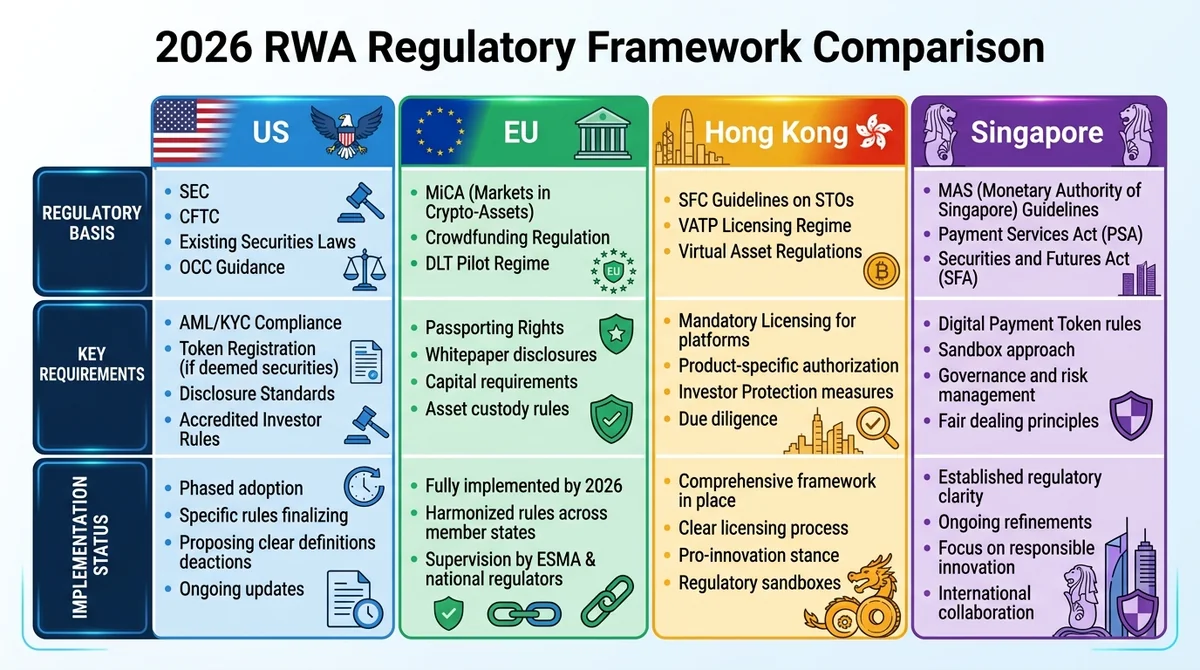
Regulatory progress: In 2026, RWA regulation enters a period of intensive implementation, with major markets such as the United States, the European Union, and Asia successively introducing or advancing compliance frameworks for tokenized assets. It is necessary to distinguish between already implemented and proposed policies: the United States is gradually clarifying the classification of tokenized assets under the securities law framework; the EU's MiCA has partially implemented compliance requirements for asset-referenced tokens and e-money tokens; Hong Kong and Singapore are promoting a licensing-centric compliance path. As of the time of writing, these developments primarily come from public regulatory documents and industry reports, and specific compliance requirements are subject to the latest disclosures by regulators in each jurisdiction.
#What Is the Regulatory Progress in Major Jurisdictions?
The United States uses existing securities laws as a basis, making case-by-case judgments on whether tokenized stocks and RWAs constitute securities. The EU's MiCA sets reserve and disclosure requirements for stablecoins and asset-referenced tokens. Hong Kong and Singapore require platforms to be licensed and restrict retail participation scope. For a more detailed policy comparison, refer to RWA Policy Map: Comparing Regulatory Approaches in Major US, EU, and APAC Jurisdictions and RWA Policy Weekly: Latest Regulatory Developments in MiCA, Hong Kong, and Singapore. Specific compliance requirements are subject to the latest disclosures by regulators in each jurisdiction.
#What Is the Timeline for Regulatory Framework Implementation?
Already implemented rules (such as stablecoin-related provisions) may immediately affect related RWA products; frameworks in consultation or transition periods influence the market more through expectations. In terms of timing, based on general trends from current public information, the first half of 2026 is more likely to see implementation details and enforcement cases, while the second half may see a new batch of license grants and product approvals. However, policy timelines are uncertain and should not be regarded as accurate predictions.
#How Does Regulatory Implementation Impact Tokenized Asset Trading Volume?
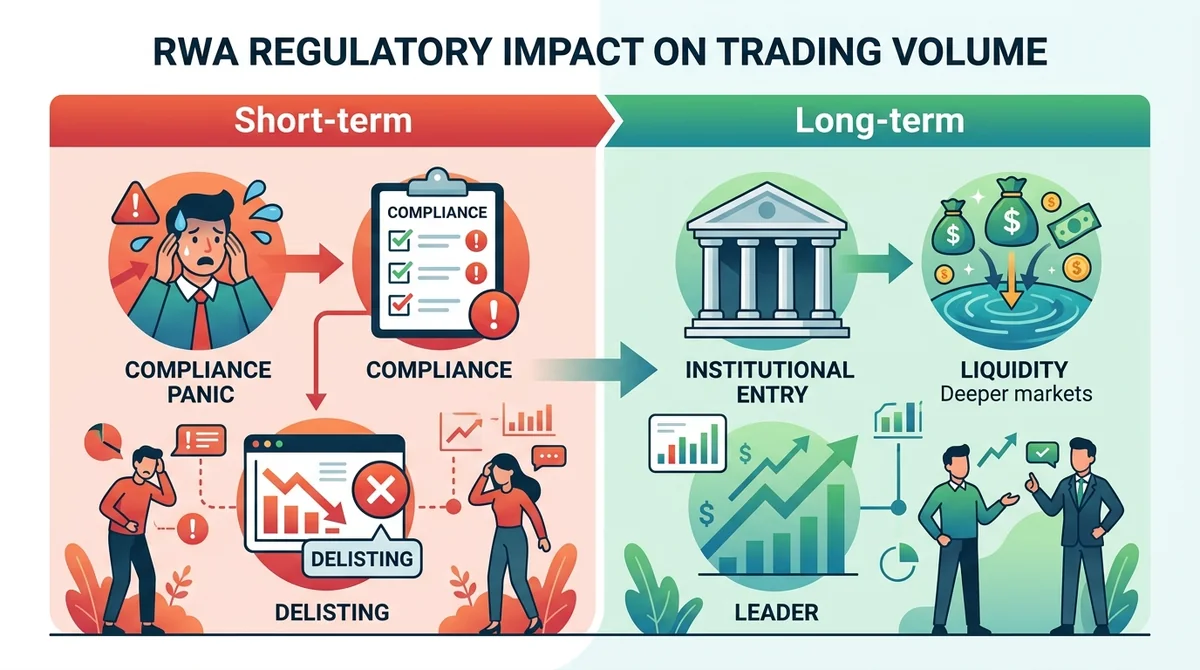
Core mechanism: The impact of regulatory implementation on trading volume can usually be divided into two stages: in the short term, compliance panic may cause market participants to reduce risk exposure, and some platforms may delist gray-area assets, thereby suppressing trading volume; in the long term, a clear compliance framework may reduce legal uncertainty for institutional entry, bringing incremental capital and deeper liquidity. However, actual outcomes are influenced by market conditions, enforcement intensity, and macroeconomic factors, and are not determined by a single policy factor alone.
#How Do Short-Term and Long-Term Trading Volume Impacts Differ?
Short-term effects are more likely to manifest as tokens with higher compliance uncertainty being sold off and platforms proactively contracting. Long-term effects depend on the speed at which institutional custody, market-making, and clearing infrastructure improve. Based on past market reaction patterns, a common path is first a volume contraction, then divergence, but different policy events and market environments may lead to different outcomes.
#Which Asset Classes Are Most Affected in Trading Volume?
Highly liquid tokenized assets with clear compliance paths (such as tokenized treasury bonds issued by licensed platforms) may recover faster; low-liquidity assets relying on gray channels face sustained trading volume shrinkage. The pace of institutional capital entry is a key variable: if large custodians and brokers join, trading volume may rise structurally. The above are general inferences lacking systematic data support.
#How Does Volatility Transmit in Policy Events?
Transmission chain: Policy events may affect tokenized asset prices by changing risk premiums and liquidity expectations. Volatility often first expands at the news level, then transmits along primary and secondary markets: the time gap between primary issuance and secondary trading may cause pricing deviations; high leverage and low liquidity segments may amplify volatility. For discussions on derivatives market liquidation cascades, refer to Crypto Derivatives Market Structure Study: Perpetual Futures Funding Rate and Liquidation Cascade Risk Transmission.
#What Is the Transmission Chain of Volatility from the Policy Side to the Asset Side?
A common transmission path can be summarized as: policy announcement or rumor → market expectation gap forms → risk premium and liquidity premium repriced → spot and derivatives price jumps → forced liquidations or stop-losses triggered → volatility further amplifies. Liquidation cascades in derivatives positions (such as perpetual futures) may exacerbate this process. For options implied volatility structure, refer to Crypto Market Volatility Surface Study: Options Implied Volatility Structure, Skew, and Trading Strategy Signals.
#What Are the Key Conditions for Volatility Amplification or Convergence?
Amplification conditions typically include: large policy expectation gaps, thin market liquidity, and concentrated leveraged positions. Convergence conditions typically include: clear policy details, sufficient transition periods, and compliant market makers stepping in to provide liquidity. Cross-market transmission time differences are also worth attention, but the strength of specific conditions can vary significantly across different events.
#Which RWA Tokens and Platforms Are Most Affected by Policy?
Compliance watershed: According to general market logic, after regulatory implementation, platforms and tokens with compliance qualifications (such as licensed exchanges, qualified custody, securities registration) may gain liquidity advantages; assets lacking a compliance path may face trading volume shrinkage and increased volatility. However, this divergence is also influenced by underlying asset quality, market sentiment, and other factors.
#How Do Compliant Tokens and Gray-Area Tokens Differ in Performance?
Compliant tokens usually have clear underlying asset disclosure, custody arrangements, and secondary market liquidity support; gray-area tokens may lose liquidity due to platform delisting or market-maker withdrawal. Different tokenized versions of the same underlying asset may also show price divergence. The above differences are inferred based on institutional design and lack comprehensive historical data validation.
#How Do Trading Platforms Adjust RWA Product Lines?
From industry trends, mainstream platforms tend to list RWA products that have been recognized or exempted by local regulators, and set suitability thresholds for retail users. Some platforms may proactively delist tokens with questionable compliance to avoid enforcement risk. The trend of liquidity concentrating on compliant platforms may become more pronounced after policy implementation, but specific platform behavior varies by jurisdiction and business model.
#How Should RWA Investors Respond to Volatility from Regulatory Implementation?
Research perspective: This article only provides a research framework and does not constitute investment advice. Investors may focus on the policy calendar and volatility indicators to understand risk rather than chase short-term trading opportunities.
#What Should You Consider Before Building Defensive Positions?
Before evaluating any position, prioritize confirming the asset's compliance status, underlying asset transparency, and platform execution capability. A defensive approach is not about predicting prices but reducing asymmetric risk arising from compliance uncertainty. Diversifying into RWA assets with clear compliance qualifications may help smooth volatility, but cannot eliminate market risk.
#What Tools Can Be Used to Monitor Policy Shocks?
Track regulatory announcements in each jurisdiction, platform listing/delisting notices, changes in tokenized asset trading volume and volatility, and derivatives-market data such as funding rates (how does perpetual futures funding rate work) and liquidation figures. These indicators help identify the timing and magnitude of policy shocks, but historical patterns do not guarantee future performance.
FAQ
Will RWA regulatory implementation definitely lead to a decline in tokenized asset trading volume?
Not necessarily. In the short term, volume may shrink due to compliance panic, but long-term compliance access and institutional entry may drive a recovery in trading volume. Specific performance depends on the asset's compliance level and infrastructure.
Which RWA assets exhibit higher volatility during policy shocks?
Tokenized assets lacking a compliance path, with thin liquidity and concentrated leverage, tend to be more volatile. Compliant tokens issued by licensed platforms are relatively stable but still affected by overall market risk.
How can one determine whether an RWA platform is compliant?
Check whether it holds relevant licenses issued by local regulators, whether it discloses underlying assets and custody arrangements, and whether it restricts retail participation. Specifics are subject to official disclosures by regulators.
Why does high leverage amplify volatility in the transmission path?
High leverage means even small price movements can trigger forced liquidations, creating chain-reaction liquidations and amplifying instantaneous volatility. Derivatives-market data such as funding rates (how does perpetual futures funding rate work) and open interest can assist in observation.
What policy event calendars should ordinary investors monitor?
Monitor rule releases, transition period deadlines, and enforcement cases from major jurisdictions' regulators (US SEC, EU ESMA, Hong Kong SFC, Singapore MAS); also track product announcements from licensed platforms.
Related Terms
Ready to try? Test the strategy on MSX with small positions. Educational content only — not investment advice.