Spot vs Perpetual: A Comparative Study of Pricing Mechanisms, Basis, and Risk Characteristics
Spot vs perpetual: pricing, basis & risk compared. Funding rate settles every 8h; positive basis=spot premium, negative=futures premium.
⚠ This article is a digital asset multi-asset research report and does not constitute investment advice. Investing involves risk, please make decisions prudently. The mechanism descriptions are based on publicly available exchange rules; data is not disclosed, and specific values are subject to real-time market conditions.
Core Conclusion: The essential difference between spot and perpetual contracts lies in—spot directly holds the asset and bears price risk, while perpetual contracts only trade price movements, anchoring to spot through mechanisms such as the funding rate, and additionally adding leverage, forced liquidation, and counterparty risk.
#1. Research Objects and Definitions
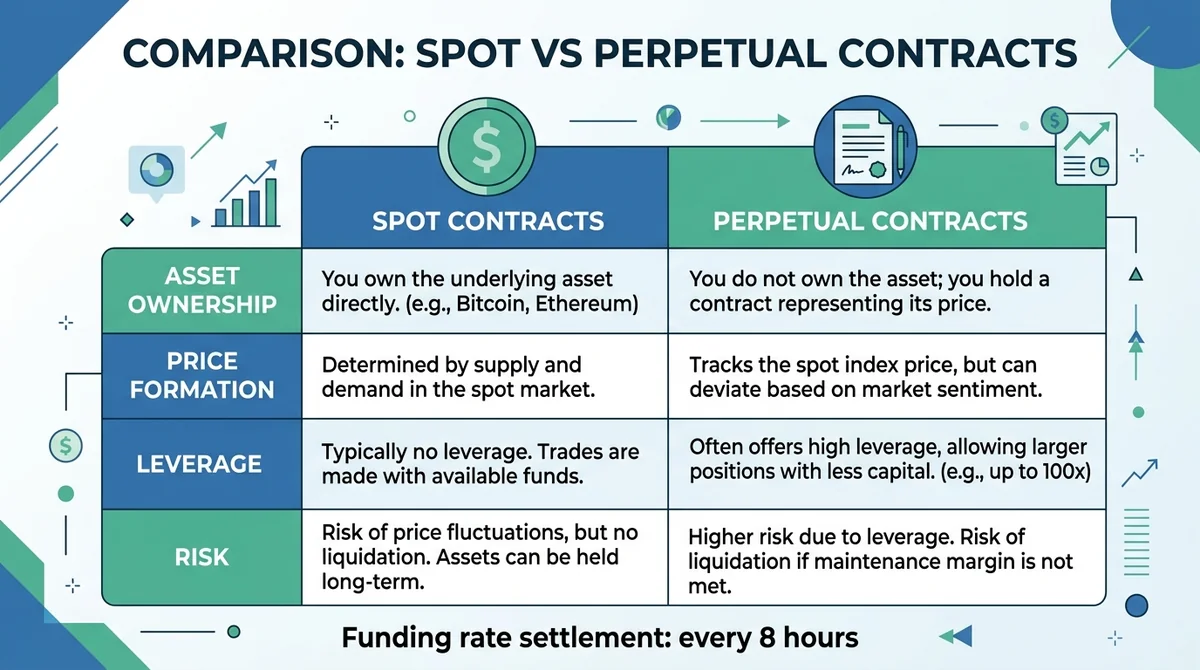
Spot: refers to directly buying and holding real assets (such as BTC, ETH, or tokenized stocks), where the asset itself enters the holder's wallet or custody account. The spot price is formed by direct matching of buy and sell orders on the exchange, directly reflecting real supply and demand.
Perpetual Contract: is a derivative contract with no expiration date, where traders take long or short positions based on the price movement of the underlying asset without actually holding the asset. The perpetual contract price is not directly formed by spot buying and selling, but is determined by market participants' expectations of future price direction and risk, and is anchored to the spot price through mechanisms such as the funding rate and mark price.
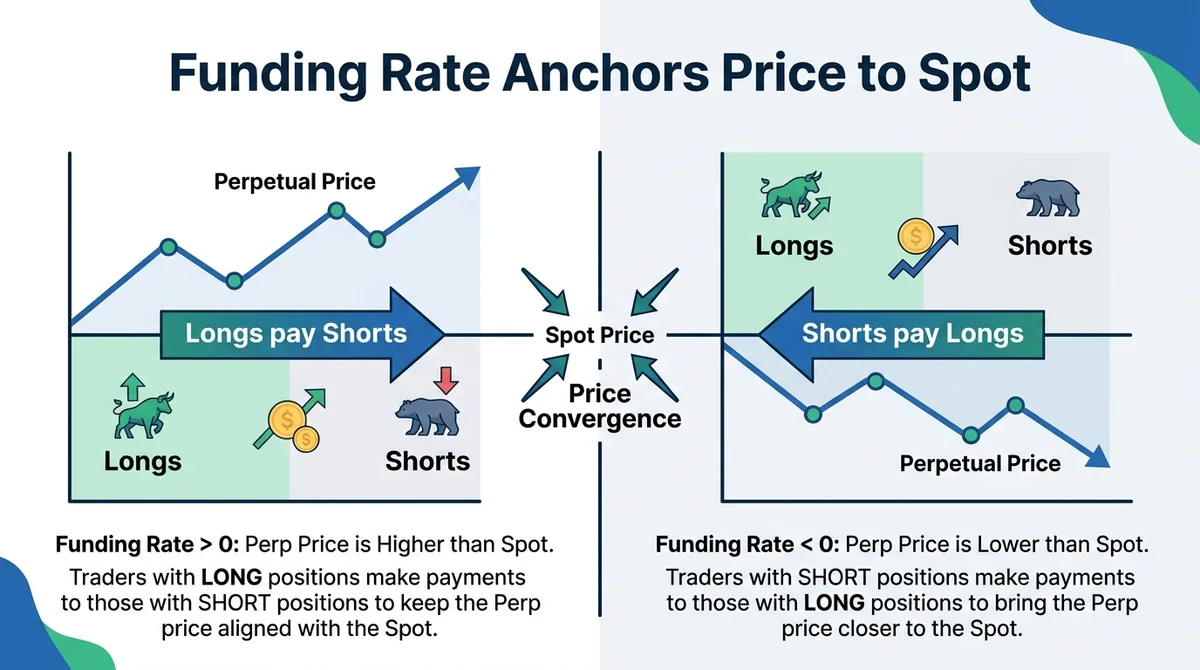
Funding Rate (how does perpetual futures funding rate work): a fee periodically paid between long and short sides of a perpetual contract, used to bring the contract price closer to the spot price. It is not a fee charged by the exchange, but a transfer payment between traders. According to publicly available rules of major exchanges, the common perpetual futures funding rate settlement schedule is every 8 hours, data as of June 2026, subject to the latest disclosure of each exchange; different platforms may differ.
#2. Key Mechanisms and Data
#2.1 What Determines the Spot Price?
The spot price is formed by matching actual buy and sell orders. The price buyers are willing to pay and the price sellers are willing to accept converge on the order book to form the latest transaction price. Since spot involves the transfer of real assets, the price discovery process more directly reflects the current supply-demand balance of the asset. Factors affecting spot supply and demand include macroeconomic expectations, regulatory developments, on-chain activity (for crypto assets), or company fundamentals (for tokenized stocks).
#2.2 What Mechanism Forms the Perpetual Contract Price?
Perpetual contracts have no expiration date, so there is no forced convergence at maturity; their price anchoring mainly relies on mechanisms such as the funding rate, and is jointly determined by market long/short forces and expectations of future spot prices. To prevent the contract price from deviating significantly from the spot price over the long term, exchanges have introduced a perpetual futures funding rate settlement schedule: when the perpetual price is higher than the spot price, longs need to pay fees to shorts, increasing the cost of going long and incentivizing shorting, causing the contract price to fall back; when the perpetual price is lower than the spot price, shorts pay longs, incentivizing a return in the opposite direction. According to publicly available rules of major exchanges, the common funding rate settlement period is every 8 hours, data as of June 2026, subject to the latest disclosure of each exchange.
Positive funding rate: usually represents crowded longs, perpetual contract premium, and bullish market sentiment. Negative funding rate: usually represents crowded shorts, perpetual contract discount, and bearish market sentiment. It should be noted that the funding rate is not a fee, but an anchoring cost paid between long and short sides.
#2.3 How to Distinguish Basis, Spot Premium, and Futures Premium?
The calculation of basis is typically: basis = spot price - contract price. Different platforms may use different contracts (perpetual or delivery) or different quote currencies, so specific values should be based on real-time market data.
- Positive basis: spot price is higher than contract price, usually called spot premium or spot backwardation.
- Negative basis: spot price is lower than contract price, usually called futures premium or contango.
In traditional commodity futures, the usage of contango and backwardation may differ slightly from crypto markets; researchers need to pay attention to consistency of definitions.
#3. Core Drivers
Core factors driving the pricing relationship between spot and perpetual and basis fluctuations include:
- Market sentiment and leverage preference: When bullish sentiment is strong and demand for leverage rises, perpetual contracts are prone to positive funding rates and negative basis (futures premium); and vice versa.
- Arbitrageur behavior: When the basis deviates from the normal range, arbitrageurs simultaneously operate in spot and perpetual to capture the spread, pushing the basis to converge.
- Liquidity conditions and funding costs: The sufficiency of spot liquidity, borrowing costs, and exchange margin requirements affect arbitrage costs and the basis level.
- Macro and regulatory events: Major policy changes and market shocks alter short-term risk appetite, causing rapid fluctuations in basis and funding rates.
#4. Key Participants
In the pricing ecosystem of spot and perpetual contracts, the main participants include:
- Spot holders: including long-term investors, institutional custodians, tokenized stock holders, etc. They bear asset price fluctuations but do not directly participate in perpetual funding rate exchanges.
- Perpetual contract traders: including directional speculators, hedgers, and high-frequency market makers. Directional traders contribute market sentiment, hedgers use perpetual contracts to hedge spot risk, and market makers provide liquidity and participate in funding rate arbitrage (how to arbitrage negative funding rate in perpetual futures).
- Exchanges: provide matching, clearing, funding rate settlement, and mark price maintenance for spot and perpetual contracts. Their rule settings (such as settlement period, rate caps) directly affect anchoring efficiency. The MSX multi-asset research team continuously tracks rule changes of major exchanges.
- Arbitrageurs: conduct reverse operations between spot and perpetual to earn basis convergence returns, and are a key force in maintaining price convergence.
Related research can be found at: Perpetual Contract Mark Price Deviation and Liquidation Alert, 2026 Perpetual Contract Funding Rate Extreme Value Strategy Research.
#5. Risks and Divergences
#5.1 Main Risks of Spot
Spot holders face the risk of asset price decline, exchange or custody platform risks (such as security incidents, withdrawal restrictions), and liquidity risk. Spot itself does not force liquidation due to price fluctuations, unless leverage or borrowing is used.
#5.2 Additional Risks of Perpetual Contracts
- Leverage and forced liquidation risk: Perpetual contracts allow high leverage; a small adverse price movement can trigger liquidation, resulting in total loss of principal.
- Funding rate cost: During the holding period, one must continuously pay or receive funding rates, which is not a neutral cost; in extreme market conditions, rates may surge.
- Counterparty and exchange risk: Profit and loss settlement of perpetual contracts depends on the exchange, with risks of exchange default, system failure, or market manipulation.
- Price deviation risk: Although the funding rate mechanism aims to converge the price difference, during extreme market conditions or insufficient liquidity, the contract price may still deviate significantly from the spot.
#5.3 Bearish Views and Divergences
- Some market participants believe that the high leverage and automatic liquidation mechanism of perpetual contracts amplify market volatility, even forming 'liquidation cascades' that exacerbate price declines.
- There is disagreement on whether the funding rate can stably anchor to spot: when depth is insufficient or exchange rules are incomplete, the funding rate may lag or be manipulated.
- There are differences in interpreting the direction of the basis: negative basis (futures premium) is sometimes interpreted as rising institutional hedging demand rather than simple bearishness, requiring judgment combined with open interest data.
#6. What to Watch Next
Going forward, one should pay attention to the following indicators and events to verify pricing mechanisms and market divergences:
- Real-time basis and funding rate history: Observe the synchronicity of basis and funding rates and the distribution of extreme values.
- Liquidation volume and long-short ratio: Reflect forced liquidation pressure and the degree of sentiment extremes.
- Exchange margin rules and rate cap changes: Rule adjustments affect funding rate transmission and basis convergence speed.
- Macro and regulatory calendar: Releases of important economic data and regulatory statements may change risk appetite.
This article does not provide specific real-time data; real-time data should be supplemented from public market APIs later.
Further reference: Macro Drivers of Funding Rate Shift and Perpetual Contract Timing Strategy, Bitcoin Spot Cross-Exchange Spread and Arbitrage Limits.
#7. FAQ
Is the funding rate a fee?
No. The funding rate is a transfer payment between long and short sides, collected and paid by the exchange to anchor the perpetual price to the spot price. The exchange does not take a cut (or only charges a very small execution fee, depending on exchange policy).
Which is riskier, holding spot or perpetual contracts?
The two have different risk types. Spot mainly bears the risk of price decline and platform custody; perpetual contracts additionally bear leverage liquidation, funding rate costs, and exchange counterparty risk. If high leverage is used, losses in perpetual contracts may exceed the principal, making it riskier; if only 1x without leverage, the risk is close to spot but still has differences in funding rate and counterparty risk.
What do positive basis and negative basis represent respectively?
Positive basis (spot price higher than contract price) is usually called spot premium or spot backwardation; negative basis (spot price lower than contract price) is usually called futures premium or contango. Different platforms may have different definitions, so judgment should be based on specific market conditions.
How can I view real-time basis and funding rate?
You can view per-minute funding rate and basis from the perpetual contract page or API of mainstream exchanges, or use third-party data platforms such as Coinglass to track aggregated data. Specific values are subject to real-time exchange disclosures.
Will perpetual contracts always converge to the spot price?
Under normal liquidity conditions, the funding rate mechanism tends to bring the perpetual price back to spot, but it is not an absolute guarantee. During extreme market conditions, liquidity depletion, or rule failure, the deviation may persist for a long time.
What is a perpetual contract?
A perpetual contract is a derivative contract with no expiration date, where traders take long or short positions based on the price movement of the underlying asset without actually holding the asset. Its price is anchored to the spot price through mechanisms such as the funding rate and mark price, and it includes additional risks of leverage and forced liquidation.
What is the core difference between spot and perpetual contracts?
Spot directly holds real assets, and its price is formed by direct matching on the order book, mainly bearing the risk of price decline and platform custody; perpetual contracts only trade price movements, and their price is determined by market expectations and the funding rate mechanism, with additional leverage, funding rate, forced liquidation, and counterparty risk. The two have different risk characteristics.
FAQ
Is the funding rate a fee?
No. The funding rate is a transfer payment between long and short sides, collected and paid by the exchange to anchor the perpetual price to the spot price. The exchange does not take a cut (or only charges a very small execution fee, depending on exchange policy).
Which is riskier, holding spot or perpetual contracts?
The two have different risk types. Spot mainly bears the risk of price decline and platform custody; perpetual contracts additionally bear leverage liquidation, funding rate costs, and exchange counterparty risk. If high leverage is used, losses in perpetual contracts may exceed the principal, making it riskier; if only 1x without leverage, the risk is close to spot but still has differences in funding rate and counterparty risk.
What do positive basis and negative basis represent respectively?
Positive basis (spot price higher than contract price) is usually called spot premium or spot backwardation; negative basis (spot price lower than contract price) is usually called futures premium or contango. Different platforms may have different definitions, so judgment should be based on specific market conditions.
How can I view real-time basis and funding rate?
You can view per-minute funding rate and basis from the perpetual contract page or API of mainstream exchanges, or use third-party data platforms such as Coinglass to track aggregated
Related Terms
Ready to try? Test the strategy on MSX with small positions. Educational content only — not investment advice.