2026 Tokenized Treasury Liquidity Risk: Cross-Market Redemption Linkage, Market Maker Hedging, and Liquidity Crisis Contagion
Tokenized Treasuries face liquidity mismatch; redemption linkage and market maker de-risking may amplify crises. Not investment advice.
2026 Tokenized Treasury Liquidity Risk: Cross-Market Redemption Linkage, Market Maker Hedging, and Liquidity Crisis Contagion
⚠ This article is a digital asset multi-asset research piece and does not constitute investment advice. Investing involves risk; please exercise caution.
Core conclusion: The liquidity risk of tokenized Treasuries stems from the liquidity discrepancy between the underlying U.S. Treasury market and the on-chain market. Redemption linkage and market maker hedging behaviors may amplify volatility under stress scenarios, resulting in cross-market contagion.
#Underlying/Business Line Definition
Tokenized Treasuries are products that map the income rights or ownership of U.S. Treasury securities (especially short-term T-bills) into tradable tokens on a blockchain. Holding tokens does not equal directly holding Treasury certificates; instead, investors obtain specific rights to the underlying assets through smart contracts and compliant custody arrangements. The traditional U.S. Treasury market has high depth and large trading volume, but the tokenized market is still in an early stage, with significantly different on-chain trading depth, redemption mechanisms, and market maker participation.
#Key Mechanisms and Data
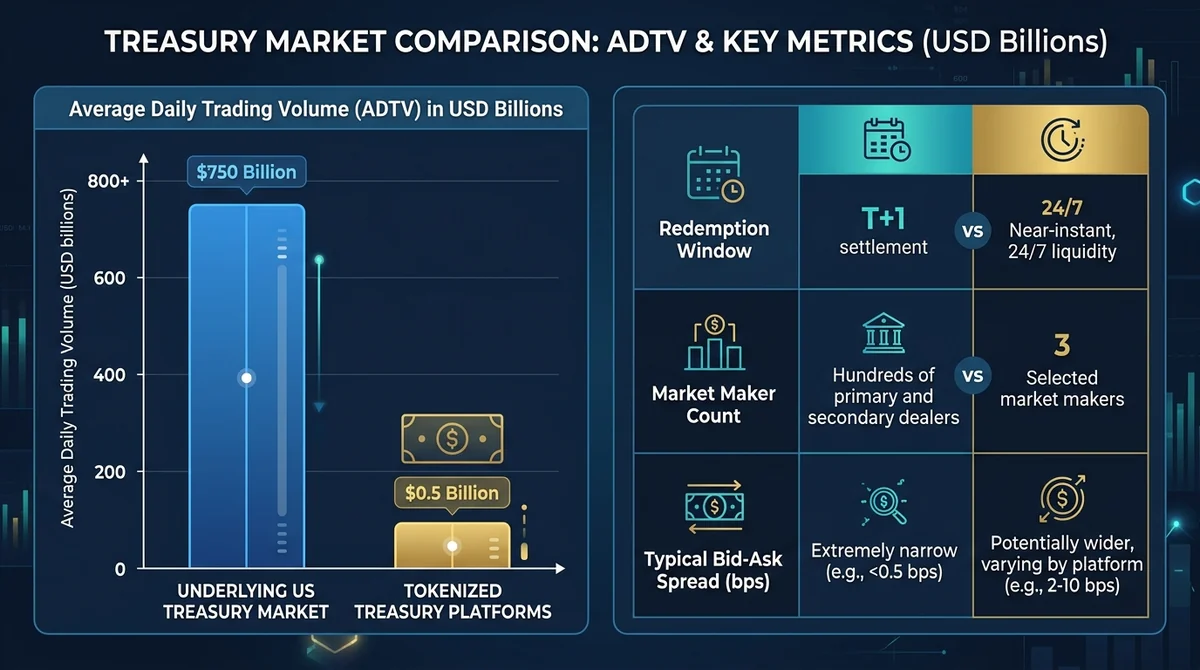
Liquidity risk core: The liquidity of tokenized Treasuries depends on two layers: first, the liquidity of the underlying U.S. Treasury market, and second, the on-chain token market trading depth. Underlying U.S. Treasuries are highly liquid assets globally, but tokenized platforms usually set redemption windows, minimum holding periods, or fees, which restrict investors' rapid exit. On the on-chain market side, liquidity of tokenized Treasuries tends to concentrate in a few market makers and protocols, with limited order book depth. Specific liquidity indicators (such as bid-ask spread, market depth, daily trading volume) need to be checked from each platform's disclosures; data comes from public disclosures/market data, as of 2026-01. Historical experience shows that during the March 2020 market turmoil and the 2023 regional banking crisis, some fixed-income ETFs' secondary market prices briefly deviated from their net asset value (NAV); tokenized products, due to on-chain trading, redemption restrictions, and market maker participation, may have more prominent price deviation risk (inferred).
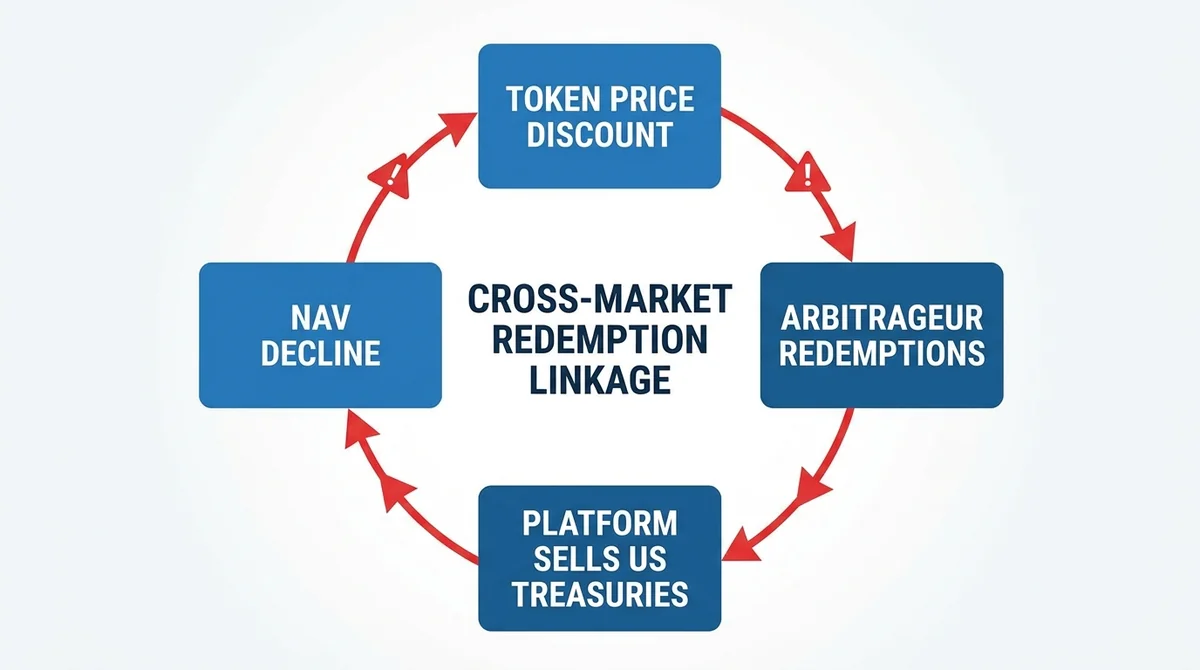
Redemption linkage mechanism: When the on-chain token price deviates significantly from the net asset value (NAV) of the underlying U.S. Treasuries, arbitrageurs will close the spread through primary market (creation/redemption baskets) or secondary market trading. However, if redemption requests concentrate, the platform may be forced to sell U.S. Treasuries in the underlying market to meet cash demand. If the underlying market also faces liquidity tightness (e.g., rapidly rising yields, repo market freeze), the net asset value of tokenized products may decline, further stimulating redemptions and forming a negative feedback loop. This cross-market redemption linkage is the core transmission path of liquidity risk.
Market maker hedging role: Market makers provide two-sided quotes for tokenized Treasuries and hold inventory to narrow spreads. They typically hedge inventory risk by holding underlying U.S. Treasuries, Treasury futures, or repo agreements. In normal markets, such hedging reduces volatility; but under stress scenarios, market makers may proactively reduce inventory or even withdraw quotes due to rising funding costs (e.g., repo rates spike) or tightened risk limits. When multiple market makers de-risk simultaneously, market depth plummets, bid-ask spreads widen, and a liquidity spiral forms. At this point, even if the underlying U.S. Treasury market has not experienced a material default, the token market may fail to trade due to lack of market making.
Crisis contagion path: A liquidity crisis can transmit from the on-chain token market to the traditional U.S. Treasury market. For example, large-scale redemptions by tokenized platforms force them to sell U.S. Treasuries in the traditional market, increasing supply pressure on short-term T-bills; simultaneously, market maker hedging behaviors may concentrate unwinding of Treasury futures or repo positions, affecting the collateral market. However, considering that the overall size of tokenized Treasuries is still small relative to the traditional U.S. Treasury market, the actual contagion effect may be limited. In addition, crypto assets are overall sentiment-sensitive; if tokenized Treasuries are classified as 'safe assets', their liquidity issues may trigger a broad sell-off by crypto investors of stablecoins, money market funds, and the RWA sector. It should be noted that the intensity and direction of contagion depend on market structure, leverage levels, and the speed of regulatory intervention, and there is currently insufficient historical sample to make precise estimates.
#Core Drivers
- Liquidity condition of underlying U.S. Treasuries: Federal Reserve monetary policy, repo market conditions, and Treasury issuance pace directly determine the liquidity of underlying assets.
- On-chain market depth and market maker willingness: Whether tokenized platforms onboard multiple market makers, offer liquidity incentives, and order book transparency all affect trading costs.
- Redemption mechanism design: Terms such as T+0/T+1/T+2 redemption, lock-up periods, redemption fees, and minimum amounts determine investor exit speed and concentrated redemption risk.
- Cross-market price discovery efficiency: The deviation between on-chain price and underlying NAV reflects arbitrage effectiveness; larger deviation indicates greater information transmission friction.
#Key Participants
- Related product providers: Include specialized tokenization platforms (e.g., Ondo Finance) and traditional asset managers (e.g., Franklin Templeton, BlackRock, etc., which have launched on-chain fund products) (mentioning facts, not a recommendation). They are responsible for product structure, compliant custody, and primary market redemption.
- Market makers: Provide secondary market liquidity for tokens; their inventory management and hedging strategies are key to determining market depth.
- Custody and compliance service providers: Hold underlying U.S. Treasuries, provide audits and compliance reports, and reduce counterparty risk.
- Investors: Include crypto-native funds, family offices, DAO treasuries, etc.; their risk appetite and liquidity needs affect redemption behavior.
- Regulators: SEC, FINRA, etc.; their regulatory stance on tokenized securities affects product scalability and market confidence.
#Risks and Divergences
- Bearish view: Tokenized Treasuries may simply be 'complicating a simple asset', unable to provide better liquidity than traditional Treasury ETFs in a crisis, while adding smart contract vulnerabilities, platform credit risk, and regulatory uncertainty.
- Divergence point: Some believe tokenized Treasuries are a bridge connecting traditional finance and DeFi, bringing 24/7 trading and programmability; others argue it is just pseudo-demand, and underlying asset liquidity cannot truly go on-chain.
- Uncertainty: The trigger threshold of liquidity spiral under extreme stress, whether market makers will honor quoting obligations in a crisis, and the scale of cross-market contagion are all uncertain. We acknowledge that historical samples are insufficient to provide probabilistic conclusions.
#What to Watch Next
- Changes in daily trading volume, bid-ask spreads, and number of market makers across tokenized Treasury platforms.
- Impact of Federal Reserve rate path and Treasury issuance plans on underlying U.S. Treasury liquidity.
- Adjustments to redemption terms or product upgrades by major platforms.
- Regulatory guidance or enforcement actions on tokenized securities.
- Real-time performance of tokenized Treasuries under extreme market events (e.g., repo market stress, stablecoin de-pegging).
#FAQ
Q: What is the fundamental difference between tokenized Treasuries and directly buying Treasury ETFs? A: Tokenized Treasuries are on-chain assets with different trading hours, programmability, and transparency, but their liquidity risk structure is more complex, involving smart contract and platform credit risk. Directly holding Treasury ETFs has mature market making mechanisms and regulatory frameworks.
Q: How does redemption linkage specifically trigger a liquidity spiral? A: When the on-chain price deviates from NAV, arbitrageurs redeem in a concentrated manner, forcing the platform to sell underlying U.S. Treasuries. If the underlying market is also tight, selling pressure increases, NAV declines, further triggering redemptions, forming a negative feedback loop.
Q: Will market makers definitely withdraw in a crisis? A: Not necessarily. Market makers may choose to continue quoting or withdraw based on risk limits and funding costs. Historically, in traditional markets, market makers often widen spreads rather than completely withdraw when volatility intensifies, but may temporarily leave under extreme shocks.
Q: How should investors evaluate the liquidity risk of tokenized Treasuries? A: Pay attention to order book depth, number of market makers, redemption terms (lock-up periods, fees), underlying asset management scale, and performance under historical stress scenarios. Also reduce concentrated redemption risk through diversified allocation and predetermined exit paths.
Q: Can tokenized Treasury liquidity risk spread to Bitcoin or stablecoins? A: There is a theoretical contagion path, especially through sentiment transmission in stablecoins and the RWA sector. However, contagion intensity depends on the size and interconnectedness of tokenized Treasuries within the crypto ecosystem; direct evidence is currently limited.
FAQ
What is the fundamental difference between tokenized Treasuries and directly buying Treasury ETFs?
Tokenized Treasuries are on-chain assets with different trading hours, programmability, and transparency, but their liquidity risk structure is more complex, involving smart contract and platform credit risk. Directly holding Treasury ETFs has mature market making mechanisms and regulatory frameworks.
How does redemption linkage specifically trigger a liquidity spiral?
When the on-chain price deviates from NAV, arbitrageurs redeem in a concentrated manner, forcing the platform to sell underlying U.S. Treasuries. If the underlying market is also tight, selling pressure increases, NAV declines, further triggering redemptions, forming a negative feedback loop.
Will market makers definitely withdraw in a crisis?
Not necessarily. Market makers may choose to continue quoting or withdraw based on risk limits and funding costs. Historically, in traditional markets, market makers often widen spreads rather than completely withdraw when volatility intensifies, but may temporarily leave under extreme shocks.
How should investors evaluate the liquidity risk of tokenized Treasuries?
Pay attention to order book depth, number of market makers, redemption terms (lock-up periods, fees), underlying asset management scale, and performance under historical stress scenarios. Also reduce concentrated redemption risk through diversified allocation and predetermined exit paths.
Can tokenized Treasury liquidity risk spread to Bitcoin or stablecoins?
There is a theoretical contagion path, especially through sentiment transmission in stablecoins and the RWA sector. However, contagion intensity depends on the size and interconnectedness of tokenized Treasuries within the crypto ecosystem; direct evidence is currently limited.
Related Terms
Ready to try? Test the strategy on MSX with small positions. Educational content only — not investment advice.