Tokenized U.S. Treasury Term Structure and On-Chain Yield Curve: Liquidity Segmentation and Spread Drivers Between Short-Term Bills and Medium-to-Long-Term Bonds (2026)
Tokenized U.S. Treasury term structure, on-chain yield curve, liquidity segmentation and spread drivers for bills vs bonds, plus portfolio and risk insights
⚠ This article is a digital asset multi-asset research piece and does not constitute investment advice. Investing involves risk; please make decisions prudently.
Core conclusion: The term segmentation in the on-chain yield curve for tokenized U.S. Treasuries arises mainly because differences in duration risk, on-chain liquidity, and redemption efficiency between short-term Treasury bills and medium-to-long-term bonds are amplified by on-chain markets.
#Asset/Business Line Definition
Tokenized U.S. Treasuries refer to digital assets that map U.S. Treasury bonds or their income rights onto a blockchain. This article covers two main maturity lines: short-term Treasury bills (remaining maturity typically within one year) and medium-to-long-term Treasury bonds (remaining maturity over one year). Tokenized products need to correspond to the actual maturity of underlying assets, but the liquidity characteristics of on-chain shares are not identical to those of the off-chain Treasury market. The scope is limited to products where underlying Treasuries are held by qualified custodians and shares or income rights are issued on-chain; it excludes synthetic or leveraged Treasury exposures.
#Key Mechanisms and Data
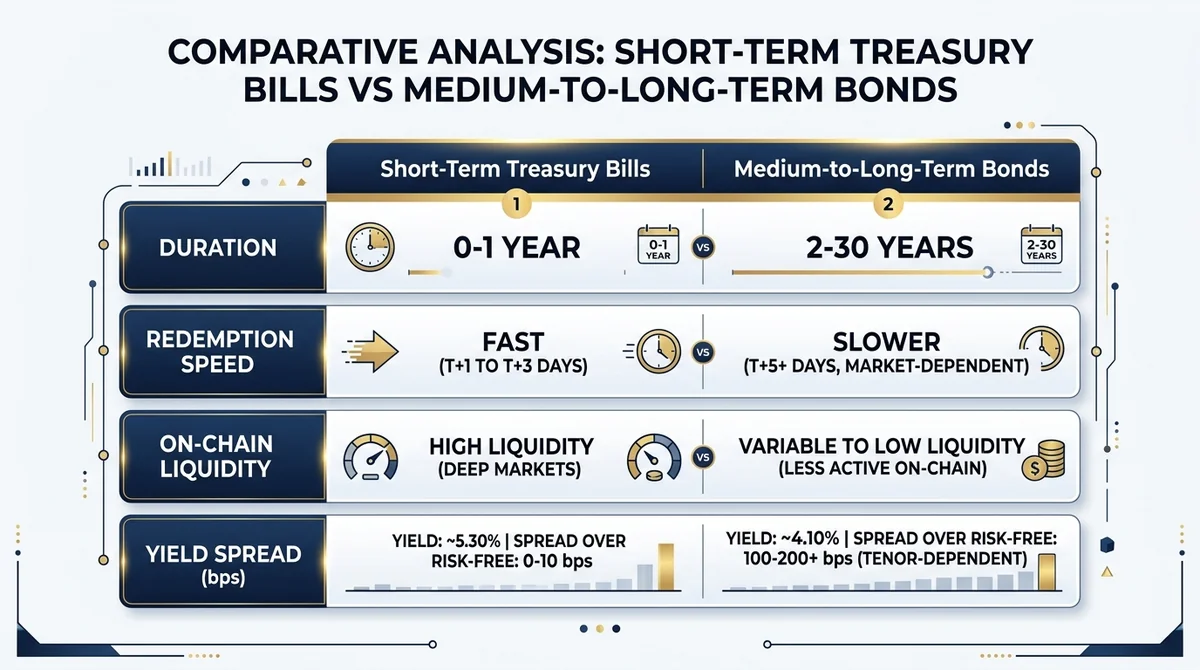
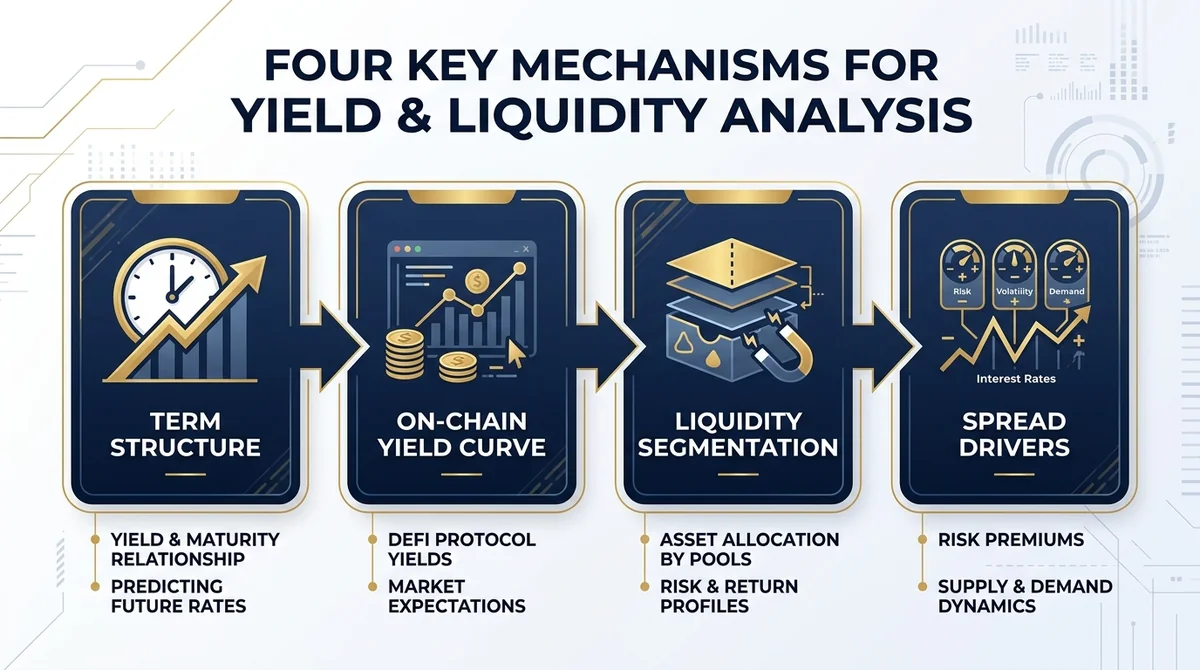
Term structure: Short-term Treasury bills have short maturities and are close to maturity, so their on-chain prices have low sensitivity to interest rate changes; medium-to-long-term bonds have higher duration, so prices typically fall more when rates rise. The on-chain performance of the two asset classes therefore diverges.
On-chain yield curve: The on-chain yield curve is formed by connecting on-chain interest rate points for tokenized Treasuries of different maturities. The short end usually tracks traditional T-bill yields, while the long end often sits above the traditional curve due to liquidity compensation and on-chain risk premium, though not always. On-chain rates are determined by supply and demand, liquidity, and underlying asset yields; compared with traditional markets, on-chain market depth is usually shallower, making the curve shape more susceptible to one-sided fund flows.
Liquidity segmentation: Short-term T-bills have short maturities and fast redemption, so investor preference is generally higher, and on-chain market makers also turn over inventory faster; medium-to-long-term bonds have longer holding periods and higher duration risk, so institutional market-making willingness may be lower, and on-chain liquidation and arbitrage mechanisms are in most cases more applicable to short-term assets. This usually results in stronger on-chain liquidity for short-term T-bills and weaker liquidity for medium-to-long-term bonds. For related risk analysis, see Tokenized Treasury Liquidity Risk Research.
Spread drivers: The spread on tokenized U.S. Treasuries is jointly determined by term premium, liquidity compensation, credit risk compensation (underlying custodian), and on-chain technical risk compensation. Term premium rises with duration, insufficient on-chain liquidity amplifies spread volatility, and technical and compliance risks also require additional compensation. Therefore, medium-to-long-term bond spreads are usually higher than short-term T-bill spreads, but the exact magnitude depends on product and market conditions.
Data are from public disclosures/market quotes, as of 2026-01 (specific values are subject to each issuer and market quote page); this article does not list specific figures and provides only qualitative analysis.
#Core Drivers
Maturity preference and funding attributes: On-chain funds are mostly stablecoins such as USDC/USDT, and holders generally prefer short-term, high-liquidity assets for cash management, which makes demand for short-term T-bills relatively more stable.
Market maker inventory risk: The duration risk of medium-to-long-term bonds requires market makers to hold more risk capital. When on-chain market depth is limited, market makers may tend to avoid long-duration inventory, further depressing medium-to-long-term liquidity.
Underlying U.S. Treasury yield environment: The slope of the traditional U.S. Treasury yield curve influences the on-chain pricing benchmark through arbitrage and fund flows. If the traditional curve steepens or inverts, the on-chain curve may adjust passively.
On-chain arbitrage and liquidation efficiency: Generally speaking, short-term assets can more easily achieve price convergence through on-chain liquidation, collateralization, and arbitrage, while medium-to-long-term assets are constrained by redemption windows and cross-market frictions, making arbitrage less efficient; however, this depends on the specific protocol and market depth.
#Key Participants
Issuers: Usually regulated on-chain Treasury protocols or fund management institutions responsible for tokenizing underlying Treasury shares and managing subscriptions and redemptions.
Custodians: Licensed custodians (banks, trusts, etc.) hold the underlying Treasuries to ensure tokens correspond to assets; custodian risk directly affects product credit.
Market makers and liquidity providers: Provide two-way quotes for tokenized Treasuries on on-chain DEXs or centralized exchanges; their inventory risk appetite determines the degree of liquidity segmentation.
Investors: Include stablecoin issuers, DeFi treasuries, family offices, and individual investors, with varying maturity preferences and risk budgets.
#Risks and Divergences
Interest rate and duration risk: If traditional U.S. Treasury yields rise, medium-to-long-term tokenized Treasury prices may fall significantly, while short-term T-bills are less affected. Investors holding medium-to-long-term products may face NAV drawdowns.
Smart contract and custody risk: On-chain tokens rely on smart contracts for minting, redemption, and yield distribution; contract vulnerabilities or custodian defaults could prevent underlying assets from being redeemed. On-chain transparency is high, but technical incidents are not zero probability.
Liquidity risk: Medium-to-long-term bond on-chain liquidity is relatively weak, and under extreme market conditions large slippage or temporary inability to exit may occur. Market makers may withdraw quotes unilaterally, widening spreads. For more discussion on cross-market redemption linkages and liquidity crisis contagion, see Cross-Market Redemption Linkages and Liquidity Crisis Contagion.
Divergences: Some argue that long-end spreads on tokenized U.S. Treasuries do not fully compensate for on-chain technical risk; others believe on-chain transparency and programmability will gradually narrow the liquidity gap with traditional markets. There is currently no consensus.
#What to Watch Next
Traditional U.S. Treasury yield curve changes: If the Fed path or inflation expectations change, the on-chain curve will reprice accordingly.
On-chain liquidity metrics: On-chain depth, bid-ask spreads, and redemption queue times for tokenized Treasuries across maturities.
Regulatory developments: Whether tokenized Treasuries are recognized as securities or money market fund substitutes will affect issuance and trading access. For policy updates, see RWA Policy Weekly Update.
New product launches: Whether more medium-to-long-term tokenized Treasury products or laddered portfolio products come online to improve long-end liquidity.
#FAQ
Q: What is the core difference between short-term Treasury bills and medium-to-long-term bonds on-chain? A: The core difference is maturity and duration risk. Short-term T-bills generally have remaining maturity within one year, are insensitive to interest rate changes, and usually have better on-chain liquidity; medium-to-long-term bonds have remaining maturity over one year, higher duration, more pronounced price declines when rates rise, and typically weaker on-chain liquidity.
Q: Why might the on-chain yield curve be higher than the traditional U.S. Treasury curve? A: The on-chain yield curve often includes additional liquidity compensation and on-chain technical risk premium at the long end. Because on-chain market depth is shallower, long-duration assets have wider bid-ask spreads, and investors demand higher yields to compensate for potential exit costs and smart contract risk.
Q: What factors mainly determine the spread on tokenized U.S. Treasuries? A: The spread is jointly determined by term premium, liquidity compensation, credit risk compensation (underlying custodian), and on-chain technical risk compensation. Because medium-to-long-term bonds have longer duration and weaker on-chain liquidity, their spreads are usually higher than those of short-term T-bills.
Q: How can I reduce liquidity risk in medium-to-long-term tokenized U.S. Treasuries? A: You can use a laddered allocation to spread funds across different maturities; also monitor redemption windows and market maker quote depth to avoid concentrated exits under extreme market conditions. Specific allocation should be assessed based on your own funding cycle.
Q: What risks should be prioritized when investing in tokenized U.S. Treasuries? A: Focus on custody and smart contract security of underlying assets, as well as duration risk of medium-to-long-term products. If custodian or contract vulnerabilities occur, redemption may be affected; and when rates rise sharply, capital losses on medium-to-long-term products will be amplified.
FAQ
What is the core difference between short-term Treasury bills and medium-to-long-term bonds on-chain?
The core difference is maturity and duration risk. Short-term T-bills generally have remaining maturity within one year, are insensitive to interest rate changes, and usually have better on-chain liquidity; medium-to-long-term bonds have remaining maturity over one year, higher duration, more pronounced price declines when rates rise, and typically weaker on-chain liquidity.
Why might the on-chain yield curve be higher than the traditional U.S. Treasury curve?
The on-chain yield curve often includes additional liquidity compensation and on-chain technical risk premium at the long end. Because on-chain market depth is shallower, long-duration assets have wider bid-ask spreads, and investors demand higher yields to compensate for potential exit costs and smart contract risk.
What factors mainly determine the spread on tokenized U.S. Treasuries?
The spread is jointly determined by term premium, liquidity compensation, credit risk compensation (underlying custodian), and on-chain technical risk compensation. Because medium-to-long-term bonds have longer duration and weaker on-chain liquidity, their spreads are usually higher than those of short-term T-bills.
How can I reduce liquidity risk in medium-to-long-term tokenized U.S. Treasuries?
You can use a laddered allocation to spread funds across different maturities; also monitor redemption windows and market maker quote depth to avoid concentrated exits under extreme market conditions. Specific allocation should be assessed based on your own funding cycle.
What risks should be prioritized when investing in tokenized U.S. Treasuries?
Focus on custody and smart contract security of underlying assets, as well as duration risk of medium-to-long-term products. If custodian or contract vulnerabilities occur, redemption may be affected; and when rates rise sharply, capital losses on medium-to-long-term products will be amplified.
Related Terms
Ready to try? Test the strategy on MSX with small positions. Educational content only — not investment advice.