Tokenized Securities Arbitrage Strategy During the IPO Issuance Window: Capturing the Spread Between Primary Market Discount and Secondary Market Premium (2026)
Explore tokenized securities arbitrage in IPO windows: primary discounts, secondary premiums, success conditions, framework, risk controls, and mistakes.
#Tokenized Securities Arbitrage Strategy During the IPO Issuance Window: Capturing the Spread Between Primary Market Discount and Secondary Market Premium (2026)
⚠ This article is digital asset multi-asset research and does not constitute investment advice. Investing involves risk; please make decisions prudently.
The core of tokenized securities arbitrage strategy is to exploit the spread between primary market discounts and secondary market premiums by subscribing and then selling at a profit. However, this strategy is only effective under specific market conditions and carries lock-up period and liquidity risks.
#What Is a Tokenized Securities Arbitrage Strategy During the IPO Issuance Window?
A tokenized securities arbitrage strategy refers to investors subscribing to tokenized securities in the primary market at a cost lower than the secondary market trading price, then selling at a higher price on the secondary market to capture the spread. This strategy typically appears during the IPO issuance window, when a significant difference may form between primary market pricing and the secondary market opening price.
#What Do Primary Market Discount and Secondary Market Premium Mean Respectively?
Primary market discount refers to the price of tokenized securities being lower than their intrinsic valuation or expected future secondary market price during the primary market issuance or subscription phase. The discount may stem from a lower issue price set by the issuer to attract investors, or from underpricing due to information asymmetry.
Secondary market premium refers to the price of tokenized securities exceeding the primary market issue price after trading begins on the secondary market. The premium usually reflects optimistic market expectations for the underlying asset, a liquidity premium, or short-term supply-demand imbalances.
#What Is the Spread Mechanism Between Tokenized Securities and Real Securities?
Tokenized securities are typically digital assets that represent price exposure to specific stocks. Trading tokens does not equal holding real stocks, and they usually have no dividends or voting rights. Therefore, tokenized securities should theoretically track real securities, but due to differences in trading venues, liquidity, compliance restrictions, and investor structures, persistent or temporary spreads can emerge between the two. During the IPO window, this spread may be amplified.
#Why Does This Spread Appear During the IPO Issuance Window?
The IPO issuance window is often accompanied by information asymmetry, heated sentiment, and locked-in chips. Primary market investors bear the risk of lock-up periods and inability to sell immediately, so issuers may offer discounts as compensation. Secondary market investors, on the other hand, are willing to pay a premium in the early listing period due to scarcity and narrative-driven demand. When primary market discounts and secondary market premiums occur simultaneously, an arbitrage space emerges, but after deducting transaction costs, slippage, lock-up period risks, etc., the actual capturable spread may be significantly smaller than the nominal spread.
#When Is This Strategy Effective and When Does It Fail?
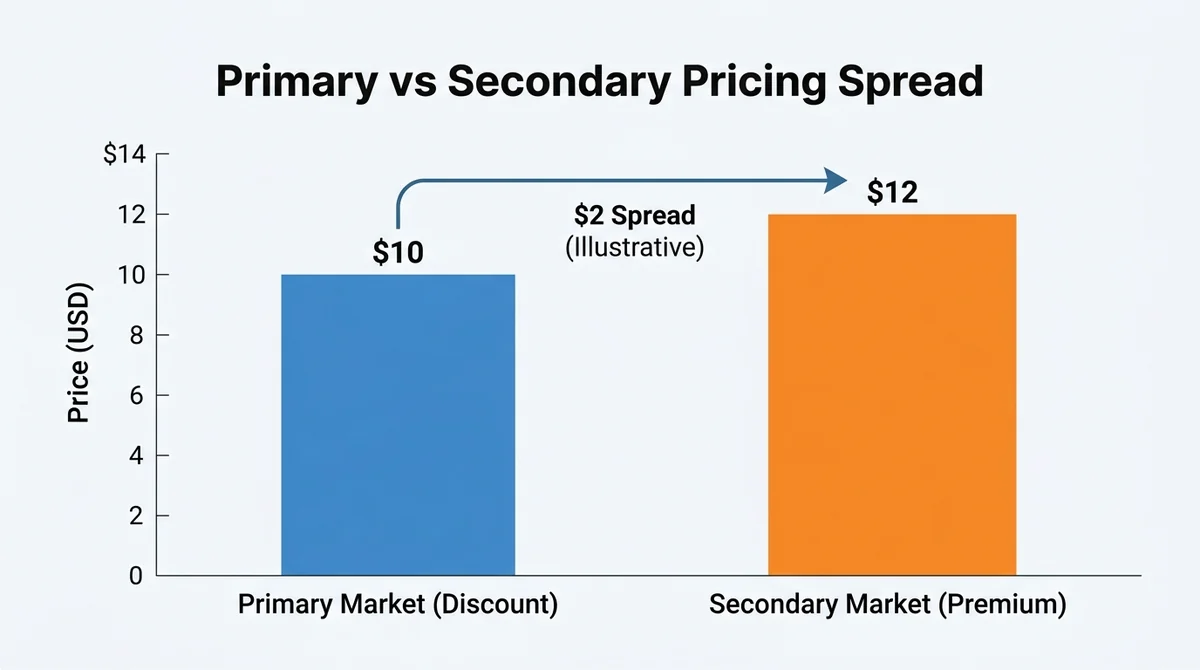
The arbitrage strategy is not always effective; its profitability depends on specific market conditions. Understanding the conditions for effectiveness and failure is the first step in risk management.
#Which Market Conditions Widen the Spread?
Effective conditions include: strong primary market subscription demand, limited secondary market liquidity, frenzied market sentiment, and poor arbitrage channels between tokenized securities and real securities. Under these conditions, the spread tends to widen, providing arbitrageurs with a relatively wide profit margin.
#Which Conditions Cause the Spread to Narrow or Reverse?
Failure conditions include: a large influx of arbitrage capital pushing up primary market prices or increasing secondary market selling pressure, concentrated selling after lock-up periods end, and secondary market break issue price (i.e., price falls below issue price). In addition, if regulatory policies tighten or real securities prices fall sharply, the spread may quickly narrow or even reverse.
#What Is the Step-by-Step Framework?
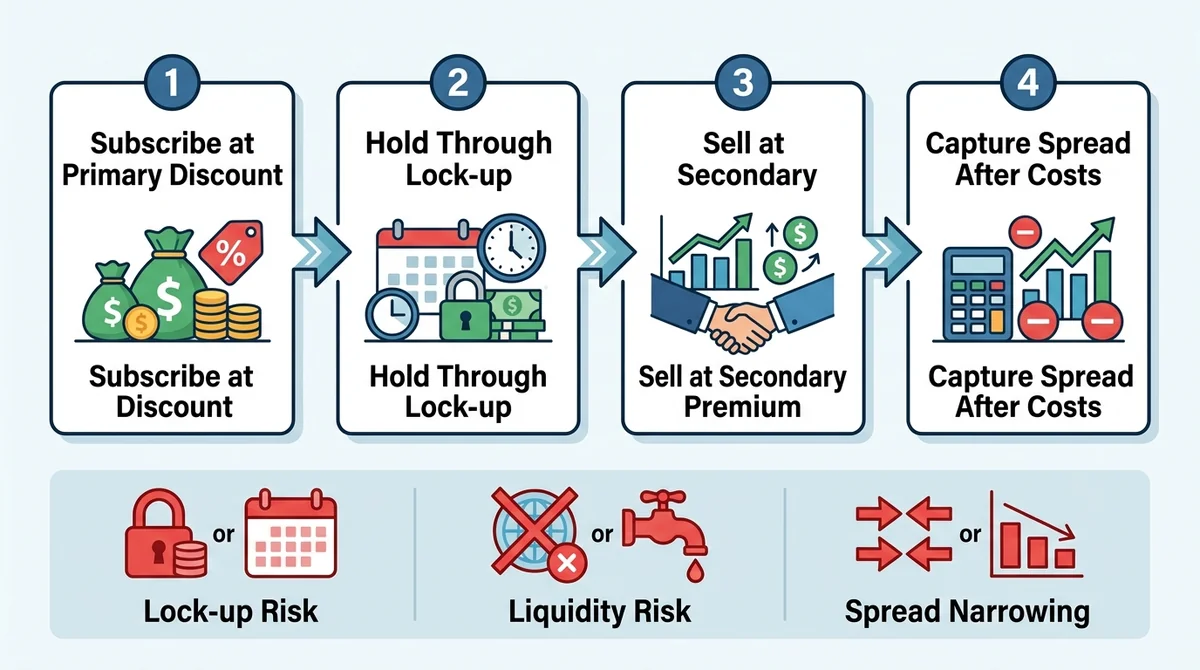
An executable tokenized securities arbitrage framework generally includes three phases: project screening, spread assessment, and execution timing.
#How to Screen Primary Market Projects Eligible for Participation?
Screening criteria include: issuer qualifications and compliance status, quality of the underlying assets of tokenized securities, lock-up period length, and whether there is a clear secondary market listing plan. Investors tend to choose projects with clear fundamentals and better liquidity expectations.
#How to Assess the Discount Magnitude and Premium Potential?
Assessing the spread requires comparing the primary market issue price with the reasonable secondary market valuation, and considering the current price of the real security, historical volatility, and the liquidity premium of the tokenized security. At the same time, it is necessary to estimate the price fluctuation risk during the lock-up period and the possible speed of discount convergence.
#How to Execute Subscription and Secondary Market Selling?
Execution timing is critical: subscription should occur when the spread is sufficient to cover expected costs and risks; selling should choose a window on the secondary market with ample liquidity and before the premium has fully converged. In practice, investors may use batch selling to reduce impact costs.
#Scenario Example
The following scenario is a hypothetical example used to illustrate the logic of spread capture and does not constitute any actual return forecast. All figures below are hypothetical and not based on any real issuance data.
#What Is a Typical Primary Market Discount Subscription and Secondary Market Selling Scenario?
Assume a tokenized security is issued in the primary market at $10, while the corresponding real stock price is $12, a discount of about 17%; on the first day of listing, the secondary market opening price is $13, a premium of 30%. An investor who subscribes in the primary market can then sell on the secondary market, with a theoretical spread of $3, but transaction fees and potential slippage must be deducted.
#How Does the Spread Evolve in This Scenario?
As arbitrageurs enter and lock-up periods end, secondary market supply increases, and the price may fall back near the real security, causing the spread to converge. If the real security price falls simultaneously, arbitrage gains may be eroded or even turn into losses.
#How to Control the Risks of This Strategy?
Risk control is key to the sustainability of the strategy, mainly including position control, lock-up period management, and liquidity management.
#How to Limit Position Size and Leverage?
Position control: Limit the capital allocation to any single project, avoiding overconcentration in low-liquidity tokenized securities. Leverage use: If the arbitrage strategy uses leverage, strict leverage caps must be set, because uncertainty in spread convergence can amplify losses.
#How to Deal with Lock-up Period and Liquidity Risk?
Lock-up period risk: During the lock-up period, selling is impossible, so you need to assess the maximum possible drawdown of both the tokenized security and the real security during the lock-up period. Liquidity risk: Ensure sufficient depth on the secondary market to avoid large sell orders causing significant price slippage. This can be mitigated by phased exits and selecting more liquid targets.
#What Are Common Mistakes Investors Make?
Identifying common mistakes helps avoid unnecessary losses.
#What Happens If You Ignore Lock-up Period Risk?
Investors who ignore lock-up period risk may experience a sharp decline in tokenized security prices during the lock-up period, resulting in the spread disappearing or even a loss at exit.
#Why Can't You Enter Just Based on the Discount Rate?
A high discount rate does not necessarily mean an arbitrage opportunity, because the secondary market may not have enough premium, or the spread may converge quickly during the lock-up period. In addition, excessive use of leverage will magnify losses, turning originally small spread fluctuations into major losses.
FAQ
What is a tokenized securities arbitrage strategy?
A tokenized securities arbitrage strategy exploits the spread between primary market discounts and secondary market premiums by subscribing and then selling on the secondary market for profit.
What are the main risks of this strategy?
The main risks include price fluctuations during the lock-up period, insufficient secondary market liquidity, uncertain spread convergence speed, and declines in real securities prices.
Why do spreads tend to appear during IPO issuance windows?
Because information asymmetry exists between primary market pricing and secondary market expectations, combined with heated sentiment and chip lock-up, causing discounts and premiums to appear simultaneously.
Can investors enter based solely on the discount rate?
Not recommended. A high discount rate does not guarantee a secondary market premium, the spread may converge during the lock-up period, and liquidity risk must also be considered.
How to control the risks of an arbitrage strategy?
Manage risk by limiting position size in any single project, controlling leverage, assessing lock-up period volatility, and ensuring secondary market liquidity.
Related Terms
Ready to try? Test the strategy on MSX with small positions. Educational content only — not investment advice.