2026 Tokenized Treasury Trading Strategy: A Timing Framework Based on On-chain Open Interest and Funding Rates
On-chain OI & funding rate timing framework for tokenized Treasury trend/reversal signals. Covers indicators, environments, failures, risk control. Not investment advice.
#2026 Tokenized Treasury Trading Strategy: A Timing Framework Based on On-chain Open Interest and Funding Rates
⚠ This article is multi-asset digital asset research, not investment advice. Investing involves risk; please decide carefully.
Core conclusion: A timing framework based on on-chain open interest and funding rates, by observing changes in contract open interest and extreme funding rate values, provides reference signals for short-term trends and reversal windows for tokenized Treasury assets with active derivatives markets; this method leans toward a behavioral finance perspective, should be combined with fundamental filters, and does not constitute any trading advice.
#What is a Tokenized Treasury Timing Strategy?
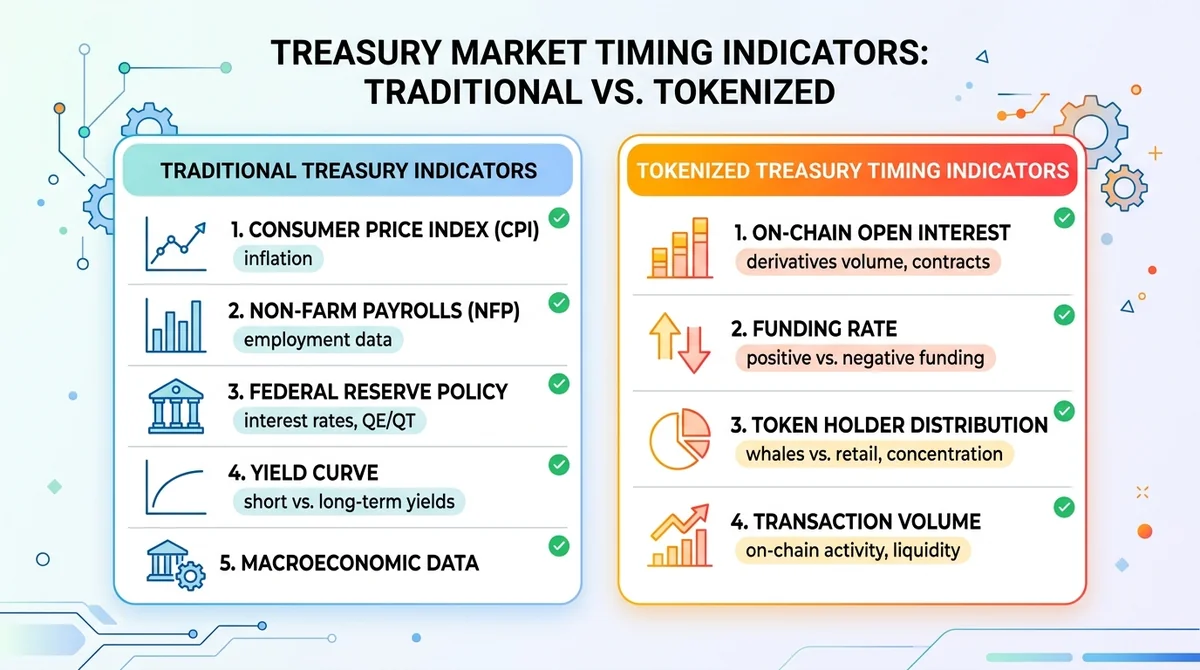
Strategy definition: This strategy uses on-chain position changes (such as contract open interest and number of holding addresses) and funding rates (positive/negative range) to judge short-term trends and potential inflection points in the tokenized Treasury market. Unlike traditional Treasury strategies that rely on macro interest rates and the yield curve, it focuses more on on-chain behavior and derivatives market sentiment. This strategy is only applicable when the underlying has an active perpetual contract or leveraged derivatives market; for tokenized Treasuries that only support spot trading, the funding rate indicator may not be applicable.
#What core indicators does the timing framework based on on-chain open interest and funding rates include?
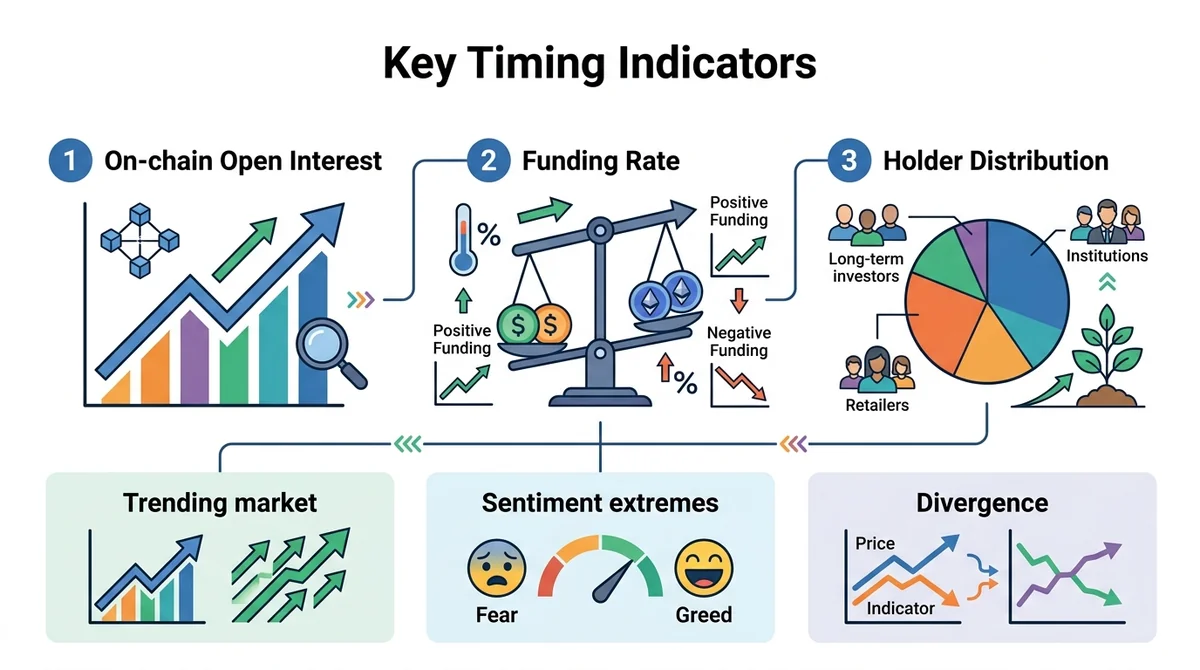
Core indicators include: ① contract open interest, reflecting outstanding long and short positions in the derivatives market; ② funding rate, the fee periodically exchanged between long and short sides, positive means longs pay shorts, negative the opposite; ③ on-chain holding addresses/position distribution, observing concentration and changes. Data should come from publicly disclosed on-chain and derivatives market quotes; please use real-time updates as the basis before use.
#How does it differ from traditional Treasury trading strategies?
Traditional Treasury trading is usually based on macroeconomic data (CPI, non-farm payrolls), the Fed policy path, term spread, etc. The tokenized Treasury timing strategy instead focuses on crypto-native indicators, especially suited to the characteristics of tokenized assets being trackable on-chain and having active derivatives markets. The two are not substitutes but rather complementary: macro determines direction, on-chain indicators assist short-term timing.
#In which market environments is the tokenized Treasury timing strategy effective?
Trending market: When funding rates and on-chain open interest expand simultaneously, the strategy can follow the trend. Sentiment extremes: When funding rates are persistently high or low, it often corresponds to short-term crowding, suggesting a reversal window. The premise for these environments is sufficient derivatives market liquidity and no obvious data manipulation.
#How does the strategy perform when funding rates hit extreme values?
From a behavioral finance perspective, when funding rates remain at extremely positive values (long crowding), subsequent prices tend to pull back; when persistently negative (short crowding), an oversold rebound may occur. But this pattern is not absolute and must be confirmed with position changes. For related mechanisms, see 2026 Perpetual Funding Rate Extreme Strategy Research.
#Can on-chain position-price divergence be used as a signal?
Rapid increase in on-chain positions accompanied by stagnant prices often signals distribution; declining positions with new price highs may indicate weakening upward momentum. Such divergences may be more pronounced in less liquid tokenized Treasury markets, but may also result from insufficient liquidity or manipulation, requiring careful interpretation.
#When might the tokenized Treasury timing strategy fail?
Insufficient liquidity: Some tokenized Treasury assets have limited on-chain depth, and position data may lag or be distorted. Distorted funding rate rules: Platforms may adjust rate rules to attract liquidity, causing signal distortion. Sudden macro policy changes: Events such as Fed interest rate decisions may instantly overwhelm on-chain signals. In addition, if the tokenized Treasury market has not yet formed active derivatives, this framework is not applicable.
#Which market structure changes weaken timing signals?
When the market is dominated by a few market makers, on-chain position data is opaque, or tokenized products have high slippage and low volume, position changes may not reflect true long/short intentions. In addition, cross-market arbitrage may cause funding rates to deviate from their sentiment meaning.
#Why does the strategy easily fail under low liquidity or manipulation?
Low liquidity means small trades can significantly affect prices, and position data may be manipulated by a few accounts. In a manipulated environment, funding rates may be artificially pushed up or down, losing their indicative meaning. Therefore, liquidity conditions of the underlying should be assessed before using this strategy. For an in-depth analysis of tokenized Treasury liquidity risk, see 2026 Tokenized Treasury Liquidity Risk Research.
#How to build a step-by-step timing framework using on-chain open interest and funding rates?
Step 1: Collect data such as contract open interest and the number of on-chain holding addresses, and remove noise (e.g., clean abnormal addresses, filter short-term fluctuations). Step 2: Quantize funding rates into percentiles and observe their positive/negative positions relative to historical range and extreme values. Step 3: Set entry/exit conditions by combining position change rate and funding rate deviation. Step 4: Backtest and live test, dynamically adjust thresholds to avoid overfitting.
#Step 1: How to select effective on-chain position indicators?
Prioritize indicators with high data frequency and historical traceability, such as contract open interest (OI), active buy/sell volume, and changes in holding addresses. Pay attention to differences between data sources and keep definitions consistent.
#Step 2: How to normalize funding rate signals into long/short scores?
Map funding rates to a 0-100 score range, or use historical percentiles (e.g., past 30-day percentile). For example, a higher historical percentile can be set as the long-overheating threshold, and a lower percentile as the short-overheating threshold; specific thresholds need backtesting validation and should not directly apply fixed numbers.
#Step 3: How to set entry and exit thresholds?
Entry conditions can be set as: funding rate is in an extreme range and position change rate confirms in the same direction; exit conditions can be set as: rate returns to median or positions show a reversal inflection point. All thresholds need out-of-sample testing to avoid parameter sensitivity.
#How is the tokenized Treasury timing strategy applied in typical scenarios?
Scenario 1: Funding rate turns negative while positions increase—short crowding, possible oversold rebound opportunity. Scenario 2: Funding rate remains high while positions decrease—long overheating, beware of long squeeze. Scenario 3: On-chain position-price divergence—if positions fall but price makes new highs, consider reducing; if positions increase but price stagnates, consider avoiding. All scenarios assume an active derivatives market exists.
#Scenario 1: What does a negative funding rate with increasing positions mean?
This means shorts are paying fees and open interest is accumulating, short forces may be overly concentrated. Historically, the more common change is a phased price rebound, but it needs confirmation of fundamental support and is not guaranteed to occur.
#Scenario 2: What does persistently high funding rate with decreasing positions mean?
Longs are paying high fees but positions are decreasing, indicating some longs are closing out, and the market may be in the prelude to a 'long squeeze.' At this time, the risk-reward ratio tends to be unfavorable for chasing longs, but other indicators are still needed for confirmation.
#Scenario 3: How to operate when on-chain position and price diverge?
Divergence itself is only a warning and does not provide direct buy/sell signals. It can be confirmed with funding rates: if divergence is accompanied by extreme rates, signal strength may be higher. Operationally, those with positions may consider reducing risk exposure, and those without positions should wait and see.
#What risks need to be controlled in the tokenized Treasury timing strategy?
Stop loss: Set stop loss based on volatility, for example using ATR to set stop distance, to avoid expanding single losses. Position sizing: A single strategy signal should not exceed a small proportion of total position; the specific proportion should be set according to personal risk tolerance, and heavy positions are not recommended. Systematic risk: Macro interest rate changes, regulatory changes; Non-systematic risk: Single protocol default, token depegging, etc.
#How to control drawdown through stop loss and position management?
Stop loss can be set with reference to ATR (Average True Range); the specific multiple should be determined through backtesting and risk budgeting, and fixed empirical values are not advisable. Position management requires not taking heavy positions on a single signal to avoid major losses from signal failure.
#How to distinguish systematic and non-systematic risks?
Systematic risk affects the entire market, such as Fed policy shifts and global liquidity tightening; non-systematic risk is concentrated in specific protocols or targets, such as smart contract vulnerabilities and insufficient reserves. Timing strategies mainly address market volatility but cannot avoid non-systematic risks.
#Disclaimer: Why do all conclusions not constitute investment advice?
This strategy only provides an analytical method based on on-chain data; all signals, thresholds, and scenarios are methodological discussions and do not make buy/sell recommendations for any specific asset. Digital assets are highly volatile; investors need to make independent judgments and bear risks.
#What are common mistakes when using the tokenized Treasury timing strategy?
Common mistake 1: Using only a single indicator and ignoring divergence between indicators. Common mistake 2: Overreacting to extreme funding rate values without confirming position changes. Common mistake 3: Overfitting historical backtests leading to live failure. Common mistake 4: Ignoring liquidity differences among tokenized Treasuries, causing signal failure.
#Why can't one only look at funding rate or only on-chain positions?
Funding rate reflects market sentiment but may be distorted by platform rules; on-chain positions reflect real positions but may lag. Combining the two can improve signal quality, while a single indicator can easily lead to misjudgment.
#What problems does overfitting historical data cause?
Overfitting causes a strategy to perform excellently on historical data but fail on new data. Avoidance methods include: using out-of-sample testing, simplifying parameters, and maintaining logical economic rationality.
#Frequently Asked Questions (FAQ) about the Tokenized Treasury Timing Strategy
What is funding rate, and how does perpetual futures funding rate work?
Funding rate is the fee periodically exchanged between long and short sides, reflecting market sentiment. In tokenized Treasury derivatives, extreme funding rate values can indicate short-term crowding or reversal, but need confirmation with on-chain positions, and only apply to assets with active derivatives markets.
Where can on-chain position data be obtained?
It can be obtained from DeFi protocol pages, blockchain explorers, or professional on-chain analysis tools such as Etherscan, Dune Analytics, etc. (specific tools depend on the underlying chain). Confirm data definitions and update frequency before use.
Which investors is this strategy suitable for?
Suitable for investors with some crypto trading experience, who can tolerate volatility and understand derivatives mechanics. Beginners should first understand funding rate and position concepts and should not directly copy the strategy.
FAQ
What is funding rate, and how does perpetual futures funding rate work?
Funding rate is the fee periodically exchanged between long and short sides, reflecting market sentiment. In tokenized Treasury derivatives, extreme funding rate values can indicate short-term crowding or reversal, but need confirmation with on-chain positions, and only apply to assets with active derivatives markets.
Where can on-chain position data be obtained?
It can be obtained from DeFi protocol pages, blockchain explorers, or professional on-chain analysis tools such as Etherscan, Dune Analytics, etc. (specific tools depend on the underlying chain). Confirm data definitions and update frequency before use.
Which investors is this strategy suitable for?
Suitable for investors with some crypto trading experience, who can tolerate volatility and understand derivatives mechanics. Beginners should first understand funding rate and position concepts and should not directly copy the strategy.
Related Terms
Ready to try? Test the strategy on MSX with small positions. Educational content only — not investment advice.