Tokenized Stock After-Hours Spread Arbitrage: Funding Rate Transmission and Basis Risk Study (2026)
Mechanisms, funding rate transmission, and basis risk of tokenized stock after-hours spread arbitrage, with a 2026 risk management framework.
⚠ This article is digital asset multi-asset research and does not constitute investment advice. Investing involves risk; please make decisions prudently.
Core conclusion: Tokenized stock after-hours spread arbitrage relies on the time window between after-hours price movements in US stocks and the delayed tracking of their tokenized mapping prices to capture returns, but the transmission of how does perpetual futures funding rate work reshapes holding costs and the basis structure. Arbitrage outcomes are subject to uncertainties such as basis volatility, thin liquidity, and liquidation triggers.
#Asset / Business Line Definition
A tokenized stock is an on-chain digital asset that maps the price exposure of a specific stock. Holding the token is not equivalent to owning the corresponding US stock, and it typically does not carry dividend rights or voting rights (data from public disclosures, as of 2026-01). After-hours spread arbitrage refers to executing arbitrage operations during the US stock after-hours session by exploiting the delay and spread in tokenized stock prices tracking after-hours movements of US stocks.
#Key Mechanisms and Data
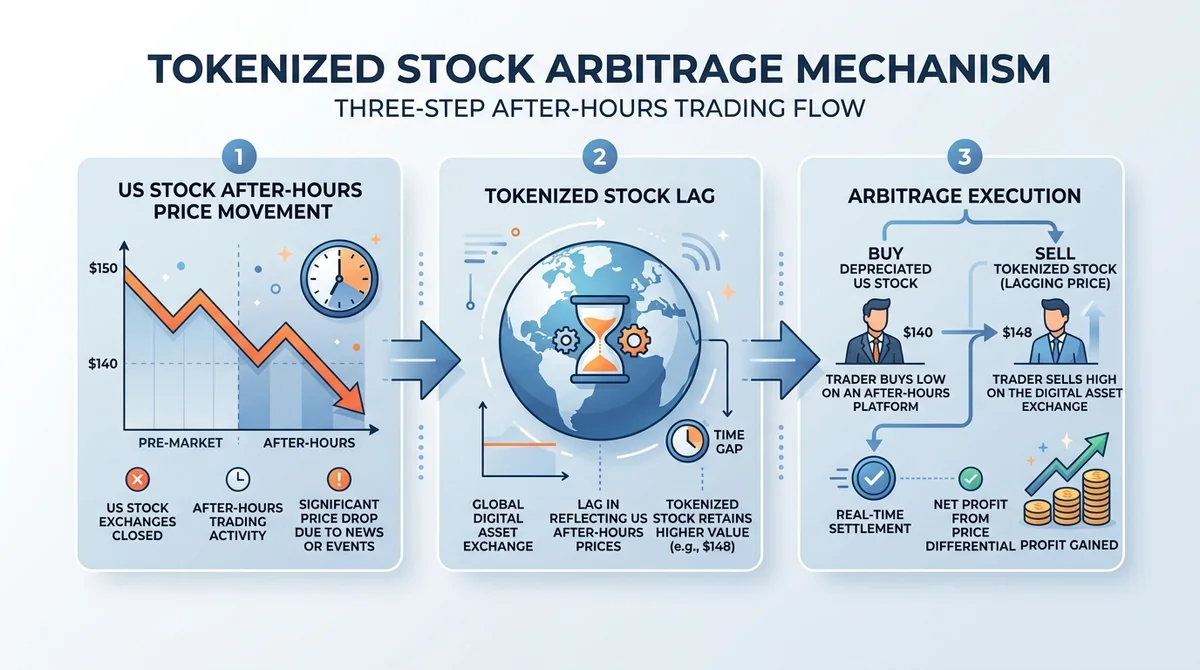
#Basic Process of After-Hours Arbitrage
During the US stock after-hours trading window (16:00–20:00 ET), prices fluctuate due to earnings releases or breaking news. Tokenized stock quotes in on-chain markets gradually follow, but they are not synchronized in real time; there is a time lag and price spread. Arbitrageurs lock in spread returns through two-sided operations—buying/selling tokenized stocks on one side and trading the corresponding US stock or related derivatives on the other. Specific parameters such as spread width and delay duration must be assessed with real-time market data. Data from public market data, as of 2026-01.
#How does perpetual futures funding rate work Transmission Mechanism
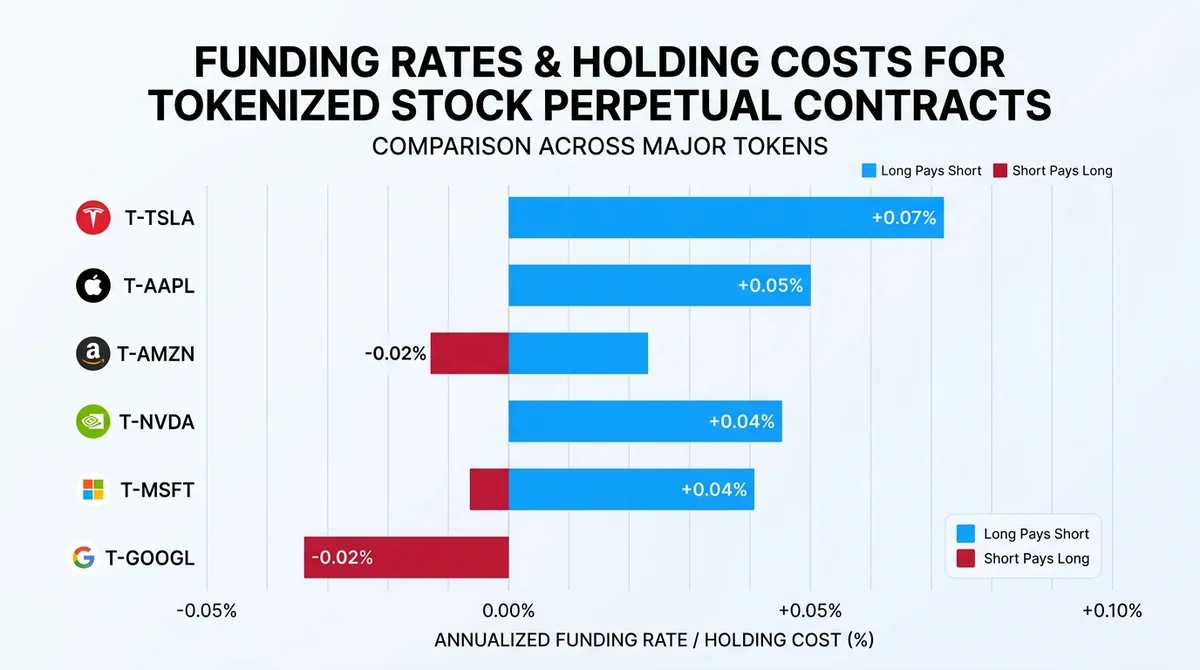
Funding rate is the fee exchanged periodically between longs and shorts in perpetual contracts, designed to bring contract prices closer to spot prices. In the perpetual contract ecosystem corresponding to tokenized stocks, how does perpetual futures funding rate work directly changes holding costs and further affects the basis between tokenized stock prices and the underlying US stocks. Funding rate is typically settled every 8 hours, with longs or shorts making payments depending on the sign of the rate. Rate transmission is not instantaneous but carries a certain lag. After-hours arbitrageurs must incorporate this lag and its direction into their strategies. Data from public disclosures, as of 2026-01.
#Sources of Basis Risk
Basis is the difference between the tokenized stock price and the underlying US stock price. During after-hours sessions, market depth is thin, which can cause the basis to widen or narrow significantly in a short period. In extreme market conditions, leveraged positions may also face a chain reaction of forced liquidation. Historical data shows that after-hours liquidity is significantly weaker than during regular trading hours, and basis volatility rises accordingly. Data from public market data, as of 2026-01.
#Core Drivers
- US stock after-hours price movements: After-hours earnings releases, breaking news, and other events are the main catalysts for price anomalies and the core source of arbitrage opportunities.
- Tokenized stock market liquidity: The depth of on-chain order books and the activity of market makers determine how quickly spreads can converge.
- Funding rate level: A high funding rate raises holding costs, squeezing arbitrage space.
- Cross-market linkage: Changes in the correlation between US stocks and crypto assets directly affect the effectiveness of arbitrage execution.
#Key Participants
- Tokenized stock issuers: Platforms that operate tokenized stock trading and minting/redemption.
- Market makers: Inject liquidity into the market and narrow bid-ask spreads.
- Arbitrageurs: Including institutions and high-frequency trading teams, profiting by capturing spreads.
- Underlying US stock market: After-hours trading venues and brokers providing relevant access.
#Risks and Disagreements
- Basis risk: The basis may not converge but instead continue to widen, causing floating losses or even realized losses on arbitrage positions.
- Liquidity risk: Insufficient after-hours market depth may lead to slippage or inability to execute when exiting positions.
- Forced liquidation risk: With perpetual futures leverage and extreme market conditions, violent price swings can trigger liquidation mechanisms.
- Regulatory uncertainty: The regulatory framework for tokenized stocks in 2026 still has variables, and trading rules may be adjusted.
- Market structure changes: New platform launches or rule revisions may alter the effectiveness of existing arbitrage.
#What to Watch Next
- US stock after-hours earnings calendar, prioritizing stocks with higher expected volatility.
- Announcements from tokenized stock platforms regarding funding rate adjustments.
- Latest policies or statements from regulators on tokenized stocks.
- Trends in correlation indicators between US stocks and crypto markets.
#FAQ
Is tokenized stock after-hours arbitrage risk-free? Not at all. The strategy faces basis volatility, insufficient liquidity, and liquidation risk, and returns are uncertain.
How does how does perpetual futures funding rate work affect arbitrage? Funding rate changes holding costs and acts on the basis; when the rate is too high, arbitrage space may be completely eroded.
How much capital is needed for after-hours arbitrage? The exact amount depends on the spread size and trading costs; sufficient capital is usually needed to cover fees and slippage.
What impact will regulatory changes in 2026 have? Tighter regulation may restrict tokenized stock trading or modify existing rules, increasing strategy uncertainty.
How to manage basis risk? It can be controlled by limiting position size, dynamic hedging, and setting strict stop-losses.
What are the main steps of tokenized stock after-hours arbitrage? First, monitor after-hours anomalies in US stocks; second, assess the spread between tokenized stocks and US stocks; then establish two-sided positions; finally, close positions for profit when the spread converges.
What factors can cause arbitrage to fail? A continuously widening basis, insufficient liquidity preventing position closure, a sudden rise in funding rate, and regulatory policy changes can all cause arbitrage failure.
How to evaluate the reliability of a tokenized stock platform? Examine the issuer's compliance qualifications, custody fee transparency, minting/redemption mechanisms, and historical operating records, and monitor regulatory developments.
FAQ
Is tokenized stock after-hours arbitrage risk-free?
No. Arbitrage faces basis risk, liquidity risk, and forced liquidation risk, and returns are uncertain.
How does how does perpetual futures funding rate work affect arbitrage?
Funding rate changes holding costs and affects the basis; a high rate may make arbitrage unprofitable.
How much capital is needed for after-hours arbitrage?
It depends on the spread size and transaction costs; a relatively large capital scale is usually required to cover fees and slippage.
What impact will regulatory changes in 2026 have?
Regulation may restrict tokenized stock trading or change rules, increasing uncertainty.
How to manage basis risk?
Manage it by controlling position size, dynamic hedging, and strict stop-losses.
Related Terms
Ready to try? Test the strategy on MSX with small positions. Educational content only — not investment advice.