Opportunity Windows and Execution Risk in Tokenized Stock Corporate Actions: Pre/Post-Event Price Exposure, Distribution Failures, and Arbitrage Capital Constraints (2026)
Event windows in tokenized stock corporate actions: ex-date price exposure drift, causes of distribution failures, and capital and limit constraints on arbitrage.
⚠ This article is digital-asset multi-asset research and does not constitute investment advice. Investing carries risk; please make decisions prudently.
Key takeaways: Corporate actions on tokenized stocks propagate through custody fee arrangements and platform rules to form an event window, and within that window the transmission of US equity prices to token prices may lag; distribution failures and arbitrage constraints mean spreads may persist for a period rather than converge immediately. These mechanisms are structural inferences; public, unified data on the specific magnitude of drift and failure rates is lacking, and platform disclosures must be checked item by item.
#Instrument / business line definition
This article studies tokenized stocks, meaning tokenized equity certificates issued on-chain or within a platform by a platform or issuer, backed by custodied underlying US equities (or a basket of US equities). Its boundaries include:
- Coverage: tokenized products whose underlying asset is US equities, involving the handling of dividends, stock splits, mergers and acquisitions, and other corporate actions.
- Not covered: other RWA categories such as tokenized treasury bonds, RWA tokenization smart contract on-chain settlement feature, and tokenized commodities (their mechanisms are discussed separately).
- Event window: the interval defined by the corporate action announcement, record date, ex-date, payment date, and on-chain settlement timing.
It must be emphasized that tokenized stocks are not direct holdings of US equities; the realization of rights depends on custody fee arrangements and platform rules, so the transmission path of corporate actions differs structurally from direct shareholding. Specific rules (snapshot basis, distribution form) are not uniform across platforms; this article discusses the mechanism framework rather than the definitive terms of any single platform.
#Key mechanisms and data
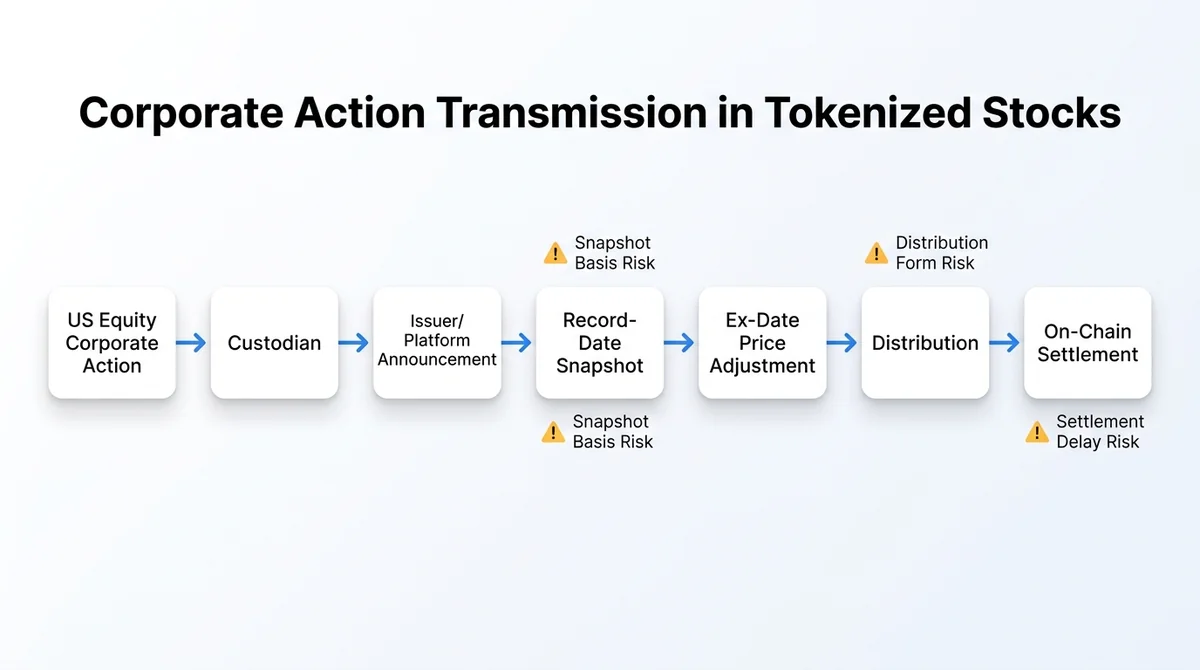
#Transmission of corporate actions in the tokenized structure
Corporate actions (dividends, stock splits, mergers, spin-offs, etc.) first occur at the underlying US equity level, then propagate through the custodian—issuer/platform—token holder chain. Key transmission nodes include:
- Announcement node: the platform publishes a corporate action handling announcement specifying the record date, distribution ratio, and crediting method.
- Record-date snapshot: the platform snapshots holdings under its own rules; the snapshot basis (on-chain balance, platform account balance, whether unsettled trades are included) directly affects distribution eligibility.
- Ex-date and distribution: after the underlying US equity goes ex-rights, the token price should in theory adjust in sync; on the payment date, the cash or token distribution is completed.
- On-chain settlement timing: if the distribution is completed via on-chain transfer, settlement delays lengthen the time to crediting.
#Time boundaries of the event window
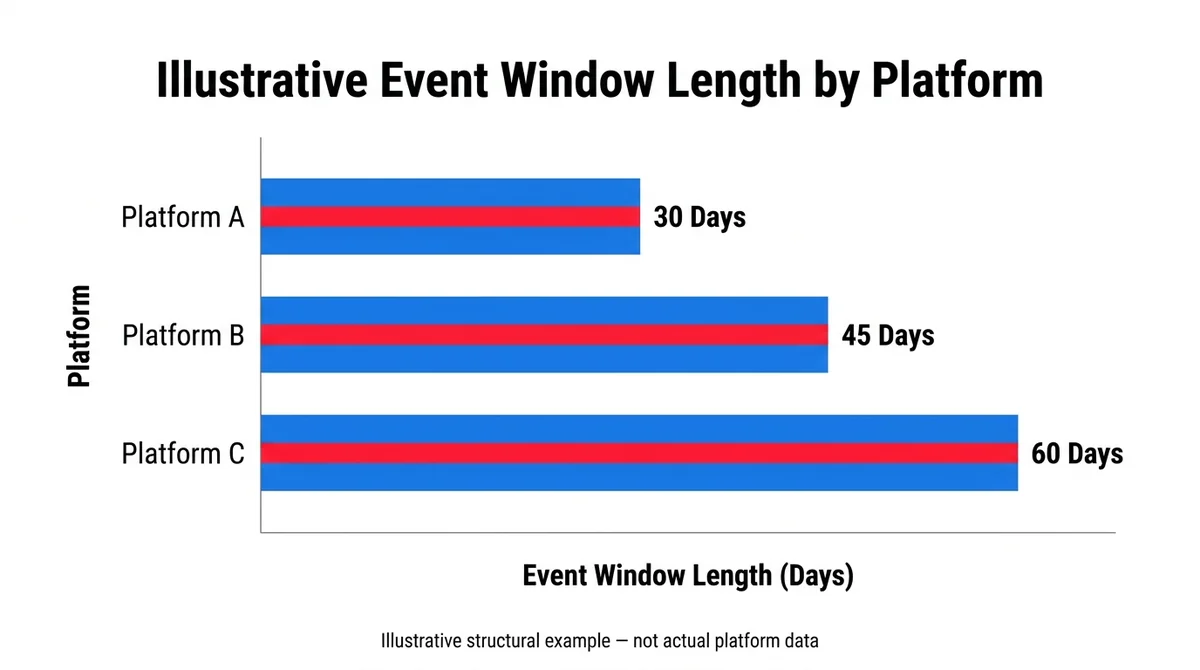
The window boundaries are determined by the following nodes: announcement date → record date → ex-date → payment date → on-chain settlement completion date. Different platforms may handle the same corporate action at different times, which in theory may cause the token price of the same instrument to diverge across platforms within the window; the degree of divergence depends on rule differences and liquidity across platforms, and the specific magnitude must be checked against actual market data.
#Changes in price exposure
Mechanically, token prices track US equity prices, and transmission within the window may lag. Around the ex-date and distribution timing, the token price and the corresponding US equity price may deviate for a period. Data on the magnitude of deviation is not publicly and uniformly disclosed and must be checked item by item against platform announcements and actual market data; this article provides no specific spread figures, and any individual-case spread should be treated as an observation rather than an industry benchmark.
#Core drivers
- Custody fee and platform rule differences: differences in record-date snapshot basis, distribution form (cash/token/reinvestment), and crediting timing are the primary drivers of spread and distribution-experience divergence within the window (mechanism inference; cross-platform comparative data is lacking).
- On-chain settlement lag: on-chain transfer confirmation times combined with platform internal settlement cycles may lengthen the distribution crediting period.
- Arbitrage capital constraints: funding costs, borrow availability, and platform limit restrictions affect the speed of spread convergence.
- Disclosure transparency: the timeliness and completeness of platform corporate action announcements affect market expectation formation and exposure pricing.
#Key participants
- Custodians and issuers: responsible for custody fee arrangements for underlying US equities and token issuance; the starting point of corporate action transmission.
- Trading platforms: set record-date snapshot, distribution, and redemption rules; the de facto determiners of window boundaries.
- Market makers and arbitrage capital: provide liquidity within the window and attempt to converge spreads, but are subject to capital and limit constraints.
- Data and announcement services: provide corporate action calendars and distribution records; the external basis for verifying exposure.
The above lists factual roles only and does not constitute a recommendation of any institution or instrument.
#Risks and disagreements
- Distribution failure risk: custody chain interruptions, record-date snapshot basis differences, and on-chain settlement delays may all cause distribution failure or delay. Specific failure rate data is not public, and crediting cannot be assumed to occur automatically.
- Exposure drift risk: around the ex-date, token prices and US equity prices may deviate for a period, and holders may bear unintended price exposure.
- Arbitrage constraint risk: spreads do not converge immediately; strategies relying on arbitrage reversion may face dual pressure from funding costs and limit restrictions within the window.
- Rule change risk: platforms may update custody fee and redemption rules; historical handling methods do not guarantee future applicability.
- Bear case: some argue that corporate action handling for tokenized stocks lacks transparency, that holders' actual rights are weaker than direct shareholding, and that spreads within the window reflect structural friction rather than arbitrageable opportunities.
#What to watch next
- The update frequency and completeness of platform corporate action announcements and distribution records.
- Adjustments to custody fee and redemption channel rules (e.g., record-date snapshot basis, distribution form).
- Progress in disclosing currently non-public data such as distribution failure rates and exposure drift statistics.
- Accumulation of cases showing differences in handling timing for the same instrument across platforms.
#FAQ
Q1: Are dividends on tokenized stocks guaranteed to be credited? A: No. Distribution depends on the custody chain, record-date snapshot, and on-chain settlement; a mismatch at any step may cause delay or failure. Specific failure rate data is not public; platform announcements and actual crediting records should govern.
Q2: Does the token price adjust automatically on the ex-date? A: In theory it should adjust with the underlying US equity's ex-rights adjustment, but transmission may lag, and platform rule differences may cause temporary deviation. The magnitude of deviation must be checked against actual market data; this article gives no specific figures.
Q3: Can spreads within the event window be arbitraged? A: Arbitrage capital is constrained by funding costs, borrow availability, and platform limits, so spreads may persist rather than converge immediately. Arbitrage is not risk-free; constraint conditions must be assessed.
Q4: Can I receive a distribution if I buy on the record date? A: It depends on the platform's snapshot basis and settlement rules. Some platforms may require that record-date holdings be settled at the snapshot time; unsettled trades may not be counted. Check platform announcements in advance.
Q5: What should I do after a distribution failure? A: We recommend handling it in the order of announcement—customer service—documentation: first verify the platform announcement and your own holding snapshot, then contact platform customer service, and keep records of trades and communications.
FAQ
Are dividends on tokenized stocks guaranteed to be credited?
No. Distribution depends on the custody chain, record-date snapshot, and on-chain settlement; a mismatch at any step may cause delay or failure. Specific failure rate data is not public; platform announcements and actual crediting records should govern.
Does the token price adjust automatically on the ex-date?
In theory it should adjust with the underlying US equity's ex-rights adjustment, but transmission may lag, and platform rule differences may cause temporary deviation. The magnitude of deviation must be checked against actual market data; this article gives no specific figures.
Can spreads within the event window be arbitraged?
Arbitrage capital is constrained by funding costs, borrow availability, and platform limits, so spreads may persist rather than converge immediately. Arbitrage is not risk-free; constraint conditions must be assessed.
Can I receive a distribution if I buy on the record date?
It depends on the platform's snapshot basis and settlement rules. Some platforms may require that record-date holdings be settled at the snapshot time; unsettled trades may not be counted. Check platform announcements in advance.
What should I do after a distribution failure?
We recommend handling it in the order of announcement—customer service—documentation: first verify the platform announcement and your own holding snapshot, then contact platform customer service, and keep records of trades and communications.
Related Terms
Ready to try? Test the strategy on MSX with small positions. Educational content only — not investment advice.