Diagnosing the Index Gap for Tokenized Stock Corporate Actions: How Crawl Budget, Internal Linking, and Page Quality Signals Affect Indexation (2026)
A three-layer diagnosis of index gaps in tokenized stock corporate action content: crawl budget, internal linking, and page quality signals, with a reusable workflow.
⚠ This article is multi-asset research on digital assets and does not constitute investment advice. Investing carries risk; please make decisions carefully.
Core conclusion: Indexation problems for tokenized stock corporate action content are more likely the result of three overlapping layers—crawl budget, internal linking structure, and page quality signals. Diagnosis should bucket issues by layer and prioritize high-value, fixable items rather than broadly attributing the problem to "search engines not indexing." This judgment is a methodological inference and must be verified against the site's own crawl logs.
#What is the index gap for tokenized stock corporate actions, and why diagnose it separately?
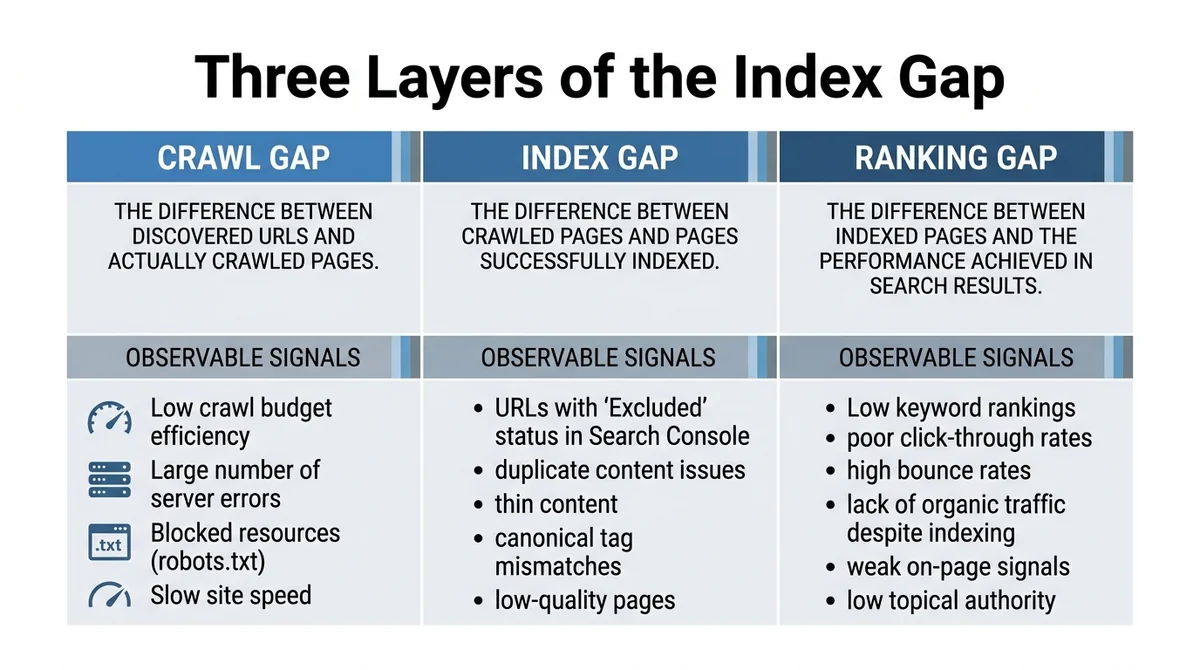
Definition: An index gap refers to the set of pages a site has published but that search engines have not effectively indexed (or that are indexed but receive no meaningful impressions). It is a different layer of problem from a crawl gap (crawlers did not fetch the page) and a ranking gap (indexed but underperforming in rankings).
Why corporate action content is more prone to problems: Corporate actions for tokenized stocks (stock splits, dividends, token mapping adjustments, redemption and share conversion arrangements, etc.) are highly time-sensitive, with short event windows and short page lifecycles. Once the crawl window is missed, page value decays quickly. At the same time, the same event is often covered repeatedly across multiple articles, easily creating thin content and near-duplicate content.
Baseline data needed for diagnosis: A list of published URLs, crawl logs or crawl frequency statistics, index status (indexed/not indexed/crawled but not indexed), and page click depth and internal link in-degree. Note: the specific values of a search engine's internal crawl budget are an undisclosed mechanism; where this article touches on that, it is marked as data not publicly available.
Data caveat: This article does not cite specific indexation rates or crawl frequency figures. If site-specific data is cited later, it must be labeled "data from public disclosures/site backend statistics, as of YYYY-MM."
#How does crawl budget affect indexation of corporate action pages?
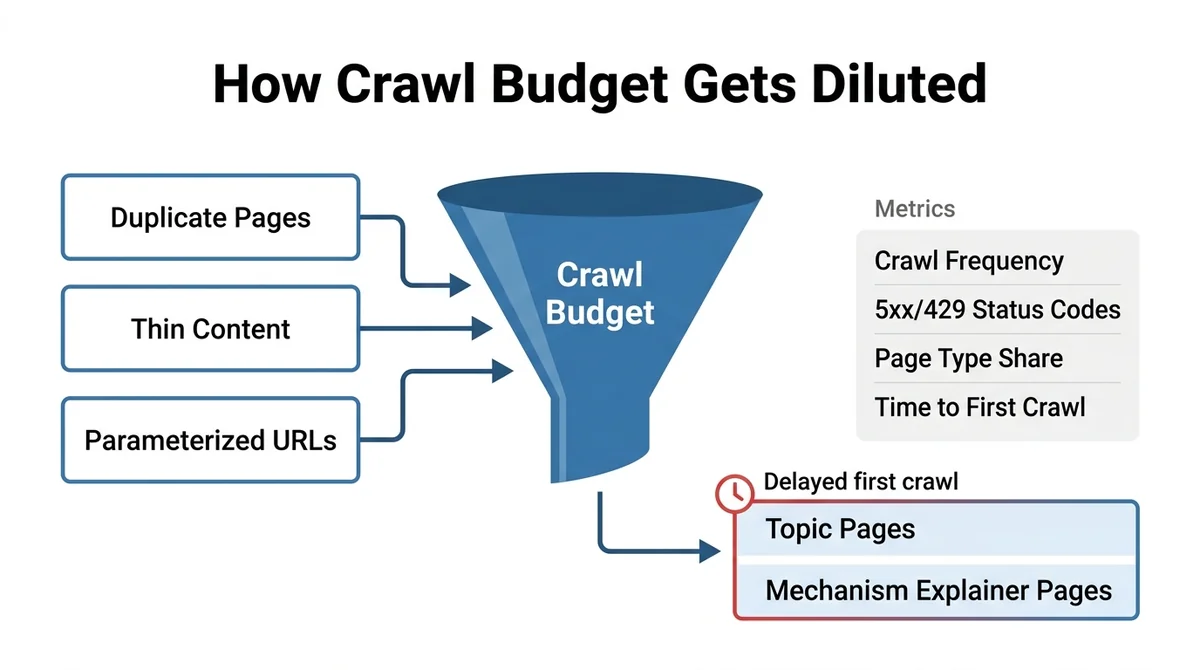
Mechanism: Crawl budget refers to the crawl resources a search engine allocates to a site within a given period, typically related to site size, content quality, update frequency, and server response conditions. The specific allocation algorithm is an internal search engine mechanism; data not publicly available.
Dilution path: If corporate action content includes large numbers of duplicate pages (multiple versions of the same event briefing), thin content (reposts of a one-line announcement), or proliferating parameterized URLs, it may consume crawl quota and delay crawling of the topic pages and mechanism explainer pages that genuinely need timely indexation.
Observable metrics: Time series of crawl frequency, distribution of response status codes (5xx/429 suppress crawling), share of crawled page types (list pages vs. detail pages), and the time lag before important pages are first crawled.
Judging whether budget is wasted: If crawl logs show a high share of low-value list pages and duplicate pages while corporate action topic pages remain uncrawled for long periods, this tends to suggest crawl budget may be diluted—but alternative explanations such as abnormal server responses or erroneous robots blocking must be ruled out.
#How does internal linking determine discovery and authority for corporate action topic pages?
Discovery path: Internal links are the primary channel through which search engines discover new pages and pass authority. Orphan pages (with no internal links pointing to them) or pages at excessive click depth (e.g., more than 4 levels) have historically been more likely to remain unindexed for long periods.
Reciprocal linking design: Corporate action topic pages should form bidirectional links with mechanism explainer research pages—topic pages link to mechanism explanations, and mechanism pages link back to topic pages in relevant passages, with anchor text consistent with the target page's topic, avoiding generic anchors like "click here."
Hierarchy control: Place corporate action topics at a level close to the homepage and distribute them centrally through section aggregation pages to avoid deep islands.
Caveat: Internal link optimization can only improve discovery and authority flow; it cannot replace content quality. The specific proportion of authority passed is an undisclosed mechanism.
#How do page quality signals affect indexation decisions for corporate action content?
Uniqueness: Content uniqueness is a core signal in indexation decisions. If the same corporate action event is covered by multiple near-duplicate articles, search engines tend to keep only one, with the rest entering a "crawled but not indexed" state.
Timeliness labeling: Corporate action pages should clearly state the event date, effective date, and data source, so that neither readers nor crawlers are left unable to judge whether the page is still valid.
Sources and standards: When citing issuer announcements, custody fee or trading platform disclosures, data standards must remain consistent; inconsistent standards weaken credibility signals.
Handling expired pages: Expired corporate action pages should be updated (adding outcomes and subsequent effects) or merged into topic pages, rather than left as-is to form low-quality inventory; low-quality inventory can in turn affect crawl budget allocation, creating a negative loop.
#How to build a reusable index gap diagnostic workflow?
Three-layer bucketing:
- Crawl anomaly layer: not crawled or crawl failed (abnormal status codes, erroneous robots blocking, server timeouts).
- Not-indexed layer: crawled but not entered into the index (near-duplicate content, thin content, missing timeliness labels).
- Indexed low-impression layer: indexed but no meaningful impressions (no differentiation in titles and snippets, scattered topics).
Prioritization: Sort by "business value × fixability," handling high-value, low-cost fixes first (e.g., adding internal links, adding timeliness labels), then content requiring restructuring.
Action categories: Structural fixes (completing internal links, compressing hierarchy, building aggregation pages) and content fixes (deduplication and merging, adding sources, updating expired events).
Data boundaries: Where the site does not provide backend data, gap scale (e.g., the share of unindexed pages) is marked as data not publicly available, with no estimates made.
#Key participants and observation targets
Participant types (facts only, not recommendations): tokenized stock issuance and distribution platforms, underlying U.S. equity issuers, custody fee and settlement service providers, and market data and data aggregators. The original sources of corporate action information are typically issuer announcements and platform disclosures; research sites mostly provide secondary curation.
Observation dimensions: The release cadence of corporate action announcements, how platforms handle token mapping adjustments, and the update frequency of topic pages.
#Risks and disagreements
Bear-case perspective: Some argue that indexation problems mainly stem from content itself lacking uniqueness, so structural optimization yields limited returns; others argue that during rapid content expansion, crawl budget constraints are the more direct bottleneck. The two explanations are not mutually exclusive and must be verified against the site's own crawl logs.
Methodological risks: Crawl log interpretation carries attribution bias; search engine mechanism details are undisclosed, so conclusions carry uncertainty; equating indexation with traffic overstates optimization effects.
#What to watch next
- Changes in crawl frequency during corporate action event windows
- Changes in index status after reciprocal linking between topic pages and mechanism pages
- Progress on merging and updating expired corporate action pages
- Availability of site backend index coverage data
#FAQ
Q1: Are index gaps and crawl gaps the same thing? A: No. A crawl gap means crawlers did not fetch the page; an index gap means the page was crawled or published but not effectively indexed. The troubleshooting methods differ.
Q2: Why is corporate action content more likely to go unindexed than regular research? A: Strong timeliness, short lifecycles, and multiple versions of the same event create thin content and near-duplicate content.
Q3: Can internal link optimization guarantee indexation? A: No. Internal links improve discovery and authority flow, but indexation decisions also depend on content quality and the site's overall crawl budget.
Q4: Should expired corporate action pages be deleted or updated? A: Historically, the more common practice is to update them with outcomes or merge them into topic pages; outright deletion loses existing link value.
Q5: Can the specific crawl budget figures be looked up? A: No. Crawl budget allocation is an internal search engine mechanism; data not publicly available. It can only be observed indirectly through crawl logs.
Risk statement and conclusion boundaries: This article is a methodological framework for index gap diagnosis and does not constitute investment advice; it does not involve price forecasts or instrument recommendations. Search engine internal mechanisms and specific gap scale data are not publicly available, and conclusions must be verified against the site's own data; cited data must be traced back to original sources.
FAQ
Are index gaps and crawl gaps the same thing?
No. A crawl gap means crawlers did not fetch the page; an index gap means the page was crawled or published but not effectively indexed. The troubleshooting methods differ.
Why is corporate action content more likely to go unindexed than regular research?
Strong timeliness, short lifecycles, and multiple versions of the same event create thin content and near-duplicate content.
Can internal link optimization guarantee indexation?
No. Internal links improve discovery and authority flow, but indexation decisions also depend on content quality and the site's overall crawl budget.
Should expired corporate action pages be deleted or updated?
Historically, the more common practice is to update them with outcomes or merge them into topic pages; outright deletion loses existing link value.
Can the specific crawl budget figures be looked up?
No. Crawl budget allocation is an internal search engine mechanism; data not publicly available. It can only be observed indirectly through crawl logs.
Related Terms
Ready to try? Test the strategy on MSX with small positions. Educational content only — not investment advice.