MSX Review 2026: Trading Products, Fees, Order Execution, and Risk Controls
MSX Review 2026 examines products, fees, execution and risk controls, including 0.3% RWA spot buys and 0.02%/0.045% maker/taker fees.
#MSX Review 2026: Trading Products, Fees, Order Execution, and Risk Controls
Risk disclosure: This article is for informational purposes only and does not constitute investment advice. Crypto assets are highly volatile, and you could lose your entire principal. Do your own research and make independent decisions (DYOR). This article discusses only evaluation methods and risk-control frameworks. It does not recommend any specific asset to buy or sell or guarantee returns.
The key conclusion of this MSX Review 2026 is that the platform covers tokenized U.S. stock spot trading, perpetual contracts, cryptocurrency trading, and Pre-IPO products, with fractional-share participation starting from 10U. Based on the MSX platform materials obtained for this review, as of April 2026, the RWA spot buy fee is 0.3%, while contract maker and taker fees are 0.02% and 0.045%, respectively. The platform has not disclosed actual execution latency, slippage, or order rejection rates. Information concerning reserves, cold wallets, compliance, and audits still requires independent verification against original documents.
All parameters in this article are based on materials obtained as of April 2026. Rules, product availability, and regional restrictions may change. Historical or current disclosures do not guarantee future conditions, so users should check MSX's latest official rules before using the platform.
#Key Takeaways / TL;DR
- As of April 2026, MSX covers tokenized U.S. stock spot trading, perpetual contracts, cryptocurrency trading, and Pre-IPO products, with fractional-share participation starting from 10U.
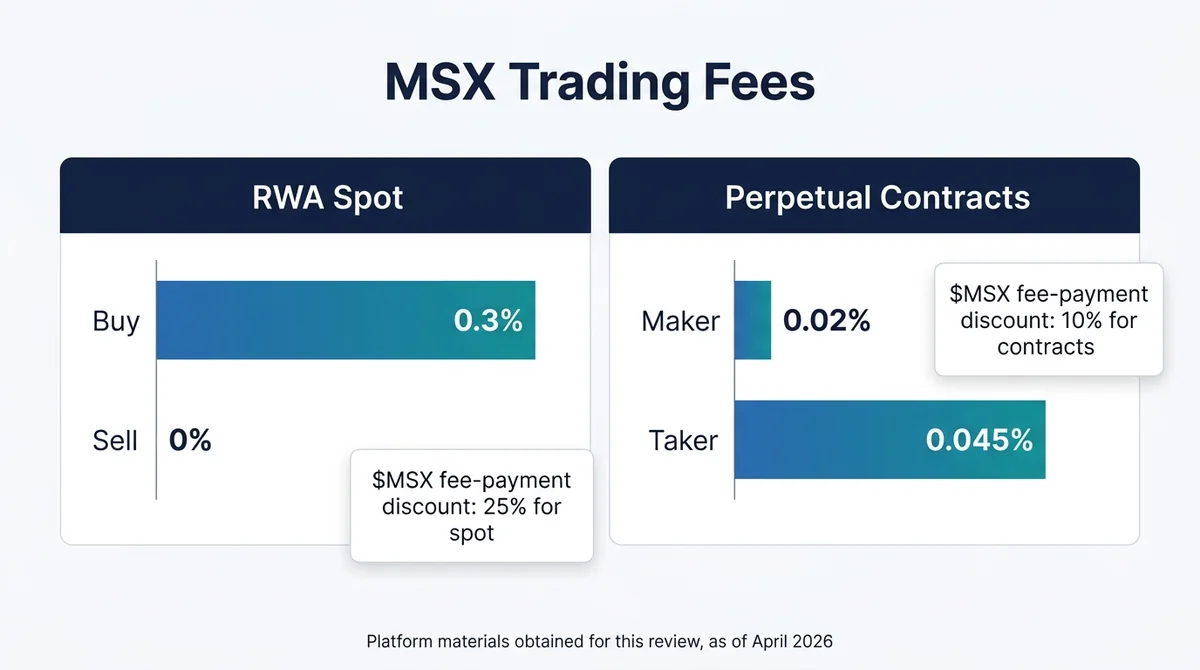
- According to the MSX platform materials obtained for this review, the RWA spot trading fee is 0.3% for buy orders and 0% for sell orders. Paying spot trading fees with $MSX provides a 25% discount.
- According to the MSX platform materials obtained for this review, contract maker and taker fees are 0.02% and 0.045%, respectively. Paying with $MSX provides a 10% discount.
- MSX provides market orders, limit orders, take-profit and stop-loss orders, and an order book, but the materials obtained do not disclose actual execution latency, slippage, order rejection rates, or stress-test results.
- Platform materials state that the reserve ratio is strictly above 100% and that 95% of digital assets are stored in Multi-Sig cold wallets. The input for this review did not include the corresponding proof of reserves, audit report version, or publication date, so these statements should be treated as platform disclosures that require verification against original materials.
#Which Factors Should an MSX Review 2026 Evaluate?
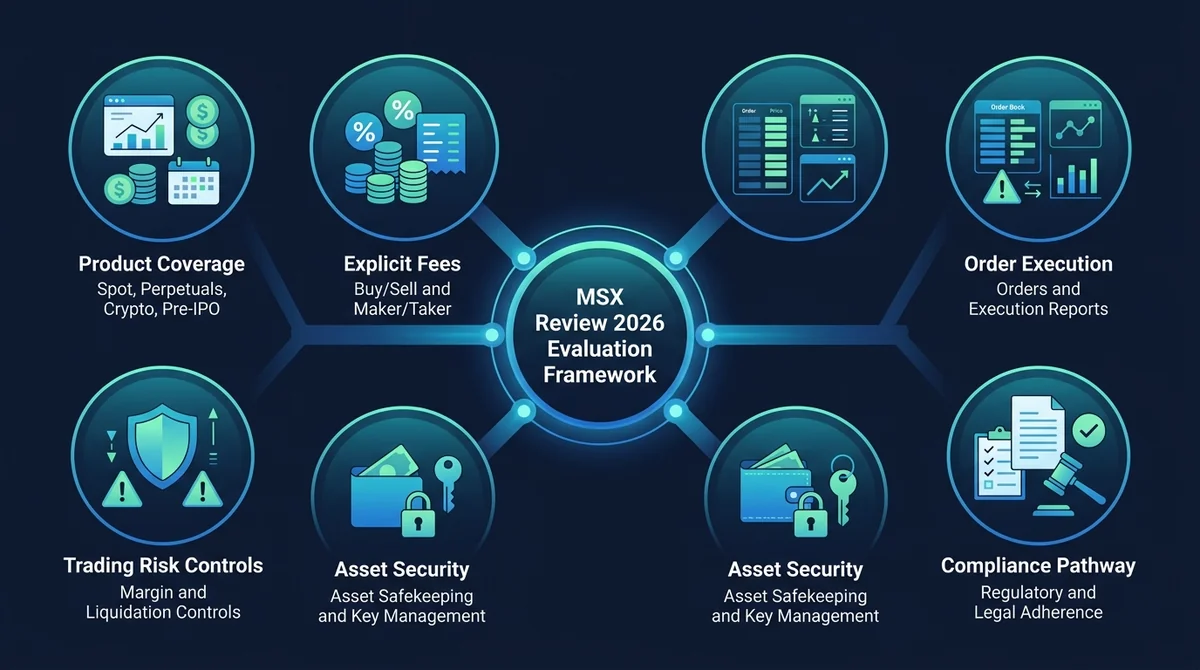
An MSX Review 2026 should assess six dimensions together: product coverage, actual fees, order execution, account-level risk controls, asset security, and the compliance pathway. It should not rank competitors without supporting data.
#What Does the MSX Review 2026 Cover?
Fees alone cannot determine whether a platform is suitable for specific trading needs. A complete review of MSX trading products must examine what can be traded, how costs arise, how orders are executed, how abnormal market conditions are handled, and who controls the assets. This article uses the following six-part framework:
- Product coverage: Distinguish among tokenized U.S. stock spot trading, perpetual contracts, cryptocurrency trading, and Pre-IPO products.
- Explicit fees: Verify buy-versus-sell fees, maker and taker fees, cross-chain bridge fees, and $MSX fee-payment rules.
- Order execution: Examine order types, the order book, market-data refresh methods, and actual execution reports.
- Trading risk controls: Examine margin monitoring, risk alerts, auto-deleveraging, and forced liquidation.
- Asset security: Verify reserves, hot and cold wallet segregation, private key custody, and audit information.
- Compliance pathway: Distinguish between disclosed qualifications, pathways still being explored, and unilateral platform claims.
#What Compliance and Security Information Has MSX Disclosed?
The provided materials state that MSX has completed a filing for security token offerings related to Regulation S under the U.S. Securities Act of 1933 and uses KYC (Know Your Customer), KYT (Know Your Transaction), and AML/CTF governance. The materials also mention frameworks such as MSB and CFTC/DCM, but the reported completion status differs across these statements.
For evaluation purposes, the information can be divided into three categories:
| Information category (as of April 2026) | Status in the provided materials | How it should be treated in the review |
|---|---|---|
| Regulation S-related STO filing | Materials state that it has been completed | Record it as a platform disclosure, while still verifying the filing documents, legal entity, and scope |
| KYC, KYT, and AML/CTF | Materials state that these have been integrated or adopted | Verify the actual account procedures and requirements in applicable regions |
| Derivatives pathways such as CFTC/DCM | Materials describe these as compliance pathways being explored | Do not state that all relevant qualifications have already been obtained |
| Smart contract audits and open-source code | Materials state that third-party audits were conducted and public materials are available | Verify the report version, audit scope, and publication date |
The input for this review did not provide the specific names, links, versions, or publication dates of filing documents, audit reports, or proof of reserves. This article therefore cannot replace verification of the original documents. To investigate custody, cold wallets, and reserve methodology further, readers can consult the site's review of MSX's non-custodial model, 95% Multi-Sig cold-wallet allocation, and reserve commitments.
#Which Platform Statements Require Further Verification?
On-chain PFOF (payment for order flow, meaning compensation paid by a trading venue for receiving order flow), connections to traditional financial liquidity, and an official proprietary-capital safety buffer should all be labeled as platform claims. The available materials do not provide sufficient independent verification data, so they cannot support conclusions such as “never depegs,” “execution is always better,” or “assets cannot be lost.”
Key areas requiring further verification include:
- How the PFOF mechanism specifically affects quotes, spreads, routing, and conflict-of-interest disclosures;
- Whether the initial depth provided by market makers can be sustained during periods of high volatility;
- The asset composition, controlling addresses, and audit scope of the official proprietary-capital safety buffer;
- Whether third-party audits cover all smart contracts, reserve accounts, and updated versions.
#What Trading Products Does MSX Offer, and When Are They Applicable?
As of April 2026, MSX covers tokenized U.S. stock spot and perpetual trading, cryptocurrency spot and contract trading, and Pre-IPO products. It also provides supporting features such as a cross-chain bridge, U Card, and platform token. This product range comes from the MSX platform materials obtained for this review. Actual product availability may be subject to account eligibility and regional restrictions.
As of April 2026, MSX supports tokenized U.S. stock spot trading, perpetual contracts, cryptocurrency trading, and Pre-IPO products. Tokenized U.S. stocks can be traded with stablecoins and use instant T+0 on-chain settlement. This information is based on platform disclosures, and users should still check the latest product rules before using the platform.
#What Trading Needs Do Tokenized U.S. Stock Spot and Perpetual Products Serve?
Tokenized U.S. stock spot trading may suit users who want to buy and sell tokenized U.S. equities with stablecoins and settle transactions instantly on-chain on a T+0 basis. Perpetual contracts—derivatives with no fixed expiration date whose positions are maintained through margin—can be used to trade both long and short directions, but they introduce the risks of insufficient margin, auto-deleveraging, and forced liquidation.
| MSX product (as of April 2026) | Disclosed features | Main evaluation priorities |
|---|---|---|
| Tokenized U.S. stock spot trading | Direct stablecoin trading; instant T+0 on-chain settlement | Buy-versus-sell fees, token structure, and on-chain settlement risks |
| Tokenized U.S. stock perpetual contracts | Extends trading from spot products to derivatives | Maker/taker fees, margin, mark price, and liquidation |
| Cryptocurrency spot trading | Crypto-to-crypto trading fee of 0% | Trading pairs, order-book depth, and execution results |
| Cryptocurrency contracts | Supports crypto-asset derivatives trading | Contract rules, execution methods, and account risks |
| Pre-IPO | Tokenization of primary-market interests; launched on March 2, 2026 | Liquidity, valuation, exit pathways, and product disclosures |
#What Use Cases Do Cryptocurrency Spot, Contract, and Pre-IPO Products Cover?
Cryptocurrency spot trading is used for direct asset exchange, contracts are used for margined derivatives trading, and Pre-IPO products extend the product range to tokenized primary-market interests. These products have different sources of risk. Their nature cannot be determined solely from the asset names displayed in the interface, and tokenized interests should not be treated as equivalent to holding assets in a traditional securities account.
When assessing product suitability, verify each of the following separately:
- Cryptocurrency spot trading: Trading pairs, deposit and withdrawal networks, order books, and asset custody methods;
- Cryptocurrency contracts: Margin assets, mark prices, liquidation rules, and fees;
- Pre-IPO: The relationship represented by the interests, liquidity arrangements, disclosures, and exit conditions;
- Tokenized U.S. stocks: Settlement methods, trading hours, and the boundaries of tokenholder rights.
#What Account Sizes Are Suitable for Fractional-Share Trading Starting at 10U?
According to the MSX platform materials obtained for this review, MSX supports fractional-share trading starting from 10U. The input materials use AAPL, TSLA, and NVDA as examples of high-priced blue-chip stocks. This threshold may be suitable for testing order placement, settlement, and fee displays with a small amount of capital. However, 10U is only the disclosed minimum participation amount as of April 2026. It does not indicate lower risk and does not constitute a recommendation of these example assets.
A small-value test can focus on recording:
- The estimated fee shown before placing an order;
- The difference between the execution prices of market and limit orders;
- The actual fee deducted and quantity received after execution;
- The network and cross-chain fees involved in transferring assets;
- Whether order cancellation, partial fills, and error messages are clearly presented.
#What Supporting Features Do the Cross-Chain Bridge, U Card, and $MSX Token Provide?
MSX's other products include an official cross-chain bridge, U Card, X Card, and the $MSX platform token. The cross-chain bridge is used to transfer assets between blockchains. According to the platform materials obtained, the disclosed fee was 0.1% as of April 2026. Features listed in the U Card materials include USDT top-ups and spending, online and offline payments, ATM withdrawals, fiat remittances, and instant internal transfers between accounts.
$MSX is the platform's governance and ecosystem incentive token, with a total supply of 1 billion tokens. Disclosed uses include fee payments, lockup benefits, VIP membership, and asset subscriptions. This article only records functions disclosed by the platform and makes no judgment about the token's value, returns, or future price. Relevant rules and availability may change.
#How Do MSX Trading Fees and Order Execution Work?
As of April 2026, according to the MSX platform materials obtained for this review, MSX charges 0.3% for RWA spot buy orders and 0% for sell orders. Contract maker and taker fees are 0.02% and 0.045%, respectively. Fee rates do not equal total trading costs: spreads, slippage, funding fees, and cross-chain costs must still be calculated separately.
As of April 2026, MSX's contract maker fee is 0.02% and its taker fee is 0.045%. Paying contract fees with $MSX provides a 10% discount. These fee rates are based on the provided platform materials, and the rules may change in the future.
#How Does MSX Charge for Spot Trading, Contracts, and the Cross-Chain Bridge?
Maker fees apply to orders that provide liquidity to the order book, while taker fees apply to orders that immediately match existing orders. A limit order is not necessarily a maker order: if it executes immediately after submission, it may still be treated as a taker order. Fees should therefore be verified against the final execution report.
| MSX fee item (as of April 2026) | Base rate | $MSX payment rule | Description |
|---|---|---|---|
| RWA spot buy fee | 0.3% | 25% discount | Calculated from the executed purchase amount |
| RWA spot sell fee | 0% | Not applicable | Input materials state that sell orders are fee-free |
| Crypto-to-crypto trading fee | 0% | No additional discount disclosed | Does not mean deposits, withdrawals, or cross-chain transfers are all free |
| Cross-chain bridge fee | 0.1% | Not disclosed | Only the provided cross-chain bridge rate |
| Contract maker fee | 0.02% | 10% discount | Calculated from the contract's executed notional value |
| Contract taker fee | 0.045% | 10% discount | Calculated from the contract's executed notional value |
The figures in the table come from platform materials obtained as of April 2026 and do not guarantee that future rates will remain unchanged. For a more detailed breakdown of each fee category, see the complete MSX Fees Review 2026.
#How Much Can Users Save by Paying Fees with $MSX?
When fees are paid with $MSX, RWA spot trading receives a 25% discount, while contract trading receives a 10% discount. The following is a fee-only illustration based on a one-way trading amount of 10,000U, excluding slippage, spreads, funding fees, and other costs:
| 10,000U one-way trade example | Base fee | Fee after paying with $MSX |
|---|---|---|
| RWA spot buy at a 0.3% rate | 30U | 22.5U (25% discount) |
| RWA spot sell at a 0% rate | 0U | 0U |
| Contract maker at a 0.02% rate | 2U | 1.8U (10% discount) |
| Contract taker at a 0.045% rate | 4.5U | 4.05U (10% discount) |
| Cross-chain bridge at a 0.1% rate | 10U | No discount rule disclosed |
Opening and closing a contract position may each incur a fee. The actual round-trip cost depends on whether each execution is classified as maker or taker. For calculations involving different combinations, see the analysis of MSX contract opening and closing paths and round-trip costs.
#What Market-Data Refresh, Order Types, and Matching Mechanisms Does MSX Provide?
MSX supports market orders, limit orders, take-profit and stop-loss orders, and an order book. The materials state that the platform integrates data sources such as Polygon.io, provides millisecond-level WebSocket order-book updates—a connection that maintains real-time, bidirectional communication between the server and client—and uses a high-performance contract engine to process highly concurrent requests.
These statements describe different capabilities:
- Order-book refresh speed: Describes how frequently market data reaches the interface;
- Matching-engine capability: Describes the infrastructure used to process order requests;
- Actual execution speed: Also depends on the network, order queue, liquidity, and market volatility;
- Execution quality: Must be assessed using slippage, rejection rates, partial-fill rates, and price deviation.
#Which Quantitative Metrics Are Still Missing From an MSX Order Execution Review?
The available materials do not disclose the distribution of actual execution latency, average slippage, order rejection rates, peak processing capacity, or stress-test results. Millisecond-level WebSocket order-book updates therefore cannot be described as millisecond-level execution and are insufficient to support a definitive ranking of execution performance.
MSX order execution cannot currently be ranked quantitatively. The materials obtained only describe millisecond-level WebSocket order-book updates and do not provide execution latency, average slippage, order rejection rates, or stress-test data. Market-data refresh speed is not the same as actual execution speed.
A more complete MSX order execution review would require at least:
- Median and tail latency from market-order submission to execution;
- Average and maximum slippage at different trade sizes;
- Order rejection rates during normal and highly volatile market conditions;
- Queue position, partial-fill rates, and cancellation success rates for limit orders;
- Deviations among source-market prices, mark prices, and final execution prices.
#How Should Investors Conduct an MSX Review and Evaluate Use Cases Step by Step?
When evaluating MSX, users should verify product characteristics, explicit fees, order execution information, account risk controls, asset security, and regional restrictions in sequence. Small-value hypothetical scenarios should be used to test whether the platform meets their needs rather than to predict asset returns.
#Step 1: Filter Products Based on Spot, Contract, and Pre-IPO Needs
First determine whether the objective is direct ownership, derivatives trading, crypto-asset exchange, or tokenization of primary-market interests. Similar product names do not imply identical rights, fees, or risks. In particular, tokenized U.S. stock spot products and perpetual contracts should not be confused with stocks held in a traditional securities account.
The filtering process can address four questions:
- Is instant T+0 on-chain settlement required?
- Can the user tolerate insufficient-margin and forced-liquidation risks?
- Does the user understand the uncertainty surrounding Pre-IPO liquidity and exits?
- Are cross-chain transfers, payment cards, or platform-token fee discounts required?
#Step 2: Calculate Explicit Fees by Order Direction and Type
For RWA spot trading, first distinguish between buy and sell orders. For contracts, distinguish between maker and taker executions. Asset transfers also require determining whether a cross-chain bridge will be used. If fees are paid with $MSX, apply the 25% spot discount and 10% contract discount separately rather than mixing the two rules.
Keep records of the following:
- Estimated and actual execution amounts;
- The rate displayed when the order was placed and the final fee deducted;
- Final maker or taker classification;
- Separate fees for opening, closing, and cross-chain transfers;
- The calculation basis used before and after the discount.
#Step 3: Examine Liquidity, Market Data, and Order Execution Information
Examine order-book depth, bid-ask spreads, order types, and execution reports. Do not treat market-data refresh speed as an execution guarantee. Market orders prioritize immediate matching, but the execution price may differ from expectations. Limit orders control the price boundary but may remain unfilled or receive only partial fills.
A small-value execution test can be performed as follows:
- Record the best bid and ask at the same point in time;
- Submit a small market order and a limit order that will not execute immediately;
- Record the times of the request, execution, and asset-balance update;
- Compare the expected price, actual execution price, and final fee;
- Repeat the test under different market conditions rather than treating one trade as a long-term conclusion.
Platform-interface procedures can be used together with the MSX Exchange App Guide to Spot and Perpetual Trading. The input body was interrupted at this link, and the Markdown closing syntax has now been completed. Because a more specific original slug was not provided, this article retains the input URL /insights rather than inventing a different link.
#Step 4: Verify Margin, Auto-Deleveraging, and Forced-Liquidation Rules
A contract review should not stop at the position-opening button or headline fee rates. Before placing an order, verify the margin asset, initial margin, maintenance margin, mark price, liquidation trigger, and auto-deleveraging conditions in the platform's latest contract rules. The available materials only state that MSX provides margin monitoring, risk alerts, auto-deleveraging, and forced-liquidation mechanisms. They do not provide specific leverage tiers or liquidation formulas, so this article does not add undisclosed parameters.
Risk verification should follow this sequence:
- Confirm whether isolated margin or another actually available margin mode will be used;
- Review the margin requirement and estimated liquidation information shown in the order interface;
- Include opening fees, closing fees, and any other potential contract costs in the budget;
- Set an affordable stop-loss boundary rather than treating the platform's liquidation price as a stop-loss;
- Retain records of risk alerts, deleveraging, or liquidation to review execution results.
#Step 5: Verify Reserves, Cold Wallets, and Audit Materials
Platform materials state that the reserve ratio is strictly above 100% and that 95% of digital assets are stored in Multi-Sig cold wallets. Because the input did not include a proof-of-reserves snapshot, wallet addresses, the name or version of a third-party audit report, or its publication date, these figures can only be recorded as platform disclosures as of April 2026. They cannot be presented as independently verified conclusions.
Verification should examine:
- Which assets and liabilities are included in the reserve-ratio methodology;
- The snapshot date and update frequency of the data;
- Whether cold-wallet addresses, signing permissions, and asset ownership can be verified;
- The auditor, audit scope, report version, and publication date;
- Whether the audit covers reserve accounts, smart contracts, and subsequent upgrades.
As of April 2026, platform materials state that the reserve ratio is above 100% and that 95% of digital assets are stored in Multi-Sig cold wallets. Because the input did not provide proof of reserves or an audit report version, these figures are official disclosures that require independent verification and should not be treated as a guarantee of principal.
#Step 6: Confirm Regional Regulations and Account Eligibility, Then Record the Conclusion
A product being displayed in the interface does not mean that users in every region can legally or compliantly access it. Before evaluating the platform, confirm the registration entity, place of residence, KYC status, product category, and local rules. The available materials do not provide a country-by-country or region-by-region access list, so this article cannot determine whether users in a particular location can access tokenized U.S. stocks, perpetual contracts, or Pre-IPO products.
Institutional users should additionally examine corporate accounts, authorization management, APIs, subaccounts, settlement reports, custody arrangements, and service agreements. The available input does not disclose these institutional trading features or provide institution-level execution latency, capacity, or service-level data. It therefore cannot confirm that MSX meets any specific institutional trading requirements.
After completing the review, users can create an evaluation record that does not include return forecasts:
- Record the date and version of the materials reviewed;
- List products that meet and do not meet the stated requirements;
- Save screenshots of fee rates, execution reports, and risk warnings;
- Distinguish among platform disclosures, personal test results, and third-party verification results;
- Recheck the information after rules change rather than relying on outdated conclusions.
#How Should an EMA Perpetual Contract Strategy Fit Into the Review Process?
An EMA (exponential moving average) can only serve as a market-observation tool selected by the trader. It cannot prove that a trend will continue. The available materials only confirm that MSX supports market orders, limit orders, and take-profit and stop-loss orders. They do not state that the platform provides a specific EMA strategy, signal service, or automated execution feature, so an EMA trading method should not be presented as an official MSX strategy.
If a trader independently uses an EMA to define trading conditions, the signal can first be calculated using an external chart or a chart actually available on the platform. A limit order can then be used to constrain the price, together with an affordable stop-loss boundary. When trading perpetual contracts, the trader should also record whether the opening and closing executions are classified as maker or taker and assess the risks of insufficient margin, auto-deleveraging, and forced liquidation. Any EMA crossover or pullback signal may fail.
#MSX Review 2026 FAQs
#What Are MSX's Core Products and Minimum Participation Amount?
MSX covers tokenized U.S. stock spot trading, perpetual contracts, cryptocurrency trading, and Pre-IPO products. According to platform materials obtained as of April 2026, fractional-share trading starts from 10U, while tokenized U.S. stock spot products use instant T+0 on-chain settlement. The minimum amount does not indicate lower risk, and product availability may also be subject to regional restrictions.
#What Are MSX's Spot and Contract Trading Fees?
As of April 2026, according to the MSX platform materials obtained for this review, the RWA spot fee is 0.3% for buy orders and 0% for sell orders, with a 25% discount when paying with $MSX. Contract maker and taker fees are 0.02% and 0.045%, respectively, with a 10% discount when paying with $MSX. Rules may change, so users should verify the latest rates before trading.
#Does Millisecond-Level WebSocket Market Data Mean Millisecond-Level Execution?
No. Millisecond-level WebSocket data only describes how the order book is refreshed. Actual execution is affected by the network, order queue, liquidity, and volatility. The available materials do not disclose actual execution latency, slippage, or order rejection rates, so they cannot establish that MSX delivers millisecond-level execution.
#Can Contract Trading Result in Liquidation and a Total Loss, and How Can Risk Be Controlled?
Contract positions may be forcibly liquidated because of insufficient margin, potentially causing substantial losses or the loss of the entire principal. MSX platform materials mention margin monitoring, risk alerts, auto-deleveraging, and forced liquidation, but these mechanisms cannot eliminate market risk. Traders should not use the liquidation price as a stop-loss or trade with money they cannot afford to lose.
#How Can a Trade Be Executed on MSX After a Cup-and-Handle Breakout?
A cup-and-handle breakout is not guaranteed to succeed. MSX supports market orders, limit orders, and take-profit and stop-loss orders. Traders can use limit orders to constrain the execution price and independently set an affordable stop-loss boundary. If contracts are used, they must also calculate maker/taker fees for opening and closing the position and account for liquidation risk. This chart pattern is not a return signal provided by the platform.
#How Can an MSX Limit Order Be Set Using the 0.618 Retracement Level?
A self-calculated 0.618 retracement price can be used as a limit-order condition, but the level is not guaranteed support. After submitting the order, check whether it enters the order book and whether partial fills occur, and set an affordable stop-loss boundary. MSX's support for limit orders does not mean that this technical level will necessarily hold.
#Is MSX Suitable for Institutional Traders?
The available materials are insufficient to confirm that MSX is suitable for specific institutional trading requirements. The input does not disclose corporate accounts, subaccounts, API permissions, institutional custody, settlement reports, or service-level agreements. It also provides no institution-level execution latency or capacity data. Institutional users should first verify these features, the contracting entity, regional eligibility, and audit materials.
#How Should Institutions Test MSX's Order Execution Quality?
Institutions should evaluate execution using actual trade data rather than relying solely on millisecond-level order-book updates. They can record submission-to-execution latency, average slippage, maximum slippage, rejection rates, partial-fill rates, and cancellation success rates across different order sizes, while distinguishing between normal and highly volatile market conditions. The available platform materials do not provide these quantitative results.
#Can Traders Use an EMA Perpetual Contract Strategy Directly on MSX?
Traders can independently use EMA signals as order conditions, but the available materials do not state that MSX provides an official EMA strategy or automated signals. Traders should calculate EMA conditions independently and then choose market orders, limit orders, or take-profit and stop-loss orders for execution. They must also calculate maker/taker fees and accept the risks of signal failure and forced liquidation.
#What Should Traders Check When Using EMA Signals for MSX Perpetual Contracts?
Traders should check the signal calculation period, order type, execution price, margin status, and stop-loss boundary. An EMA crossover only reflects a calculation based on historical prices and cannot guarantee future direction. If a limit order executes immediately, it may also be charged as a taker order. The available materials do not provide specific leverage tiers, so this article does not add undisclosed leverage parameters.
#Can MSX Be Used in Every Country or Region?
No universal conclusion can be drawn from the available materials. Product availability may depend on the user's place of residence, registration entity, KYC status, and product category. The input does not provide a region-by-region list of access rules or restrictions. Users should check local rules, the platform's latest terms, and their actual account permissions before opening an account or trading.
#Does a Regulation S-Related Filing Mean MSX Is Licensed in Every Region?
No. The input materials state that MSX completed a security token offering filing related to Regulation S, but this does not establish that the platform has obtained licenses for every country, region, or product category. References to CFTC/DCM in the materials concern a compliance pathway being explored and should not be presented as confirmation that all qualifications have been obtained.
#Have MSX's Reserve Ratio and 95% Cold-Wallet Allocation Been Independently Verified?
The available input cannot confirm that independent verification has been completed. Platform materials state that the reserve ratio is above 100% and that 95% of digital assets are stored in Multi-Sig cold wallets, but they do not provide proof of reserves, wallet addresses, an audit report name, a report version, or a publication date. These figures should be labeled as platform disclosures rather than guarantees of principal security.
#How Can a Beginner Review a Specific MSX Contract Order?
First confirm the nature of the contract and understand the margin risks. Then review the order book and choose a market or limit order. Before submission, record the notional trade amount and estimated fee. After execution, verify the maker/taker classification, actual fee deducted, and execution price, and finally set an affordable stop-loss boundary. Contracts may be forcibly liquidated, so beginners should not interpret a low minimum amount as low risk.
The focus of an MSX Review 2026 should not be to judge the platform using one fee rate or promotional claim. Instead, it should separately examine product characteristics, explicit costs, execution quality, margin risk, reserve disclosures, and regional eligibility. Based on materials obtained as of April 2026, MSX has disclosed multiple product categories and specific fee rates, but information on order execution, audit versions, proof of reserves, and region-by-region access remains incomplete. Users should review the latest official materials and independently assess the risks before using the platform.
FAQ
What are MSX's core products and minimum participation amount?
MSX covers tokenized U.S. stock spot trading, perpetual contracts, cryptocurrency trading, and Pre-IPO products. Fractional-share trading starts from 10U, and tokenized U.S. stock spot products use instant T+0 on-chain settlement. The minimum amount does not indicate lower risk.
What are MSX's spot and contract trading fees?
As of April 2026, RWA spot buy orders are charged 0.3% and sell orders 0%, with a 25% discount when paying with $MSX. Contract maker and taker fees are 0.02% and 0.045%, with a 10% discount when paying with $MSX.
Does millisecond-level WebSocket market data mean millisecond-level execution?
No. Millisecond-level WebSocket data only describes how the order book is refreshed. Actual execution is affected by the network, order queue, liquidity, and volatility. The available materials do not disclose actual execution latency, slippage, or order rejection rates.
Can contract trading result in liquidation and a total loss, and how can risk be controlled?
Contract positions may be forcibly liquidated because of insufficient margin, potentially causing substantial losses or the loss of the entire principal. MSX provides margin monitoring, risk alerts, auto-deleveraging, and forced liquidation, but these mechanisms cannot eliminate market risk.
How can a trade be executed on MSX after a cup-and-handle breakout?
MSX supports market orders, limit orders, and take-profit and stop-loss orders, but a cup-and-handle breakout is not guaranteed to succeed. Traders can use limit orders to constrain the execution price and set a stop-loss. If contracts are used, maker/taker fees and liquidation risk must also be considered.
How can an MSX limit order be set using the 0.618 retracement level?
A self-calculated 0.618 retracement price can be used as a limit-order condition, but the level is not guaranteed support. After submission, check whether the order enters the order book and receives partial fills, and set an affordable stop-loss boundary.
Related Terms
Ready to try? Test the strategy on MSX with small positions. Educational content only — not investment advice.