Multi-Sig Wallet Security Strategy 2026: How Multi-Signature Works, Cold/Hot Wallet Isolation & Crypto Asset Risk Control
How multi-signature wallets work, M-of-N model selection, cold/hot wallet isolation, and crypto asset risk control frameworks for individuals, teams, and platforms.
#Multi-Sig Wallet Security Strategy 2026: How Multi-Signature Works, Cold/Hot Wallet Isolation & Crypto Asset Risk Control
Disclaimer: The multi-sig wallet strategies described in this article are for technical methodology reference only and do not constitute investment advice. Crypto asset prices are highly volatile, and technical operations carry irreversible risks that may result in total loss of principal. Please do your own research and make independent decisions (DYOR).
#Key Takeaways / TL;DR
- A multi-sig wallet requires M out of N private keys to jointly authorize a transaction, eliminating single points of failure entirely
- Common M-of-N configurations: 2-of-3 for personal backup, 3-of-5 for team co-management — different scenarios call for different setups
- Core cold/hot wallet isolation principle: hot wallets hold only amounts you can afford to lose; cold wallet signing devices never connect to the internet
- Platform-level practice: store 95% of digital assets in multi-sig cold wallets, keeping only the minimum liquidity needed in hot wallets to defend against hacks
- Most common mistakes: storing all backup keys in one location, setting M too low, and operating signing devices while online — these three errors alone can render a multi-sig system completely ineffective
#What Is a Multi-Sig Wallet Security Strategy?
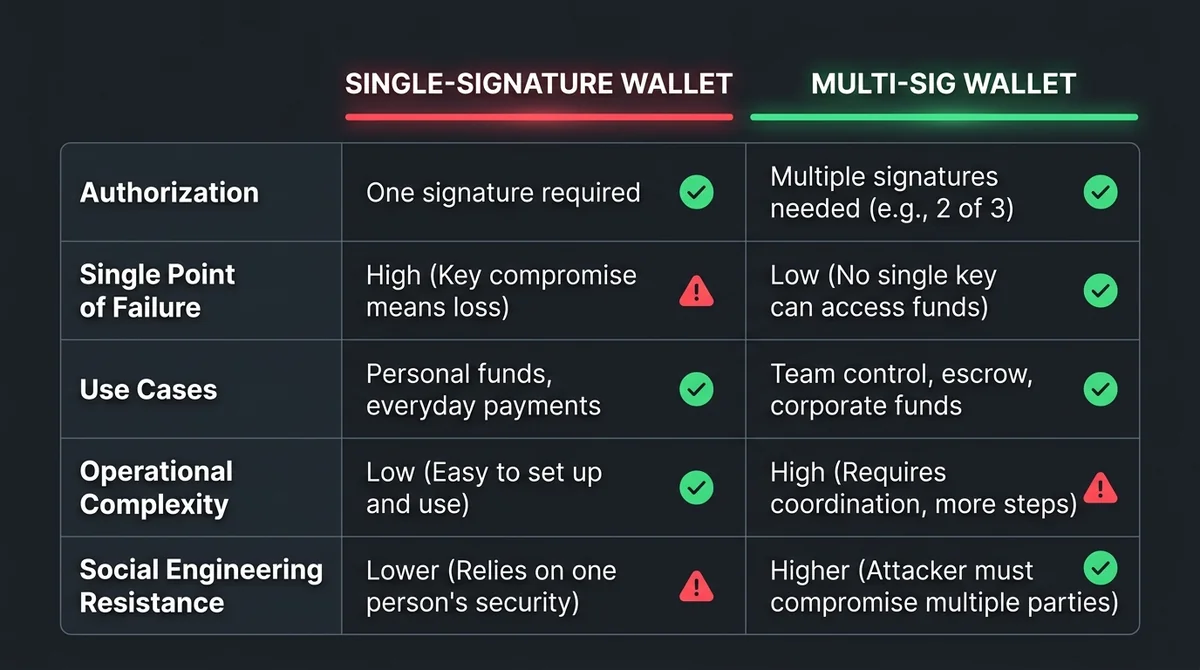
A multi-sig wallet is a security mechanism that requires multiple private keys (the unique credentials that control crypto assets — compromising them means losing ownership) to jointly authorize a transaction. Compared to single-signature wallets, multi-sig effectively eliminates single-point-of-failure risk and is the industry-standard protection for high-value crypto holdings.
#What Is the Multi-Signature (Multi-Sig) Mechanism?
The core logic of multi-signature is distributed authorization: a transaction is no longer controlled by a single private key but requires a predetermined number of private keys to sign before it can execute. This mirrors the real-world concept of a safe that needs two keys to open.
Technically, multi-sig wallets are implemented through smart contracts or native protocols (such as Bitcoin's P2SH). The signature threshold is hard-coded on-chain, and no single party can bypass it. Once deployed, the rules are immutable.
#What Is the Fundamental Difference Between Multi-Sig and Single-Signature Wallets?
| Dimension | Single-Signature Wallet | Multi-Sig Wallet |
|---|---|---|
| Authorization | Single private key controls all assets | Requires M-of-N private keys to sign jointly |
| Single point of failure | Lost or leaked key means total loss | A single lost key does not compromise funds |
| Use cases | Small daily transactions | Large holdings, team co-management, DAO treasuries |
| Operational complexity | Low | Higher — requires coordinating multiple signers |
| Resistance to social engineering | Weak | Stronger (attacker must compromise multiple signers simultaneously) |
The core flaw of a single-signature wallet is total loss from a single point of failure: once a private key is leaked or lost, assets face immediate total loss with no recourse. Multi-sig distributes this risk across multiple key holders — a compromised individual node does not endanger the overall asset.
#How Does the M-of-N Model Balance Security and Convenience?
In the M-of-N model, N is the total number of keys and M is the minimum number of signatures required to execute a transaction. Higher M means stronger security but lower operational efficiency; lower M means greater convenience but a reduced security threshold.
Common configurations and their use cases:
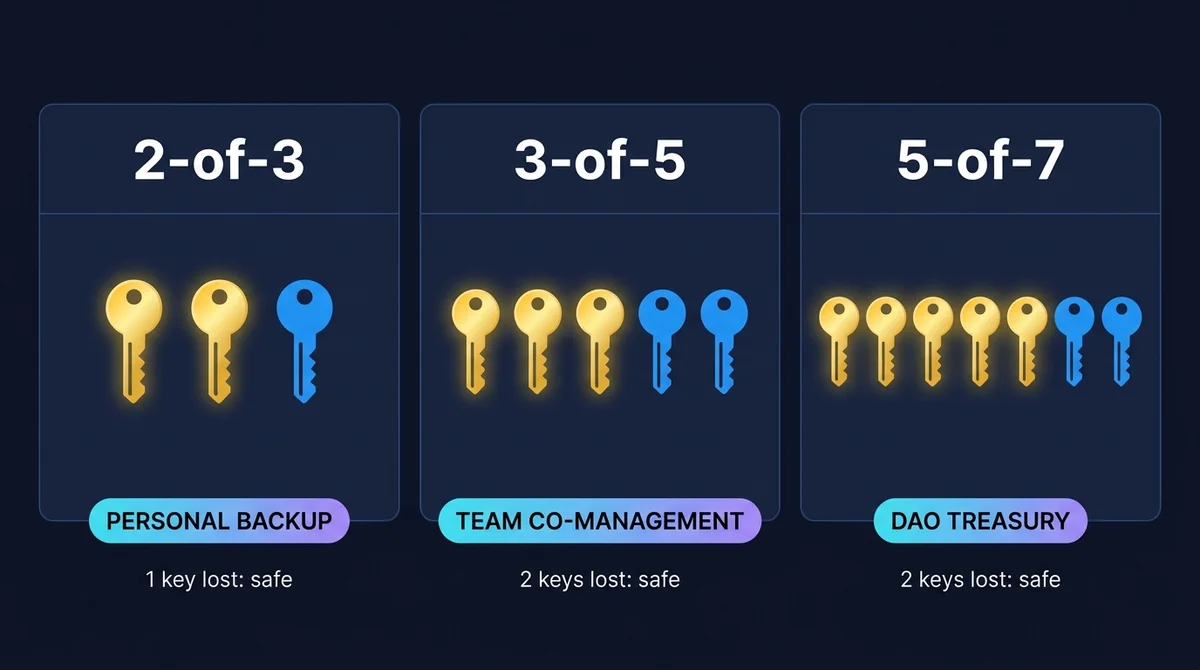
- 2-of-3: Suitable for high-value personal holdings. Hold 3 private keys; any 2 can initiate a transaction. Even if 1 is lost, assets remain recoverable; even if 1 is stolen, the attacker cannot complete a transfer alone.
- 3-of-5: Suitable for team co-management or DAO treasuries. Five core members each hold 1 key; at least 3 must reach consensus to move funds, preventing unilateral control by a minority.
- 1-of-N: Security equivalent to single-sig — effectively no multi-sig protection in practice. Not recommended for large holdings.
Selection principle: M must be greater than N/2, and you must account for the extreme scenario where enough signers become simultaneously unavailable — in a 3-of-5 setup, if 3 members are unreachable at the same time, funds will be permanently locked.
#When Does Multi-Sig Cold/Hot Wallet Isolation Work Best?
When holdings exceed your acceptable loss threshold, or when funds are co-managed by multiple parties, a multi-sig cold/hot wallet isolation strategy maximizes protection against hacks and internal operational risk. It is especially suited for long-term holdings where 95% of assets are kept in offline multi-sig cold storage.
#Which Holding Scenarios Are Best Suited for Multi-Sig Cold Storage?
Not every holding requires multi-sig cold storage. The key criterion is: would losing this amount cause unacceptable harm to you? Three scenarios are typically the right fit:
- High-value personal holdings: When a single holding exceeds your personal acceptable loss threshold (usually benchmarked as "loss would not affect quality of life"), multi-sig cold storage should be enabled
- Team co-managed funds: Project funds jointly held by multiple parties or partnership assets must use multi-sig to prevent any single member from unilaterally moving funds
- DAO treasuries: Public funds of decentralized autonomous organizations require equal weight on transparency and security — multi-sig is the standard configuration
Conversely, small liquid funds used for daily trading are not suitable for multi-sig cold storage, as the operational friction severely impacts efficiency.
#What Is the Core Logic of Cold/Hot Wallet Tiered Management?
The essence of cold/hot wallet tiering is physically separating the convenience of high-frequency access from the security of large asset storage — neither compromising the other.
Tiering principles:
- Hot wallet (software wallet with persistent internet connection): Hold only the amount you might need in the next 1–2 weeks — the maximum you could afford to lose entirely
- Cold wallet (offline hardware or paper wallet): Store large long-term holdings; signing devices never connect to the internet
- Fund transfer rules: Replenishing liquidity from cold wallet to hot wallet must go through the multi-sig authorization process; bypassing approval to transfer directly is prohibited
This logic ensures that even if hackers compromise the hot wallet environment, they cannot reach the primary assets in cold storage.
#How Do Platforms Achieve 95% Asset Isolation with Multi-Sig Cold Storage?
Platform-level cold/hot isolation is more systematic. Using MSX's security architecture as a reference: 95% of digital assets are stored in multi-sig cold wallets, with hot wallets retaining only the minimum liquidity needed to meet daily withdrawal demands. This ratio is an industry benchmark validated through practice — the smaller the hot wallet exposure, the lower the maximum loss ceiling from any single security incident.
MSX also commits to maintaining on-chain reserves strictly greater than 100% for all listed assets (Proof of Reserves — a publicly verifiable on-chain self-attestation of reserves), forming a dual layer of asset protection alongside multi-sig cold storage.
Key design elements for platform-level cold storage:
- Dynamic monitoring of hot wallet balances, with automatic replenishment triggers from cold storage when thresholds are breached
- Cold storage withdrawals require multi-sig approval with a time lock delay
- Regular Proof of Reserves public verification to prove to users that reserves are real
For more on how to evaluate crypto platform security credentials, see Crypto Exchange Comparison Methodology 2026: How to Select the Best Platform Across Fees, Liquidity, and Compliance.
#When Can Multi-Sig Strategy Fail or Introduce New Risks?
Multi-sig is not foolproof: if poor backup management leads to all keys being lost, assets become permanently unrecoverable; when the number of available signers falls short or signers are picked off one by one through social engineering, multi-sig protection fails entirely. Understanding these limits is a prerequisite for using multi-sig correctly.
#What Catastrophic Consequences Can Result from Poor Key Management?
The security of multi-sig rests on the premise of distributed key custody. Once that premise breaks down, the consequences are often worse than with a single-signature wallet:
- All backup keys lost: In a 2-of-3 setup, if all 3 private keys are lost, assets are permanently locked with no recovery method
- All backup keys stolen: If all 3 backups are stored in the same location or the same cloud storage, theft is equivalent to a single-sig compromise — multi-sig loses all meaning
- Seed phrase management chaos: If multiple devices recover the same private key, the effective number of independent keys is actually reduced
#How Does Multi-Sig Process Complexity Affect Emergency Operations?
If multiple signers in an M-of-N setup become unavailable simultaneously, fund transfers will be completely blocked. Typical risk scenarios:
- In a 3-of-5 team multi-sig, 3 core members simultaneously encounter an emergency (illness, unreachable, device failure)
- Urgent market conditions require moving funds quickly, but gathering signers takes hours
- Signing device firmware needs updating, temporarily making the device unavailable
The right response is to design recovery plans during the setup phase, not scramble for solutions when emergencies arise.
#How Can Social Engineering Attacks Bypass Multi-Sig?
The core threat that multi-sig cannot defend against is signers themselves being deceived or coerced. Typical attack paths:
- Signer-by-signer deception: The attacker impersonates a trusted identity and contacts each signer separately, obtaining authorization one at a time
- Phishing spoofed interfaces: Forged signing requests trick signers into authorizing malicious transactions without realizing it
- Smart contract vulnerabilities: Multi-sig wallets implemented via smart contracts (such as Gnosis Safe) may have code vulnerabilities that allow attackers to bypass signature verification
Defending against social engineering depends on strict signing operation procedures, not the technical mechanism itself — independently verify transaction details before every signature, and refuse any pressure to rush the process.
#What Is the Step-by-Step Framework for Building a Multi-Sig Cold/Hot Wallet Security System?
The four core steps to building a multi-sig cold/hot wallet system are: assess risk tolerance → select the M-of-N model → configure hardware wallets as offline signing devices → establish cold/hot fund transfer and on-chain audit processes. All four steps are essential.
#Step 1: Assess Your Holdings and Risk Tolerance
Before choosing any technical solution, answer this question: "If these assets were completely lost, how significantly would it affect my life and finances?"
Tiered recommendations:
- Small liquid funds (daily trading, immediate use): A hot wallet is sufficient — no multi-sig needed
- Mid-size holdings (loss would be noticeable but not catastrophic): 2-of-2 or 2-of-3 setup
- Large or core assets (loss would cause significant financial impact): Multi-sig cold storage is mandatory; M≥2 with at least 1 key stored on an offline hardware device
#Step 2: Choose the Right Multi-Sig Configuration (M-of-N)
| Configuration | Use Case | Security | Operational Ease |
|---|---|---|---|
| 2-of-2 | Individual + backup device | Medium | Low (both parties required) |
| 2-of-3 | High-value personal holdings | High | Medium (tolerates 1 lost key) |
| 3-of-5 | Team co-management, DAO treasury | Very high | Medium (tolerates 2 lost keys) |
| 2-of-4 | Mid-size teams | High | Higher (tolerates 2 lost keys) |
Key selection principle: M must be greater than N/2, ensuring an attacker cannot complete authorization with only a minority of keys.
#Step 3: Configure Hardware Wallets as Multi-Sig Signing Devices
Hardware wallets (such as Ledger, Trezor, and similar offline signing devices) are the physical substrate of multi-sig cold storage. Configuration essentials:
- Each private key corresponds to a separate hardware wallet — do not generate multiple keys on the same device
- Hardware wallet initialization must be fully offline: the device must not be connected to the internet when generating the seed phrase, and no cameras should be nearby
- Back up seed phrases on metal plates (paper backups are vulnerable to fire and water damage) and store them in physically secure locations
- Test after deploying the multi-sig contract: use a small amount to verify the entire signing workflow and confirm every key can sign normally
- Signing operation procedure: verify the recipient address and amount on the hardware wallet screen before every signing event — do not rely solely on what the computer screen displays
For more detail on seed phrase secure backup, see What Is a Seed Phrase? Crypto Wallet Private Key Backup and Security Strategy 2026.
#Step 4: Establish Cold/Hot Fund Transfer and Audit Processes
Once the multi-sig system is in place, day-to-day operations require supporting process management — otherwise, security mechanisms gradually erode under the pressure of "convenient shortcuts":
- Set hot wallet balance caps: funds exceeding the cap automatically trigger a prompt to transfer to cold storage; accumulating large balances in the hot wallet is not permitted
- Cold wallet withdrawal approval process: record the requester, reason, and recipient address for every withdrawal; confirm twice before multi-sig authorization
- Set per-transaction limits and time locks: transfers above a threshold automatically trigger a 24–48 hour time lock, leaving a window to catch anomalous transactions
- Regular on-chain reconciliation: monthly verification of cold and hot wallet on-chain balances against internal records to catch anomalies promptly
- Regular recovery drills: every quarter, run a complete drill of the "key lost → restore from backup → reconfigure" workflow using test funds
#What Are Real-World Examples of Multi-Sig Cold/Hot Isolation?
From personal 2-of-3 cold storage to DAO 3-of-5 co-managed treasuries and exchange platforms keeping 95% of assets in multi-sig cold wallets, multi-sig cold/hot isolation has proven its effectiveness across crypto asset management scenarios at every scale.
#High-Value Personal Holdings: 2-of-3 Configuration for Asset Protection
Scenario: An individual holds a significant amount of crypto assets and wants to balance security with operability.
2-of-3 configuration:
- Key A: Everyday hardware wallet, stored in a home safe
- Key B: Backup hardware wallet, stored at a separate physical location (e.g., a workplace safe)
- Key C: Seed phrase backed up on a metal plate, stored in a bank safe deposit box or at a law firm
Fault tolerance: Losing or having any single key stolen does not affect asset security. An attacker must obtain at least 2 keys simultaneously to move assets, and since all 3 keys are in different locations, the probability of simultaneous theft is extremely low.
#DAO Treasury: 3-of-5 Multi-Sig for Co-Management and Transparency
Scenario: A decentralized autonomous organization (DAO — an on-chain organization governed through smart contracts) needs to manage public funds while preventing any single member from absconding or being compromised.
3-of-5 configuration:
- 5 core contributors each hold 1 private key, distributed across different time zones
- Any fund transfer requires at least 3 members to sign jointly
- All signing records are visible on-chain and can be verified by community members at any time
- Signing rights rotate periodically; departing members' keys are revoked through redeployment of the multi-sig contract
Transparency mechanism: DAOs typically combine Proof of Reserves with regular treasury balance disclosures, paired with multi-sig signing records to achieve complete fund transparency.
#Exchange Platform: 95% Cold Storage + Multi-Sig Architecture
Scenario: An exchange needs to simultaneously protect user assets and maintain withdrawal liquidity.
Platform-level architecture (referencing MSX's security framework):
- Cold storage layer: 95% of user digital assets held in multi-sig cold wallets, signing devices physically isolated, with periodic audits
- Hot wallet layer: Retains only the minimum liquidity needed for same-day (T+0) withdrawals; balance dynamically monitored
- Replenishment process: When hot wallet balance falls below threshold, a multi-sig approval is triggered to replenish from cold storage, requiring authorization from multiple operators
- On-chain verification: Regular Proof of Reserves (on-chain reserve self-attestation with reserves >100%) published to users to publicly verify asset security
This architecture ensures that even if the hot wallet is completely compromised, worst-case losses are capped at the hot wallet exposure, leaving the 95% of assets in cold storage intact.
#What Are the Key Risk Control Points for a Crypto Multi-Sig System?
Risk control for a crypto multi-sig system must cover four layers: geographically distributed key backups, real-time on-chain risk monitoring, automated position reduction and forced liquidation mechanisms, and pre-drilled emergency asset transfer plans. Missing any single layer leaves a security blind spot.
#How to Prevent Asset Lockout from Lost Key Backups?
The core principle of key backup strategy is: geographic distribution + media diversification + sufficient quantity.
Recommended backup configuration:
- At least 3 independent backups, stored in at least 3 different physical locations
- Media diversification: hardware wallet (electronic) + metal plate (physical) + encrypted digital storage (offsite)
- No 2 backups in the same location — earthquakes, fires, and theft often affect the same area
- Never store plaintext private keys or seed phrases in cloud storage: even encrypted cloud storage carries the risk of account compromise
- Regularly verify backup validity: every six months, confirm that the backed-up seed phrase can successfully restore the wallet
#How Do On-Chain Risk Controls and Multi-Layer Alerts Work Alongside Multi-Sig?
Technical risk control systems serve as real-time monitoring complements to the multi-sig mechanism. An effective on-chain risk control system typically includes:
- On-chain price oracles (modules that feed external price data to smart contracts): real-time asset price monitoring with anomalous volatility alerts
- Anomalous transaction monitoring: identifies unusual transfer patterns (e.g., large late-night withdrawals or transfers to new addresses)
- Multi-layer alert system: small anomalies trigger notifications; large anomalies trigger freezes requiring additional verification
- Automated position reduction and forced liquidation: protects assets from being liquidated to negative values under extreme market conditions
MSX's multi-layer risk control system covers margin monitoring, risk alerts, automated position reduction, and forced liquidation, combined with on-chain price oracles and multi-market data aggregation to calculate mark prices. This system-level risk control, working alongside multi-sig, provides full-stack protection from key security to trading risk.
#How to Activate an Emergency Plan After a Security Incident?
Emergency plans must be designed and drilled before an incident occurs — improvised responses under pressure tend to go wrong. Standard emergency plan elements:
- Pre-designated emergency transfer address: generate one new address in advance reserved exclusively for emergencies, known to all signers
- Time lock protection: normal transfers have a 24–48 hour delay, providing enough time to halt anomalous transactions upon detection
- Rapid communication channel: all signers have an encrypted communication channel, enabling contact within 1 hour in emergencies
- Complete recovery drill: at least once a year, run a full drill of the "key compromised → emergency transfer → new multi-sig deployment" workflow
- Preserve on-chain evidence: after a security incident, retain all transaction records to facilitate subsequent tracing and insurance claims
For guidance on verifying crypto platform security credentials, see Is MSX Exchange Fee Structure Worth It? 2026 Full Review: Fees, Compliance, and User Reputation.
#What Are the Most Common Mistakes When Using Multi-Sig Wallets?
The most common multi-sig failures cluster around three areas: storing all backups in one location, setting M too low so multi-sig offers no real protection, and operating signing devices while online. These three mistakes can render a carefully designed multi-sig system completely ineffective.
#Typical Backup Management Mistakes
The following mistakes appear frequently in practice, and each can cause irreversible asset loss:
- Storing all key backups in the same location: whether it's the same safe or the same cloud folder, centralized storage completely negates the purpose of distribution
- No physical backup — relying solely on digital storage: hardware failure, account compromise, or service shutdown can all cause backups to disappear permanently
- Never verifying backup usability: many people only discover when recovery is needed that they copied down a seed phrase with one wrong word
- Passing backups to family or heirs in plaintext: the transmission process itself is a leakage risk
#Common Pitfalls During Multi-Sig Configuration
- Setting M too low: a 1-of-3 configuration is technically multi-sig, but any single stolen key completes the transaction — effectively single-sig
- All keys generated by the same person: even with multi-sig, if generation happens on the same internet-connected computer, OS-level malware can capture all private keys simultaneously
- Skipping small-amount testing before depositing large sums: deploying the multi-sig without verifying every key can participate in signing, then depositing large assets directly
- Failing to record the multi-sig contract address and configuration parameters: unable to reproduce the original setup when changing devices or redeploying
#Daily Habits That Undermine Multi-Sig Protection
- Operating signing devices in an online environment: when a hardware wallet is connected to a computer infected with malware, the signing process can be hijacked
- Reusing hot wallet addresses as one of the signers: the hot wallet's private key is persistently online — once the hot wallet is compromised, one signing right is lost
- Ignoring transaction detail verification on signing requests: habitually tapping "confirm" without checking the recipient address on the hardware wallet screen
- Never drilling the recovery process: actual emergencies see very high operational error rates; drills are the only way to reduce human error
For a deeper look at how platforms protect large-value user assets, see Crypto Beginner's Guide 2026: MSX vs Binance vs OKX — Security, Fees, and Liquidity Compared.
#Multi-Sig Wallet Security Strategy FAQ
This FAQ covers the most common questions crypto investors encounter when implementing multi-sig cold/hot wallet strategies, including configuration selection, hardware setup, emergency recovery, and platform security verification.
Q1: How should institutional investors verify a platform's cold storage security when making large crypto trades?
There are three core verification dimensions. First, does the platform publicly disclose Proof of Reserves with reserves consistently greater than 100%? Second, does it explicitly disclose the cold/hot wallet ratio — the industry standard is 90–95%+ in cold storage? Third, are third-party security audit reports publicly available? MSX, for example, commits to 95% of digital assets in multi-sig cold wallets, on-chain reserves strictly greater than 100%, and provides third-party security audit reports.
Q2: Should individual users choose a 2-of-3 or 3-of-5 multi-sig configuration?
Individual users typically choose 2-of-3: 3 keys can be stored on a primary device, a backup device, and a secure offline location respectively — losing any 1 key does not prevent asset recovery, and the workflow is relatively straightforward. 3-of-5 is better suited for team co-management; for personal use it adds unnecessary operational complexity and key management overhead. The core principle is M no lower than 2, with N−M≥1 (tolerating the loss of at least 1 key while still enabling recovery).
Q3: After buying crypto with fiat, how do I safely transfer assets from an exchange to a personal multi-sig cold wallet?
After purchasing crypto with fiat, handle the transfer in three steps. First, do a small test withdrawal from the exchange to confirm the multi-sig cold wallet address is correct and functional. Second, transfer in batches rather than moving everything at once, capping the loss from any single operational error. Third, verify the on-chain balance after each transfer arrives to confirm the receiving address matches the multi-sig configuration. Before any withdrawal, always verify the recipient address on the hardware wallet screen — never rely solely on what the computer screen shows.
Q4: If all private keys in a multi-sig wallet are lost, are assets truly unrecoverable?
Yes. This is a fundamental property of crypto asset self-custody — no centralized entity can reset your private keys. In a 2-of-3 setup, if all 3 private keys are lost (meaning all 3 backups are destroyed or missing), assets are permanently locked on-chain, unrecoverable and non-inheritable. This is precisely why key backup management is the most critical part of any multi-sig system and must be taken seriously at the configuration stage — there is no remediation after the fact.
Q5: What are the main differences between smart contract multi-sig (e.g., Gnosis Safe) and native multi-sig (e.g., Bitcoin P2SH)?
The core difference lies in flexibility versus attack surface. Native multi-sig (e.g., Bitcoin P2SH) encodes rules at the protocol layer — the logic is simple and security is high, but flexibility is low and complex conditions are not supported. Smart contract multi-sig (e.g., Gnosis Safe on Ethereum) supports complex logic such as time locks, daily limits, and role permissions — high flexibility, but the smart contract code itself is an additional attack surface. If the contract has vulnerabilities, an attacker may be able to bypass signature verification and call the contract directly. When choosing contract-based multi-sig, prioritize mature contracts that have undergone multiple security audits, and avoid unverified custom implementations.
Q6: How does crypto derivatives trading asset security work alongside multi-sig wallets?
Derivatives trading typically takes place in exchange-custodied accounts, with assets held by the platform rather than directly in a user's multi-sig wallet. The security focus for derivatives trading is therefore choosing a platform with a credible cold storage architecture (such as 95% cold storage + multi-sig), not configuring personal multi-sig. Personal multi-sig cold wallets are best suited for long-term holdings not involved in trading. Funds used for derivatives trading should stay in a trusted platform account, sized at your acceptable loss threshold — depositing all assets as derivatives margin is not recommended.
#Risk Disclosure and Disclaimer
The multi-sig wallet strategies, cold/hot wallet isolation approaches, and crypto asset risk control frameworks described in this article are for technical methodology reference only and do not constitute investment advice. Crypto asset prices are highly volatile, and technical operations (private key management, multi-sig configuration, on-chain transfers) carry irreversible risks — any mistake can result in permanent asset loss.
No security mechanism can eliminate risk 100%: multi-sig can significantly reduce single-point-of-failure risk but cannot defend against scenarios where all signers are attacked simultaneously, smart contract code vulnerabilities, or the user's own operational errors. Before implementing any security strategy, readers should thoroughly assess their personal risk tolerance, seek professional security advisory guidance where necessary, and make independent decisions (DYOR).
MSX platform security data referenced in this article (such as the 95% cold storage ratio and Proof of Reserves >100%) are sourced from MSX's official public disclosures. Readers can verify further at the MSX official website or via Telegram official support. For technical questions, contact official support at [email protected].
FAQ
How should institutional investors verify a platform's cold storage security when making large crypto trades?
Derivatives trading funds are typically custodied by the platform, so users cannot configure multi-sig directly. The security focus for derivatives trading is choosing a platform with a credible cold storage architecture — such as 95% cold storage with multi-sig. Personal multi-sig cold wallets are best suited for long-term holdings not involved in trading. Funds used as derivatives margin should be sized at your acceptable loss threshold; depositing all assets into a derivatives account is not recommended.
Related Terms
Ready to try? Test the strategy on MSX with small positions. Educational content only — not investment advice.