Tokenized US Treasury Spot and Perpetual Basis Arbitrage: Funding Rate and Term Structure Signals (2026)
Explores tokenized US Treasury spot vs perpetual basis arbitrage mechanics, effective conditions, failure risks, and framework. Not investment advice.
⚠ This article is a digital asset multi-asset research piece and does not constitute investment advice. Investing involves risk; please make decisions prudently.
Tokenized US Treasury spot and perpetual basis arbitrage is a strategy that earns basis by simultaneously holding tokenized US Treasury spot and shorting the corresponding perpetual contract. Funding rate and term structure signals determine the arbitrage space and exit timing.
#What is tokenized US Treasury spot and perpetual basis arbitrage?
#What is tokenized US Treasury spot?
Tokenized US Treasury spot is a digital asset that maps the beneficial ownership of US Treasury bonds (usually short-term Treasury bills) onto the blockchain, giving holders the interest-bearing properties of the underlying bonds. Such assets are not equivalent to directly holding real Treasury bonds; their trading, redemption, and custody mechanisms have on-chain and off-chain differences and may be affected by issuer compliance and liquidity arrangements.
#What is the basic logic of basis arbitrage?
Basis arbitrage is implemented by establishing two opposite positions simultaneously: buying tokenized US Treasury spot (long) and selling an equal notional amount of perpetual contracts (short). If the spot price is higher than the perpetual contract price (positive basis), holding until the basis converges and closing the position can theoretically earn basis profit, while the interest income from the spot side provides an additional buffer. However, actual returns are also affected by funding rates, margin requirements, redemption liquidity, trading fees, slippage, and taxes.
#What role do funding rate and term structure play?
The funding rate is a periodic payment exchanged between long and short sides of perpetual contracts. In an arbitrage structure holding spot long and perpetual short, when the funding rate is positive, the perpetual short typically receives the funding fee, which increases arbitrage returns; when the funding rate is negative, the short must pay fees, eroding returns. The steepness of the term structure (yield curve) implies market expectations for future interest rates, affecting spot interest pricing and contract premium space. For macro drivers of funding rate shifts, refer to funding rate shift macro drivers.
#When is this basis arbitrage strategy effective?
#How do positive or negative funding rates affect arbitrage returns?
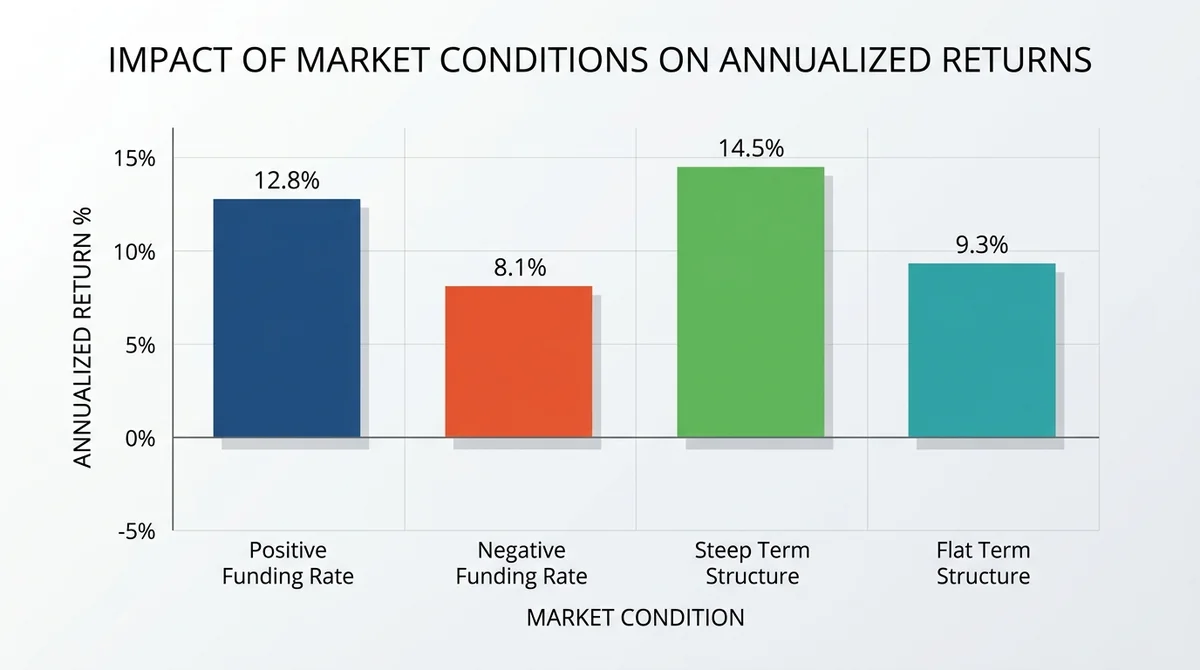
When the funding rate remains positive, the funding fees received by the perpetual short can offset holding costs, resulting in higher net returns for basis arbitrage. Conversely, a flip to negative funding rates directly reduces arbitrage returns and can even reverse the arbitrage logic. Historically, positive funding rates are more common in bull markets, but this is not absolute.
#Is arbitrage space larger when the term structure is steep?
A steep term structure usually means the market expects future interest rate increases or that liquidity premiums for different maturities have widened. In this case, the yield on tokenized US Treasury spot may be higher than the implied funding cost of contracts, making the basis more favorable for arbitrage. However, a steep structure may also signal higher market risk and should be judged in conjunction with volatility.
#Is it more favorable when market volatility is low?
In a low-volatility environment, deviations between spot and perpetual prices are easier to predict, margin call risk is lower, and arbitrageurs can hold positions more stably. However, low volatility may also compress the basis itself, narrowing arbitrage space. Therefore, low volatility is one of the necessary conditions, but not a sufficient condition.
#When might it fail?
#What happens when the funding rate reverses?
When the funding rate flips from positive to negative, arbitrageurs who were short must start paying funding fees, which quickly erodes arbitrage profits. If arbitrageurs have not preset exit thresholds, they may be forced to close positions at unfavorable times.
#What if the basis narrows sharply or even becomes negative?
Narrowing basis means the expected convergence profit disappears early. If the basis turns from positive to negative, with spot price below perpetual contract price, the arbitrage position may face losses. At this point, evaluate whether preset stop-loss conditions have been triggered to avoid expanding losses. For related liquidity risks, see tokenized US Treasury liquidity risk research.
#What is the impact of insufficient market liquidity?
Insufficient liquidity leads to wider bid-ask spreads and higher closing costs. In extreme cases, perpetual contracts may be difficult to trade, or redemption of tokenized spot may be delayed, preventing arbitrageurs from exiting in time and causing additional losses.
#Step-by-step framework and scenario example
#Step 1: How to identify basis opportunities?
Screen target tokenized US Treasury products and observe the basis between their spot prices and corresponding perpetual contracts. Combined with funding rate levels, prioritize targets with positive basis and positive funding rates. Note that quotes may differ across exchanges or platforms. For a definition of basis, refer to Investopedia.
#Step 2: How to execute spot and perpetual contract pairing?
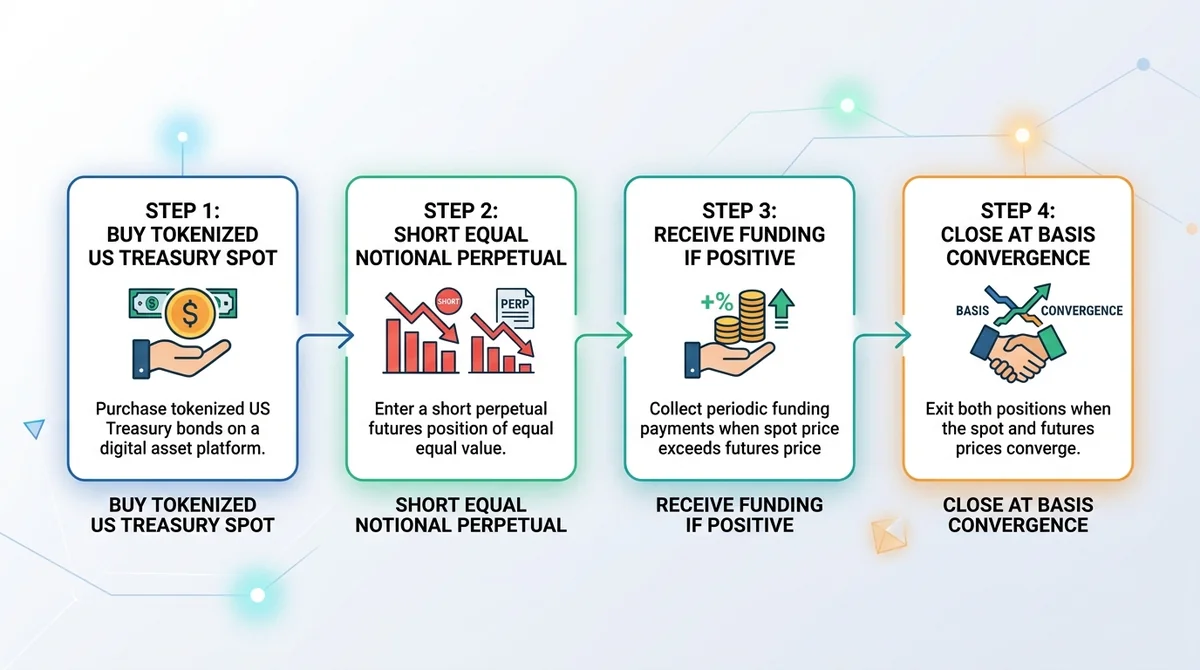
After confirming the opportunity, simultaneously buy tokenized US Treasury spot and sell an equal notional amount of perpetual contracts, ensuring notional matching to eliminate directional price risk. Pay attention to slippage and margin usage during execution. For differences in spot and perpetual pricing mechanisms, refer to comparison of spot and perpetual pricing mechanisms.
#Step 3: How to monitor changes in funding rate and term structure?
Continuously track funding rate settlement cycles and values, as well as yield changes across different maturities. Set funding rate thresholds and basis thresholds; once breached, trigger closing operations.
#Scenario example: simulating a typical operation
Suppose a tokenized US Treasury spot has a positive basis and a positive funding rate. An arbitrageur buys spot and shorts perpetual, expecting basis convergence and positive funding fee income. If the basis converges as expected, the position is closed to realize spread profit, plus funding fee income during the period; if the funding rate flips negative or the basis widens, returns may be lower than expected or even negative. This example is only for illustration and does not represent actual market conditions.
#Risk control and common mistakes
#How to set position and leverage limits?
It is recommended to maintain moderate leverage to avoid forced liquidation due to price fluctuations. You can set an overall leverage cap (e.g., not exceeding 2x) and set a stop-loss line for the basis, such as forced closing when the basis reversal exceeds a certain magnitude.
#Common mistake: ignoring funding rate changes
Funding rates may reverse quickly when market sentiment changes; if arbitrageurs do not set alerts, they may turn from profit to loss. Regularly check funding rate prediction indicators.
#Common mistake: over-concentration in a single tokenized product
Different tokenized US Treasury products have differences in redemption mechanisms, liquidity, and compliance risks. Over-concentration may amplify single-product risk; diversifying across multiple products and maturities can reduce concentration risk. Additionally, pay attention to the erosion of net returns by costs such as trading fees and slippage.
This article is only a methodological study and does not constitute investment advice.
FAQ
Is basis arbitrage a risk-free strategy?
No. Although basis arbitrage hedges directional risk, it still faces risks such as funding rate reversal, basis widening, insufficient liquidity, and redemption delays. No strategy can guarantee risk-free returns.
Can basis arbitrage still be conducted when the funding rate is negative?
When the funding rate is negative, the perpetual short must pay fees, which reduces arbitrage returns and may even make the arbitrage economically meaningless. At this point, you should reassess the benefits and costs or suspend execution.
What is the difference between tokenized US Treasury spot and traditional US Treasuries?
Tokenized US Treasury spot is an on-chain asset representing the beneficial ownership of underlying Treasury bonds. It may offer more flexible trading hours and settlement methods, but it carries on-chain smart contract risk, issuer credit risk, and redemption restrictions, and is not equivalent to directly holding real Treasury bonds.
How to control leverage risk in basis arbitrage?
Maintain moderate leverage, avoid excessively amplifying positions; set basis stop-loss lines and funding rate alerts; diversify across multiple tokenized products and maturities, and account for trading fees and slippage costs to reduce concentration in a single asset.
Related Terms
Ready to try? Test the strategy on MSX with small positions. Educational content only — not investment advice.