2026 Crypto Spot Market Microstructure Study: Order Book Depth, Spreads, and Price Discovery Efficiency
In-depth analysis of order book depth, bid-ask spreads, and price discovery efficiency in the 2026 crypto spot market, exploring liquidity fragmentation, data transparency, and regulatory divergence risks.
⚠ This article is a digital asset multi-asset research piece and does not constitute investment advice. Investing involves risk; please make decisions prudently.
The core conclusion on the microstructure of the 2026 cryptocurrency spot market is that order book depth, bid-ask spreads, and price discovery efficiency jointly determine trading costs and market quality, but the current lack of public data limits quantitative analysis.
#What characterises order book depth in the 2026 crypto spot market?
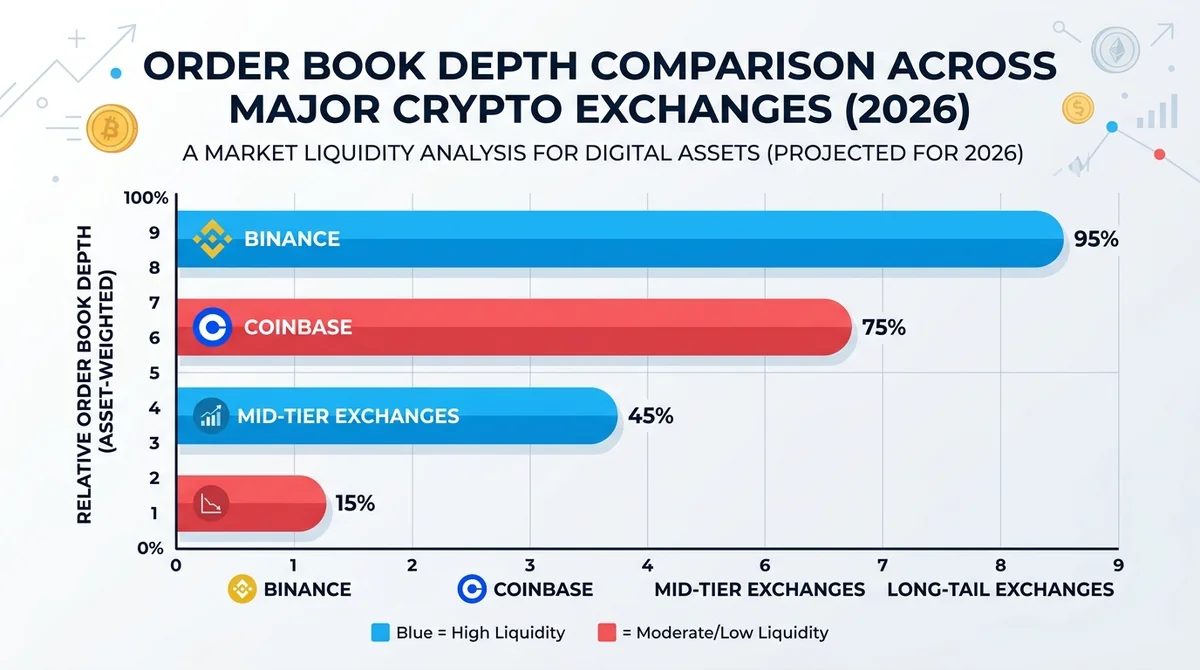
Order book depth is a key indicator of a market's ability to absorb large orders. In 2026, order book depth varies significantly across exchanges: top-tier exchanges typically have thicker order books, able to withstand larger market order shocks without significant slippage; whereas long-tail exchanges clearly lack depth, and large trades may trigger violent price swings. Specific figures cannot be precisely quantified due to incomplete exchange data disclosure; the above characteristics are based on public market observations and industry consensus.
#How does order book depth differ among major exchanges?
Top-tier exchanges like Binance and Coinbase, benefiting from higher trading volumes and greater market maker participation, maintain thick order books across multiple price levels. In contrast, small and medium-sized exchanges may have depth concentrated at only a few price levels and are more susceptible to the impact of single large orders.
#How does market depth change in normal versus extreme market conditions?
Under normal market conditions, order book depth is relatively stable, with market makers continuously providing liquidity. However, in extreme conditions (such as flash crashes or major news releases), market makers may rapidly withdraw orders, causing depth to plummet and slippage to widen sharply. This phenomenon persists in 2026, and because the market structure has not fundamentally changed, it has historically been more common during periods of high volatility.
#How do bid-ask spreads affect trading costs in the 2026 crypto spot market?
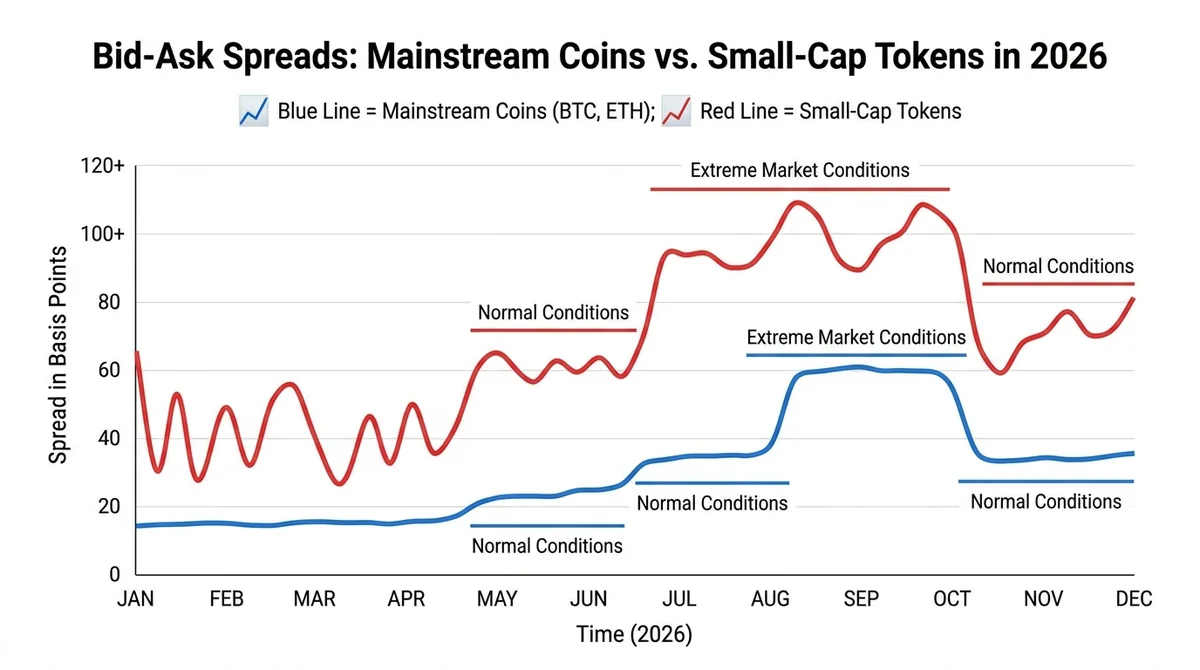
Bid-ask spreads are a direct reflection of trading costs. In 2026, spreads for mainstream coins (such as BTC and ETH) are typically narrow, reflecting higher liquidity; while spreads for small-cap tokens may widen significantly. Specific figures are not publicly disclosed, but widespread market observation shows mainstream coin spreads are within a few basis points.
#What level are spreads for mainstream trading pairs?
Spreads for mainstream trading pairs are often within a few basis points, but there are differences across exchanges. Spreads are closely related to market volatility and trading volume: when volatility rises or volume shrinks, market makers demand higher risk compensation, and spreads widen accordingly.
#What is the relationship between spreads, market volatility, and trading volume?
During periods of high volatility, spreads tend to widen, increasing trading costs. This is because market makers face greater inventory risk and require wider spreads to protect themselves. Declining trading volume also leads to wider spreads, as liquidity providers diminish.
#What factors determine price discovery efficiency in the 2026 crypto spot market?
Price discovery efficiency reflects the speed and accuracy with which the market incorporates new information into prices. In 2026, order book transparency, trader composition (retail, institutional, market makers), and market volatility jointly influence price discovery efficiency.
#How does order book transparency affect price discovery?
Higher order book transparency generally leads to more efficient price discovery. A transparent order book allows all participants to see depth and pending orders, thereby incorporating new information into prices more quickly. However, some exchanges may hide part of the order book depth, which reduces transparency.
#What role do different trader compositions (retail, institutional, market makers) play in price discovery?
The participation of institutions and market makers helps improve the quality of price discovery. Institutional investors typically trade based on fundamentals or quantitative models, and their orders often contain more information; market makers maintain market efficiency through continuous quoting. Retail trading may introduce more noise but can also provide liquidity.
#What risks and divergences does the 2026 crypto spot market microstructure face?
The 2026 crypto spot market microstructure faces risks such as liquidity fragmentation, data opacity, and regulatory divergence.
#How does liquidity fragmentation affect market efficiency?
Liquidity fragmentation may reduce overall market depth and price discovery efficiency. Since cryptocurrency trading is dispersed across numerous exchanges, prices for the same asset may exhibit temporary differences across platforms, requiring arbitrageurs to trade across multiple venues, increasing execution costs and risks.
#What research challenges do data opacity and regulatory divergence bring?
Exchanges have inconsistent data disclosure standards, making horizontal comparisons difficult. Some exchanges do not provide complete historical order book data, or data is severely delayed, which poses difficulties for microstructure research. Changes in the regulatory environment may reshape market microstructure, for example through restrictions on market maker behaviour or compliance requirements for exchanges.
#What indicators should be monitored next to track crypto spot market microstructure?
To track crypto spot market microstructure, attention should be paid to order book snapshots, trade tick data, and on-chain data.
#Which public data sources can be used to monitor order book depth and spreads?
Some exchanges provide order book snapshots and trade data via APIs, which researchers can use to calculate depth and spreads. In addition, aggregator platforms such as Kaiko and CryptoCompare offer cross-exchange microstructure indicators, but may have delays or incomplete coverage.
#How can microstructure indicators assist trading decisions?
Microstructure indicators should be used as risk management tools rather than predictive tools. For example, monitoring order book depth can help traders assess potential slippage for large orders; spread changes can signal liquidity conditions. Combining high-frequency data with on-chain data (such as exchange net flows) can provide a more comprehensive perspective.
#Core Conclusion
The microstructure of the 2026 cryptocurrency spot market remains in evolution, with order book depth, spreads, and price discovery efficiency significantly influenced by exchange differences, market conditions, and the regulatory environment. The lack of unified data standards makes precise quantification difficult, but understanding these mechanisms helps traders better manage risk.
#Asset/Business Line Definition
This research focuses on the microstructure of the cryptocurrency spot market, including order book depth, bid-ask spreads, and price discovery efficiency. The spot market is the foundational layer of digital asset trading, interconnected with perpetual contracts and derivative markets such as tokenized stocks.
#Key Mechanisms and Data
- Order book depth: Top-tier exchange depth is significantly higher than long-tail exchanges; depth may plummet in extreme conditions. Specific data not disclosed.
- Bid-ask spread: Mainstream coin spreads are narrow, widening during high volatility. Specific data not disclosed.
- Price discovery efficiency: Affected by order book transparency and trader composition; participation of institutions and market makers helps improve efficiency.
#Core Drivers
- Exchange competition and liquidity concentration: Top-tier exchanges attract liquidity through market maker incentives and low fees, leading to depth concentration.
- Market volatility: During high volatility, market makers withdraw orders, deteriorating depth and spreads.
- Regulatory policy: Regulatory differences across jurisdictions affect exchange operations and market maker behaviour.
- Technical infrastructure: Matching engine speed, API stability, etc., affect order book updates and price discovery.
#Key Participants
- Top-tier exchanges: Binance, Coinbase, OKX, etc., providing primary liquidity.
- Market makers: Such as Jump Trading, Wintermute, maintaining market depth through continuous quoting.
- Institutional investors: Including hedge funds and family offices, whose large orders influence price discovery.
- Retail traders: Provide base liquidity but may increase noise.
#Risks and Divergences
Bearish views argue that liquidity fragmentation and data opacity make the crypto spot market microstructure far less mature than traditional financial markets, and price discovery efficiency may be overestimated. Additionally, regulatory uncertainty could lead to exchange closures or market maker exits, further deteriorating market quality.
#What to Watch Next
- Whether major exchanges improve transparency of order book data disclosure.
- Regulatory standards for market maker behaviour.
- Development of cross-exchange liquidity aggregation technology.
- Real-time changes in order book depth during extreme market conditions.
#FAQ
Q: What risks does insufficient order book depth bring? A: Insufficient order book depth leads to larger slippage for large market orders, increasing trading costs and potentially triggering violent price swings.
Q: Why are spreads for mainstream coins usually narrower than for small coins? A: Mainstream coins have high trading volume, intense market maker competition, and ample liquidity, hence narrower spreads; small coins have poor liquidity, and market makers demand higher risk compensation, resulting in wider spreads.
Q: What are the consequences of low price discovery efficiency? A: Low price discovery efficiency means new information is not reflected in prices in a timely manner, potentially causing prices to deviate from fair value, increasing arbitrage opportunities but also market uncertainty.
Q: How does liquidity fragmentation affect arbitrage? A: Liquidity fragmentation means price differences for the same asset across different exchanges may persist, requiring arbitrageurs to manage multiple accounts and risks simultaneously, increasing execution costs and potentially compressing arbitrage space.
Q: How can ordinary traders use microstructure indicators? A: Traders can monitor order book depth and spreads to assess trading timing, such as placing large orders when depth is thick to reduce slippage, or trading when spreads are narrow to lower costs. However, these indicators should be used as auxiliary tools, not predictive bases.
FAQ
What risks does insufficient order book depth bring?
Insufficient order book depth leads to larger slippage for large market orders, increasing trading costs and potentially triggering violent price swings.
Why are spreads for mainstream coins usually narrower than for small coins?
Mainstream coins have high trading volume, intense market maker competition, and ample liquidity, hence narrower spreads; small coins have poor liquidity, and market makers demand higher risk compensation, resulting in wider spreads.
What are the consequences of low price discovery efficiency?
Low price discovery efficiency means new information is not reflected in prices in a timely manner, potentially causing prices to deviate from fair value, increasing arbitrage opportunities but also market uncertainty.
How does liquidity fragmentation affect arbitrage?
Liquidity fragmentation means price differences for the same asset across different exchanges may persist, requiring arbitrageurs to manage multiple accounts and risks simultaneously, increasing execution costs and potentially compressing arbitrage space.
How can ordinary traders use microstructure indicators?
Traders can monitor order book depth and spreads to assess trading timing, such as placing large orders when depth is thick to reduce slippage, or trading when spreads are narrow to lower costs. However, these indicators should be used as auxiliary tools, not predictive bases.
Related Terms
Ready to try? Test the strategy on MSX with small positions. Educational content only — not investment advice.