Research on Spot and Perpetual Basis Arbitrage Mechanisms in the 2026 Crypto Market: Basis Convergence Paths and Funding Rate Anchoring Effects
Deep dive into spot vs perpetual basis arbitrage in crypto, focusing on basis convergence paths, funding rate anchoring effects, and 2026 market structure shifts.
⚠ This article is a multi-asset digital asset research piece and does not constitute investment advice. Investing involves risk; please make decisions prudently.
Core conclusion: The funding rate is not a transaction fee, but an anchoring cost paid between longs and shorts. The essence of spot and perpetual basis arbitrage is to exploit basis deviations and capture risk-adjusted returns as the basis converges.
#What is the basic mechanism of spot and perpetual basis arbitrage in the crypto market?
Underlying definition: This article examines the basis (price difference) arbitrage between spot assets (such as BTC, ETH) and their corresponding perpetual contracts in the crypto market. Perpetual contracts are derivatives with no expiry date, and their prices are anchored to spot prices through the perpetual futures funding rate settlement schedule.
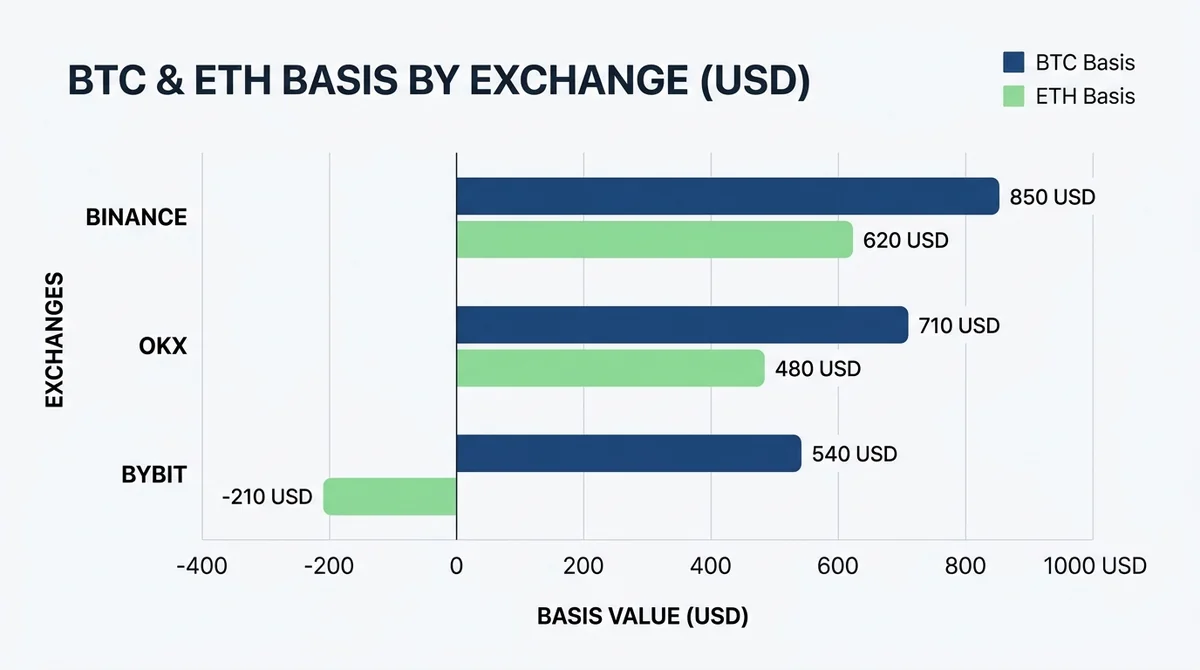
Key mechanism: Spot prices and perpetual prices tend to converge in the long run, with short-term basis deviations. Basis is defined as: Basis = Perpetual price - Spot price. A positive basis (contango) means the perpetual price is above spot; a negative basis (backwardation) is the opposite. Arbitrageurs profit by simultaneously buying the undervalued asset and selling the overvalued one, waiting for the spread to converge.
Data note: Specific basis values change in real time with market conditions; data is from public quotes as of May 2026.
Core drivers:
- Market sentiment and leverage demand: High leverage demand pushes perpetual prices up, widening positive basis.
- Arbitrage capital scale: Large inflows of arbitrage capital accelerate basis convergence and compress arbitrage spreads.
- Liquidity depth: Higher liquidity reduces execution costs for arbitrage and speeds up convergence.
Key participants: Arbitrageurs (including quant funds, market makers, individual traders), exchanges (offering spot and perpetual trading pairs), clearing houses (managing margin and liquidations).
Risks and disagreements: The bearish view argues that basis arbitrage yields thin profits in efficient markets and faces risks of sudden funding rate reversals, trading cost erosion, and liquidation.
What to watch next: Focus on basis levels on major exchanges, historical percentiles of funding rates, and the impact of regulatory policies on arbitrage capital flows.
FAQ:
- Q: Is basis arbitrage risk-free? A: No. Basis arbitrage faces risks such as funding rate volatility, slippage, and liquidation; it is not risk-free arbitrage.
- Q: Why does the perpetual price deviate from spot? A: Short-term supply-demand imbalances, changes in leverage demand, and market sentiment can cause perpetual prices to deviate from spot; the how does perpetual futures funding rate work mechanism drives reversion.
#How does the funding rate anchor spot and perpetual price spreads?
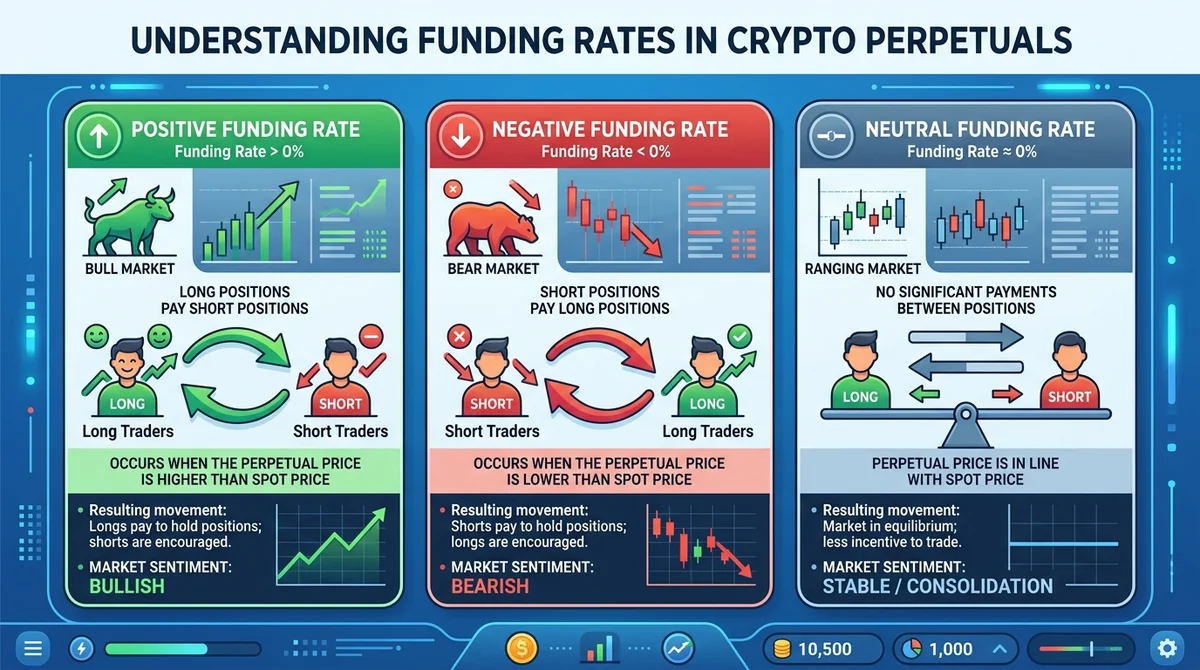
Mechanism definition: The funding rate is a periodic fee exchanged between longs and shorts, typically paid every 8 hours. When the perpetual price is above spot, longs pay shorts, pushing the perpetual price down; the opposite applies when the perpetual price is below spot.
Anchoring effect: The funding rate uses economic incentives to pull the perpetual price back toward spot. In extreme market conditions, the funding rate can fluctuate sharply, weakening the anchoring effect and causing the basis to persist.
Data note: Specific funding rate values vary by exchange and coin; data is from public quotes as of May 2026.
Core drivers:
- Long-short balance: Funding rate is positive when longs dominate and negative when shorts dominate.
- Spot price volatility: Funding rate fluctuations increase in high-volatility environments.
- Exchange rate rules: Different exchanges have different funding rate calculation methods and caps.
Key participants: Perpetual contract traders, exchanges (setting funding rate parameters), arbitrageurs (exploiting the relationship between funding rate and basis).
Risks and disagreements: The bearish view argues that the funding rate anchoring effect may fail in extreme conditions, and arbitrageurs may face losses from persistently adverse funding rates.
What to watch next: Monitor the frequency of extreme funding rate values, cross-exchange funding rate differences, and the impact of market structure changes on the anchoring effect.
FAQ:
- Q: Is the funding rate a transaction fee? A: No. The funding rate is a fee paid between longs and shorts; exchanges typically do not charge this fee.
- Q: Does a higher funding rate mean greater arbitrage opportunities? A: Not necessarily. High funding rates may be accompanied by high volatility and liquidation risk, requiring comprehensive assessment.
#What factors influence the basis convergence path?
Influencing factors:
- Market liquidity and depth: Higher liquidity enables faster arbitrage execution and quicker convergence.
- Leverage demand and market sentiment: High leverage demand pushes perpetual prices up, widening positive basis; when sentiment reverses, basis converges quickly.
- Arbitrage capital scale and competition: Large inflows of arbitrage capital accelerate convergence and reduce arbitrage spreads.
Data note: Specific convergence speeds vary with market conditions; data is from public quotes as of May 2026.
Core drivers: Improved market efficiency (institutional participation, algorithmic trading) shortens basis deviation periods; DeFi perpetual protocols offer new arbitrage tools but introduce smart contract risk.
Key participants: Arbitrageurs, market makers, DeFi protocols, centralized exchanges.
Risks and disagreements: The bearish view argues that excessive arbitrage capital competition may keep the basis in a low-volatility state, making arbitrage profits thin.
What to watch next: Track differences in basis convergence speeds across exchanges and liquidity changes in DeFi perpetual protocols.
FAQ:
- Q: How long does basis convergence take? A: It depends on market liquidity and arbitrage capital scale; it can range from minutes to hours.
- Q: Do DeFi perpetual protocols affect basis convergence? A: Yes. DeFi protocols provide new arbitrage channels and may accelerate convergence, but they also introduce smart contract risk.
#What limitations and risks does crypto market arbitrage face?
Limitations and risks:
- Funding rate volatility risk: Funding rates can reverse suddenly, causing losses on arbitrage positions.
- Trading costs and slippage: Fees, slippage, and capital transfer costs erode arbitrage profits.
- Liquidation and margin risk: Leveraged arbitrage faces liquidation risk, requiring stop-losses and position management.
Data note: Specific trading costs and slippage vary by exchange and trade size; data is from public quotes as of May 2026.
Core drivers: Market volatility, exchange fee policies, and margin requirement changes all affect arbitrage feasibility.
Key participants: Arbitrageurs, exchanges (fee and margin rules), clearing houses.
Risks and disagreements: The bearish view emphasizes that arbitrage is not risk-free, especially in extreme conditions where significant losses can occur.
What to watch next: Monitor exchange fee adjustments, margin rule changes, and the historical performance of arbitrage strategies in extreme market conditions.
FAQ:
- Q: How much capital is needed for an arbitrage strategy? A: It depends on trading pair liquidity and leverage usage; small capital may face a higher cost ratio.
- Q: How can liquidation risk be managed? A: Set stop-losses, control leverage multiples, diversify positions, and monitor the TRUMPUSDT perpetual futures margin requirements explained in real time.
#How do 2026 crypto market structure changes affect arbitrage mechanisms?
Structural changes:
- Regulatory policy changes: Stricter regulation may raise compliance costs and compress arbitrage spreads.
- Increased institutional participation: More institutional capital may improve market efficiency and reduce basis volatility.
- New derivatives and DeFi protocols: DeFi perpetual protocols offer new arbitrage tools but introduce smart contract risk.
Data note: Specific regulatory developments and institutional capital flow data come from public disclosures as of May 2026.
Core drivers: Evolution of global regulatory frameworks, entry of institutional investors, and technological innovations (e.g., Layer2 reducing transaction costs).
Key participants: Regulators, institutional investors, DeFi protocol developers, exchanges.
Risks and disagreements: The bearish view argues that regulatory uncertainty may increase compliance risk for arbitrage strategies, and institutional participation may further narrow basis arbitrage profits.
What to watch next: Follow regulatory policy implementation in major jurisdictions, institutional holdings data, and changes in DeFi perpetual protocol trading volumes.
FAQ:
- Q: Will regulators ban basis arbitrage? A: There is currently no explicit ban, but regulation may affect leverage, KYC, and other requirements, increasing arbitrage costs.
- Q: Is institutional participation beneficial or detrimental to arbitrageurs? A: Institutional participation improves market efficiency and may reduce arbitrage spreads, but it can also increase market depth and reduce slippage.
#How to build a robust spot and perpetual basis arbitrage strategy?
Strategy construction:
- Select arbitrage targets and timing: Choose trading pairs with good liquidity and large basis volatility, and enter when the basis deviates from its historical mean.
- Dynamically adjust funding rate exposure: Monitor funding rate changes and adjust positions or hedge in a timely manner.
- Assess return-to-risk ratio: Use backtesting and stress testing to evaluate strategy robustness, focusing on maximum drawdown and Sharpe ratio.
Data note: Backtest results are based on historical data and do not represent future performance; data is from public quotes as of May 2026.
Core drivers: Strategy robustness depends on understanding market microstructure, execution speed, and risk management capabilities.
Key participants: Arbitrage strategy developers, quantitative trading teams, risk managers.
Risks and disagreements: The bearish view argues that over-optimized backtests may fail in live trading; historical performance should be treated with caution.
What to watch next: Track live strategy performance, extreme funding rate events, and the impact of market structure changes on strategy parameters.
FAQ:
- Q: Does an arbitrage strategy require programming skills? A: Manual arbitrage is possible but inefficient; programming and automated execution help improve competitiveness.
- Q: How to choose arbitrage trading pairs? A: Prioritize pairs with good liquidity, large basis volatility, and low trading costs, such as BTC/USDT perpetual.
FAQ
Is basis arbitrage risk-free?
No. Basis arbitrage faces risks such as funding rate volatility, slippage, and liquidation; it is not risk-free arbitrage.
Is the funding rate a transaction fee?
No. The funding rate is a fee paid between longs and shorts; exchanges typically do not charge this fee.
How long does basis convergence take?
It depends on market liquidity and arbitrage capital scale; it can range from minutes to hours.
How much capital is needed for an arbitrage strategy?
It depends on trading pair liquidity and leverage usage; small capital may face a higher cost ratio.
How can liquidation risk be managed?
Set stop-losses, control leverage multiples, diversify positions, and monitor the TRUMPUSDT perpetual futures margin requirements explained in real time.
Related Terms
Ready to try? Test the strategy on MSX with small positions. Educational content only — not investment advice.