On-Chain Cash Flow Duration and Interest Rate Sensitivity in DeFi Yield Strategies: Protocol-Level Repricing Mechanisms and Risk-Adjusted Return Definitions (2026)
Deconstructing rate sensitivity of DeFi yield strategies via cash flow duration: protocol repricing, impermanent loss definitions, and a unified risk-adjusted framework.
⚠ This article is a digital asset methodology study and does not constitute investment advice. Investing carries risk; please make decisions prudently.
Core conclusion: The cash flow duration of a DeFi yield strategy measures the time structure of cash flow recovery. The longer the duration, the more sensitive the strategy's present value is to changes in interest rates and repricing. However, most protocols today do not disclose duration or impermanent loss definitions, so cross-strategy comparison requires unifying assumptions first. The related conclusions are a methodological framework rather than verifiable quantitative results.
#Underlying / Business Line Definitions
The research object of this article is the interest rate risk measurement framework for on-chain yield strategies, covering: lending protocol deposit and borrow rates, liquidity provision (LP) yield, leveraged staking and restaking yield, and more. Boundary notes are as follows:
- Only the cash flow structure on the yield side is discussed; no directional price judgment on specific assets is involved.
- Only protocol-level mechanisms (interest rate models, governance parameters, repricing frequency) are discussed; off-chain macro rate path forecasting is not expanded.
- How does perpetual futures funding rate work is included as an external interest rate variable for reference, but is not the main thread of this article.
Data note: This article does not cite unverified specific numerical values. Parameters such as how does perpetual futures funding rate work, utilization rate, and collateral ratio are subject to the latest disclosure in each protocol's official documentation. Disclosure definitions differ across protocols, and when citing, one must return to the original protocol documentation to verify. The writing time of this article is 2026, and no specific data snapshot is attached.
#Why Do DeFi Yield Strategies Need the Concept of Cash Flow Duration?
#What Are the Similarities and Differences Between On-Chain Cash Flow Duration and Traditional Bond Duration?
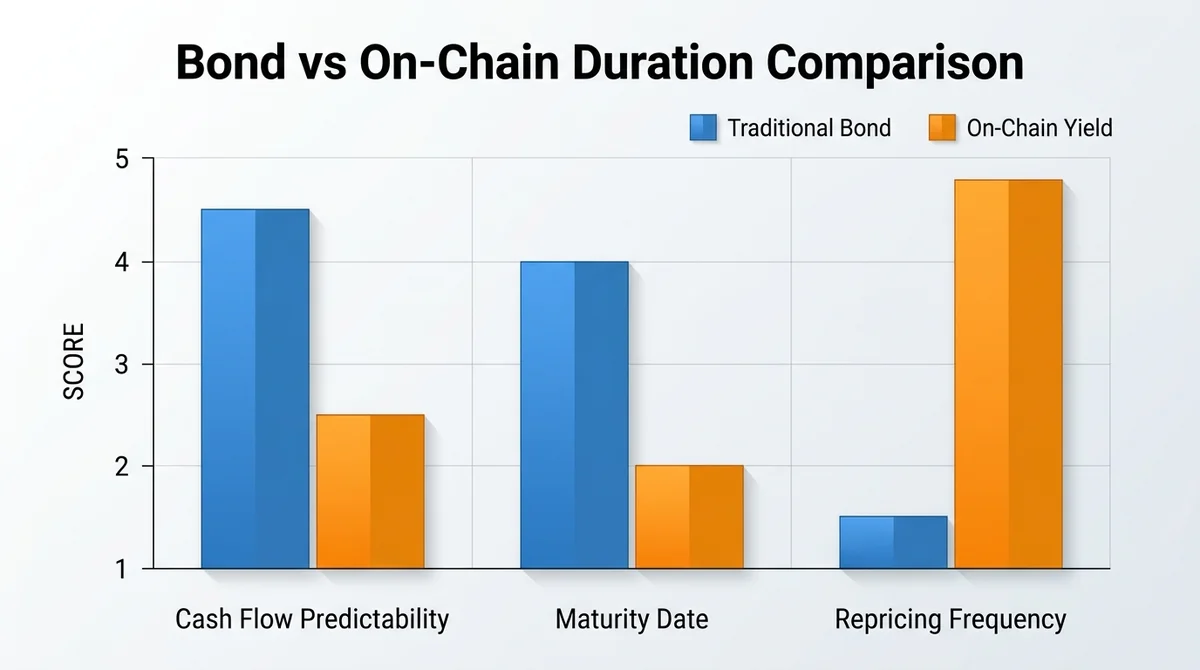
Traditional bond duration is the weighted average of cash flow recovery time, with cash flows and maturity dates relatively fixed. The cash flow sources of on-chain yield strategies are diverse (interest, trading fees, token rewards), and their scale changes dynamically with capital utilization and governance parameters. Therefore, duration can only serve as an approximate measure, not a precise pricing tool.
#How Does Duration Affect the Interest Rate Sensitivity of Yield Strategies?
The general rule is: the longer the duration, the greater the impact of interest rate changes on the strategy's present value. In on-chain scenarios, this means that when protocol interest rate models or governance parameters are adjusted, strategies with longer duration (such as long-term locked positions or low-turnover LP positions) tend to show more pronounced present value fluctuations. This rule comes from general principles of interest rate risk measurement, and its applicability to on-chain scenarios still requires empirical testing.
#What Evaluation Blind Spots Arise from the Lack of Duration Metrics?
- Looking only at annual percentage yield (APY) while ignoring the time structure of cash flow recovery.
- Being unable to distinguish whether "high APY comes from high interest rates" or "high APY comes from compensation for long lock-up periods."
- In a rate-cutting cycle, the reinvestment risk of long lock-up strategies may be underestimated.
Data not public: Most protocols do not disclose duration metrics. Researchers must infer them from transaction records and rate history, and the inferred results depend on assumptions.
#How Do Protocol-Level Repricing Mechanisms Change the Cash Flow Path of DeFi Yield?
#How Do Interest Rate Model Adjustments Affect Deposit and Borrow Rates?
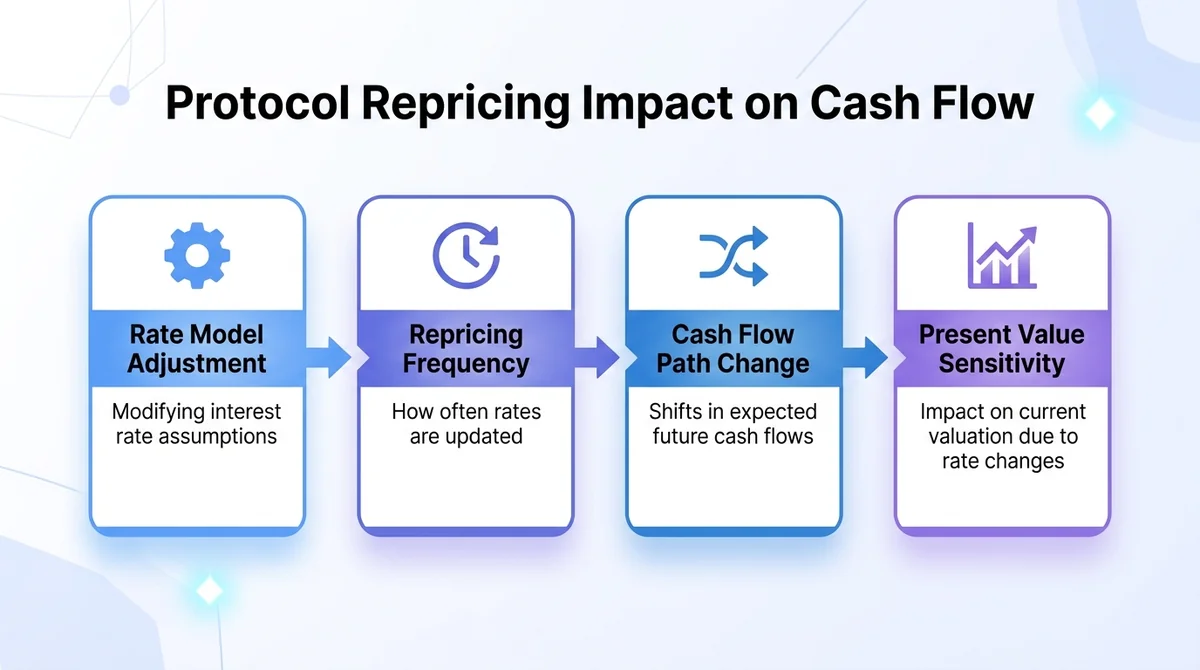
Mainstream lending protocols use dynamic pricing based on capital utilization: as utilization rises, borrow rates rise, and deposit rates rise accordingly. This mechanism makes interest rates endogenous, and the cash flow path continuously adjusts with market supply and demand. The specific curve shape and inflection points vary by protocol and require consulting each protocol's official interest rate model documentation.
#How Do Governance Parameter Changes Trigger Repricing?
Parameters that governance can adjust typically include collateral ratios, reserve factors, and interest rate curve inflection points. Parameter changes directly alter the slope and position of the interest rate curve, thereby triggering protocol-level repricing and affecting the cash flows of existing positions.
#How Does Repricing Frequency Affect Strategy Duration?
The general rule: the higher the repricing frequency, the shorter the duration. High-frequency repricing makes interest rates reflect market changes more quickly, reducing the sensitivity of the strategy's present value to interest rates, but it also reduces the rate protection provided by lock-up periods.
Must be distinguished: protocol-level repricing (mechanistic adjustment) and market-level interest rate fluctuations (supply-demand driven) are two different types of variables. Conflating them in analysis will lead to duration estimation bias.
#How Should Impermanent Loss Be Incorporated into the Risk-Adjusted Return Definition?
#What Is the Relationship Between Impermanent Loss and Interest Rate Sensitivity?
Impermanent loss is mainly driven by price volatility, but in perpetual futures leverage or strategies linked to funding rates, price volatility and interest rate volatility may amplify each other, creating a link between impermanent loss and interest rate sensitivity. The strength of this link in specific strategies must be verified case by case.
#Where Do the Differences in Impermanent Loss Calculation Under Different Definitions Lie?
There are two common definitions:
- Relative-to-holding definition: compares against simply holding the two assets, measuring the LP's relative loss.
- Absolute return definition: absolute profit and loss denominated in fiat or stablecoins.
The two definitions may produce opposite results in cross-strategy comparison, so the benchmark must be explicitly stated.
#How Should the Comparison Benchmark for Risk-Adjusted Returns Be Unified?
Suggested framework: risk-adjusted return = nominal yield − impermanent loss − repricing friction − fees and slippage. Repricing friction refers to rebalancing costs caused by interest rate or parameter adjustments. This framework is a methodological suggestion and has not yet been validated through industry standardization.
Data not public: Real-time impermanent loss data usually must be calculated independently, and protocols generally do not directly provide disclosure under a unified definition.
#What Are the Common Divergences in Cross-Strategy Comparison of Risk-Adjusted Return Definitions?
#How Large Are the Disclosure Differences Across Protocols for the Same Metric?
Divergences center on: fee treatment (whether management fees are deducted), reward treatment (whether token rewards are valued at spot or discounted), and lock-up treatment (whether a liquidity discount is included). These differences make APYs with the same name not directly comparable.
#Should Repricing Friction Be Counted as a Cost?
From a risk measurement perspective, it tends to be included. Repricing friction includes transaction costs and slippage, and especially in protocols with frequent parameter adjustments, friction may significantly erode nominal yield. The specific magnitude depends on the protocol and rebalancing frequency; this article does not provide unverified estimates.
#How Can Misjudgments Caused by Inconsistent Definitions Be Avoided?
- Explicitly state all assumptions and data sources.
- Apply the same conversion rules to different protocols.
- Mark unavailable data as "not public" rather than defaulting to zero.
Data not public: Standardized cross-protocol data is currently lacking, and any horizontal comparison carries the researcher's subjective assumptions.
#What Data and Model Limitations Does Current Research on On-Chain Cash Flow Duration and Interest Rate Sensitivity Face?
#Can Duration Be Directly Inferred from On-Chain Data?
Transaction records are queryable, but cash flow attribution is complex: a single transaction may simultaneously include interest, rewards, and fees, and splitting them requires internal protocol data. On-chain data alone is insufficient to directly infer duration.
#What Assumption Risks Do Interest Rate Sensitivity Models Have?
The main assumptions include: interest rate path, repricing frequency, and stability of capital utilization. When assumptions deviate from reality, duration and sensitivity estimates will be systematically biased.
#What Disclosure Standards Are Needed in the Future to Improve Comparability?
- A unified duration disclosure definition.
- A unified benchmark for impermanent loss calculation.
- Timestamps of repricing events and records of parameter changes.
Data not public: Most protocols do not provide duration disclosure, which is the core reason for the current lack of comparability.
#Key Participants
- Lending protocols: underlying protocols that provide interest rate models and repricing mechanisms.
- LPs and yield aggregators: package multi-source yield and are the link with the most complex duration structure.
- Data and risk control service providers: provide on-chain data indexing and risk metrics, but duration definitions are not yet standardized.
The above lists factual roles only and does not constitute any asset recommendation.
#Risks and Divergences
- Bearish view: duration is an approximate concept on-chain, and introducing it may create an "illusion of precision" that instead misleads decisions.
- Data risk: insufficient disclosure makes all duration estimates depend on assumptions, and the robustness of conclusions is limited.
- Mechanism risk: governance parameters can be changed quickly, and historical duration may not represent the future.
- Principal risk: DeFi strategies carry smart contract, liquidation, and liquidity risks that may lead to loss of principal.
#What to Watch Next
- Whether mainstream lending protocols update interest rate models or governance parameters.
- Whether industry disclosure initiatives for duration and impermanent loss definitions emerge.
- Co-movement between how does perpetual futures funding rate work and on-chain interest rates (must be verified in real time against public market data sources).
- Changes in the lock-up structure of restaking and leveraged staking strategies.
#Risk Statement and Scope of Use
This report is a methodology study, does not constitute investment advice, and does not provide price forecasts or buy/sell recommendations. All analysis is based on public mechanism reasoning, and actual parameters are subject to the latest protocol disclosure. Interest rate sensitivity analysis applies only under explicitly stated assumptions. DeFi strategies carry the risk of principal loss; please make decisions prudently.
FAQ
What is on-chain cash flow duration?
On-chain cash flow duration measures the weighted average time of cash flow recovery for a DeFi yield strategy. The longer the duration, the more sensitive the strategy's present value is to interest rate and repricing changes, making it a basic metric for assessing interest rate risk; because on-chain cash flows are not fixed, it can only serve as an approximate measure.
How does protocol-level repricing affect DeFi yield?
Protocol-level repricing changes the cash flow path through interest rate model and governance parameter adjustments. The general rule is that the higher the repricing frequency, the shorter the duration, reducing the strategy's sensitivity to interest rates, but the rate protection provided by lock-up periods also weakens.
Which definition should be used to calculate impermanent loss?
There are commonly the relative-to-holding definition and the absolute return definition, and the two may produce opposite results in cross-strategy comparison. Unified comparison must explicitly state the benchmark and include both impermanent loss and repricing friction in the risk-adjusted return.
Why can't APYs from different protocols be compared directly?
Because the treatment of fees, token rewards, and lock-up periods is inconsistent, APYs with the same name are not directly comparable. Cross-protocol comparison requires unified conversion rules and explicit assumptions.
What is the biggest limitation of current duration research?
Most protocols do not disclose duration or impermanent loss definitions, and on-chain data makes it difficult to directly separate cash flow attribution. Therefore, duration estimates depend heavily on researcher assumptions, and the robustness of conclusions is limited.
Related Terms
Ready to try? Test the strategy on MSX with small positions. Educational content only — not investment advice.