Execution Risk in Huobi vs MEXC Fee Arbitrage: Slippage and Trade Receipt Discrepancies in AB Testing (2026)
In-depth analysis of execution risk in Huobi vs MEXC cross-exchange fee arbitrage, focusing on slippage and trade receipt discrepancy quantification, exchange differences, and risk controls.
⚠ This article is digital asset multi-asset research and does not constitute investment advice. Investing involves risk; please make decisions prudently.
Execution risk in fee arbitrage is not an abstract concept—it is the profit erosion caused by both slippage and trade receipt discrepancies.
#What is execution risk in Huobi vs MEXC fee arbitrage?
Execution risk definition: The deviation between the executed price and the expected price. In cross-exchange arbitrage, even when a significant fee difference exists between two exchanges, actual slippage and receipt discrepancies directly affect profit and may even invalidate the arbitrage.
What specific stages are included in cross-exchange arbitrage execution risk?
Execution risk spans the entire process from order placement to trade confirmation, mainly including:
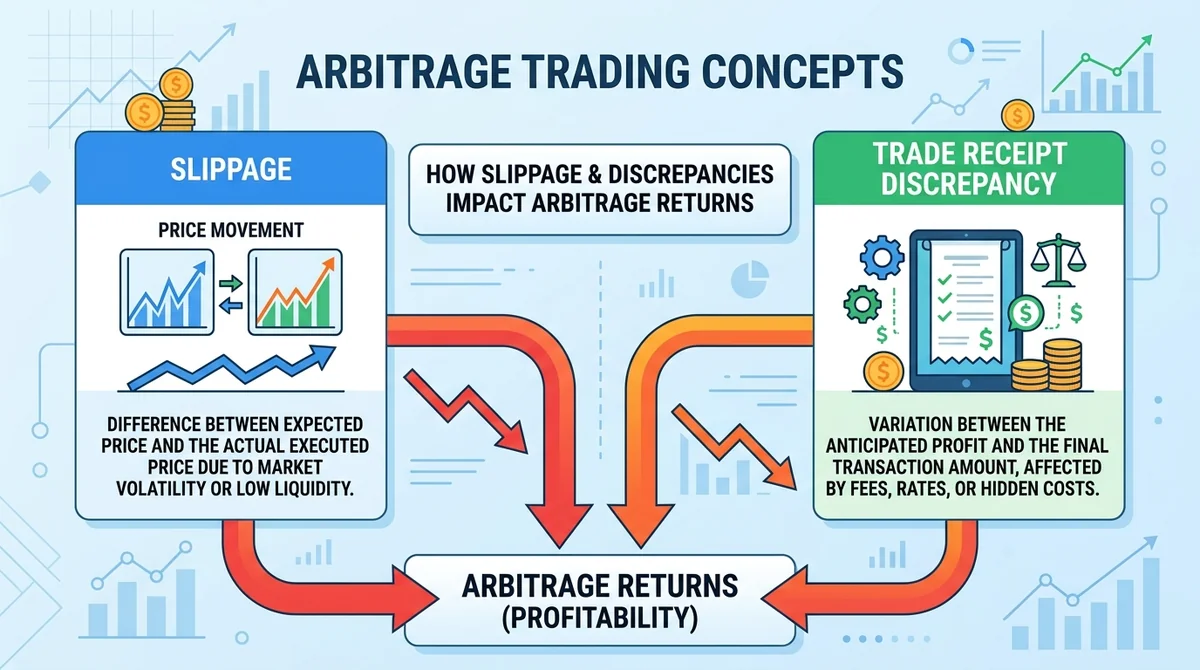
- Slippage: The difference between the actual average execution price of an order and the expected price at order placement, typically caused by insufficient order book depth or market volatility.
- Trade receipt discrepancy: The inconsistency between the trade data reported by the exchange and the actual trade (verifiable through on-chain or third-party data), which may stem from matching delays, data aggregation methodology, or system errors.
How do slippage and trade receipt discrepancies affect arbitrage returns?
Slippage directly increases one-sided costs, while receipt discrepancies may lead arbitrageurs to misjudge actual positions and P&L. When combined, the originally thin fee difference can be completely eroded.
#How to quantify slippage and trade receipt discrepancies in AB testing?
How to design an AB test to separate slippage and receipt discrepancies?
The core of AB testing is parallel execution of the same strategy: run identical arbitrage strategies on Huobi and MEXC simultaneously, recording the expected price, actual execution price, and exchange-reported data for each order. By comparing data from both exchanges, slippage and receipt discrepancies can be estimated separately.
Which metrics can be used to quantify trade receipt discrepancies?
Common metrics include:
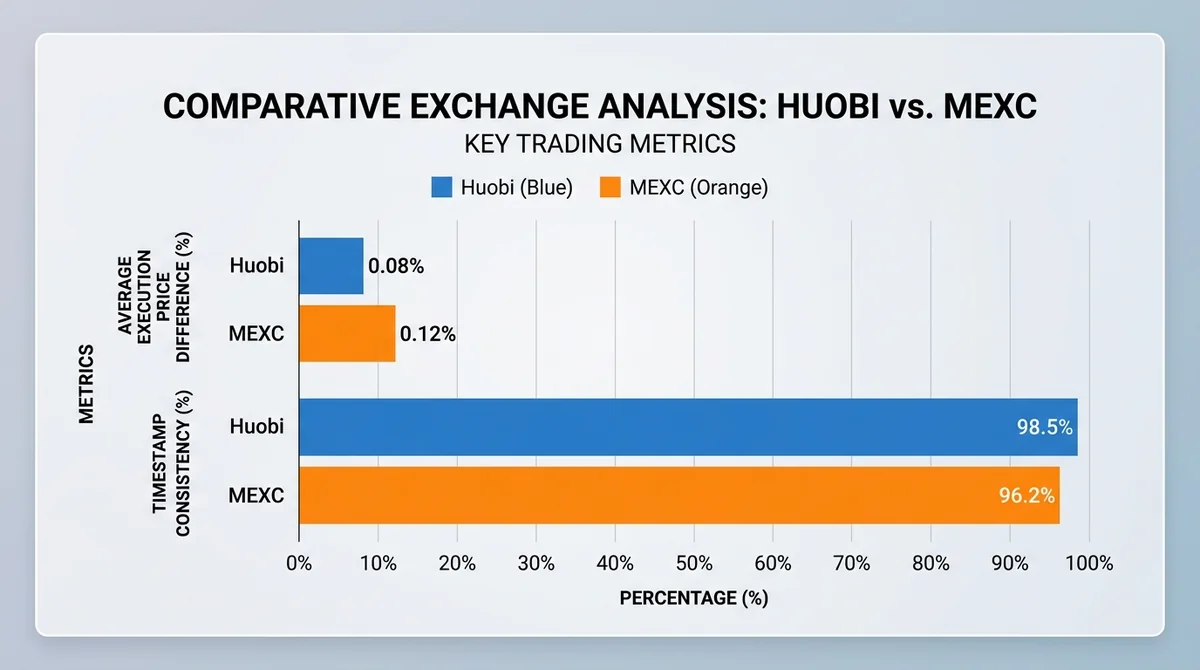
- Average execution price difference: The deviation of the exchange-reported average execution price from an independent data source (such as reference prices from other exchanges or on-chain data).
- Timestamp consistency: The deviation between the reported trade time and the actual matching time.
- Quantity completeness: The degree to which the reported trade quantity matches the actual order book traded volume.
#How do execution risk characteristics differ between Huobi and MEXC?
How do order book depth and liquidity differences affect slippage on the two exchanges?
Huobi and MEXC differ in order book depth for major trading pairs. On an exchange with shallower depth, orders of the same size will incur greater slippage. Additionally, liquidity on the two exchanges may vary across time periods (e.g., Asian hours vs European/American hours), requiring dynamic assessment. However, specific depth data is not publicly available and cannot be quantified.
Are there systematic differences in trade receipt discrepancies between the two exchanges?
Public data is currently lacking, but based on community feedback and some non-public testing, systematic differences in receipt discrepancies may exist between the two exchanges. For example, one exchange may tend to delay reporting or provide incomplete reports for partial fills. It is recommended to conduct small-scale tests yourself and record the distribution of discrepancies.
#How to manage execution risk in fee arbitrage?
What risk control measures can reduce the impact of slippage?
- Limit orders and slippage protection: Set a maximum acceptable slippage and abandon the trade if exceeded.
- Order splitting: Split large orders into multiple smaller orders to reduce impact on the order book.
- Execution algorithms: Use algorithms such as TWAP and VWAP to execute over different time intervals.
How to validate and improve strategies for handling trade receipt discrepancies?
- Regularly calibrate discrepancy models: Build statistical models based on historical receipt discrepancy data and update them periodically.
- Cross-validation: Use third-party data sources (such as on-chain data, prices from other exchanges) to verify reporting accuracy.
- Dynamic adjustment: When discrepancies exceed a threshold, pause arbitrage or adjust strategy parameters.
#What to watch next
- Whether Huobi and MEXC update fee structures or launch new trading pairs, affecting arbitrage opportunities.
- Changes in liquidity on both exchanges, especially the impact of large orders on the order book.
- Whether public research or tools emerge that can more precisely quantify trade receipt discrepancies.
#FAQ
Q: Which has a greater impact on arbitrage returns, slippage or trade receipt discrepancies? A: It depends on specific market conditions and strategy. When liquidity is sufficient, slippage may be small, but if receipt discrepancies cause misjudgment, they may lead to greater risk. It is recommended to monitor both.
Q: How to estimate discrepancies between the two exchanges without public data? A: You can conduct small-scale AB tests yourself, record and compare exchange reports with independent data sources, and build your own discrepancy sample.
Q: Can limit orders completely eliminate slippage? A: No. Limit orders can only cap slippage, but they may face the risk of not being filled, thereby missing arbitrage opportunities.
Q: Does order splitting always reduce slippage? A: Usually yes, but excessive splitting increases the number of trades and fees, which may offset the benefits of reduced slippage. A balance is needed.
Q: Does execution risk only exist between Huobi and MEXC? A: Execution risk exists in any cross-exchange arbitrage, but different exchanges have different risk characteristics. This article uses Huobi and MEXC as examples, but the methodology can be generalized.
FAQ
Which has a greater impact on arbitrage returns, slippage or trade receipt discrepancies?
It depends on specific market conditions and strategy. When liquidity is sufficient, slippage may be small, but if receipt discrepancies cause misjudgment, they may lead to greater risk. It is recommended to monitor both.
How to estimate discrepancies between the two exchanges without public data?
You can conduct small-scale AB tests yourself, record and compare exchange reports with independent data sources, and build your own discrepancy sample.
Can limit orders completely eliminate slippage?
No. Limit orders can only cap slippage, but they may face the risk of not being filled, thereby missing arbitrage opportunities.
Does order splitting always reduce slippage?
Usually yes, but excessive splitting increases the number of trades and fees, which may offset the benefits of reduced slippage. A balance is needed.
Does execution risk only exist between Huobi and MEXC?
Execution risk exists in any cross-exchange arbitrage, but different exchanges have different risk characteristics. This article uses Huobi and MEXC as examples, but the methodology can be generalized.
Related Terms
Ready to try? Test the strategy on MSX with small positions. Educational content only — not investment advice.