Valuation Input Sensitivity in Pre-IPO Research Frameworks: How Disclosure Granularity, Comparable Company Selection, and Discount Range Transmit to Pricing Conclusions (2026)
A methodology study tracing how disclosure granularity, comparable company anchoring, and discount range drive Pre-IPO valuation sensitivity, with presentation and risk disclosure frameworks.
⚠ This article is a methodology study and does not constitute investment advice. Investing involves risk; please make decisions prudently.
Core conclusion: The sensitivity of Pre-IPO valuation conclusions mainly stems from three input assumptions—disclosure granularity, comparable company anchoring, and discount range. Any change in one input transmits along the chain of "disclosed data → assumptions → model → range conclusion." Research should therefore present a range and the direction of sensitivity rather than a single-point valuation.
#Subject/Business Line Definition
The research subject of this article is valuation input sensitivity within Pre-IPO research frameworks. It is a methodology-level research compilation and does not provide pricing or trading judgments on any specific target. The scope of discussion includes:
- Pre-IPO primary market equity: secondary transfers of unlisted company shares, employee stock ownership platform units, Pre-IPO round financing, etc.;
- IPO expectation research: IPO issuance windows, valuation anchoring, and the information disclosure environment (see the site's "IPO Issuance Window Research: Timing, Valuation Anchoring, and Pre-IPO Information Environment Analysis");
- Adjacent asset forms: tokenized stocks, RWA, and other assets appearing as "non-traditional equity exposure," whose valuation also faces issues of disclosure granularity and liquidity discounts.
It should be noted that Pre-IPO appears in this article only as a research topic and does not constitute any trading recommendation or price forecast.
#Key Mechanisms and Data
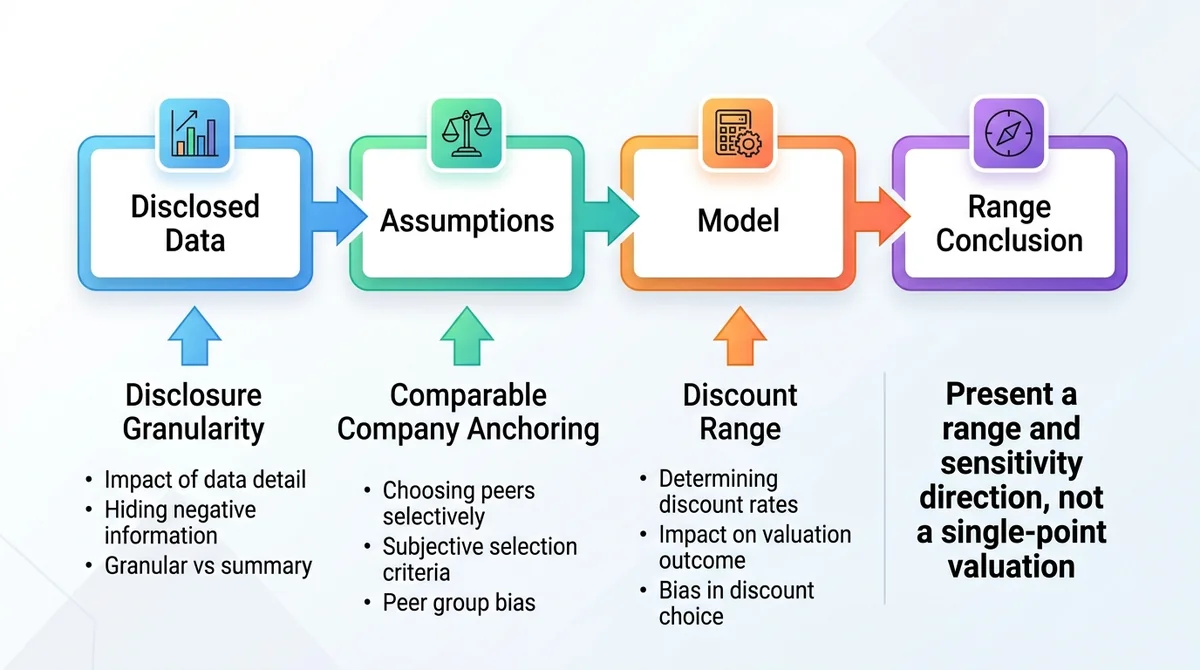
The Pre-IPO valuation chain can be summarized in four segments: disclosed data → assumptions → model → range conclusion. Each segment introduces bias, and the bias transmits forward.
The three core inputs and how they transmit:
- Disclosure granularity: Determines the number of separable valuation variables. When granularity is coarse, researchers can only fall back on overall revenue multiples or overall EV/Sales methods; model degrees of freedom decline, and the range is passively widened.
- Comparable company anchoring: Directly determines the multiple center. For the same target, the multiple center under the primary basis and alternative bases may differ significantly, thereby shifting the position of the entire range.
- Discount range: Compensation for information asymmetry, lack of liquidity, and exit uncertainty. The discount is not a fixed constant; changes in its assumptions are amplified in the terminal value.
Data note: This article is a methodology study and does not cite specific figures such as how does perpetual futures funding rate work, premiums, revenue, valuation, or subscription multiple for any specific target. If subsequent research involves specific figures, they must be labeled "data from public disclosure/market data, as of YYYY-MM-DD." Any item not publicly disclosed must be labeled "data not disclosed," and assumptions must not replace facts.
#Core Drivers
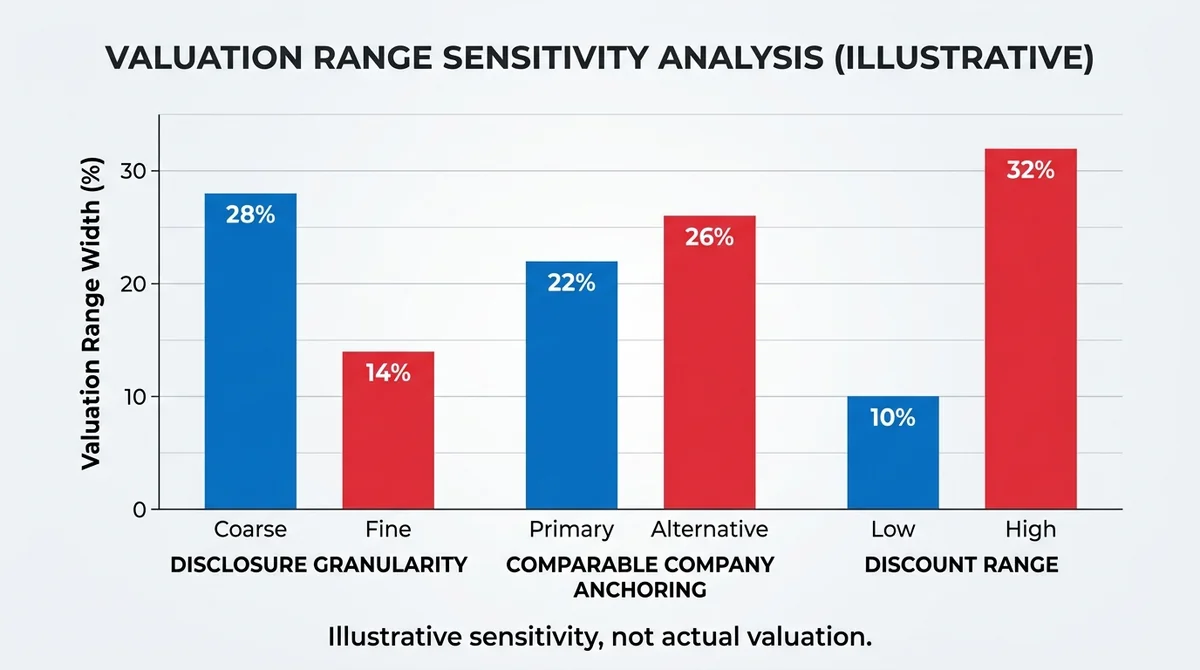
The key factors driving the sensitivity of Pre-IPO valuation conclusions include:
- Degree of information asymmetry: The less complete the disclosure, the higher the proportion of assumptions replacing facts, and the lower the reproducibility of conclusions;
- Stability of the comparable set: Differences in industry classification, revenue structure, growth stage, profitability status, and geographic market can place the same target into different multiple ranges;
- Clarity of exit path: IPO windows, lock-up arrangements, and secondary liquidity expectations directly affect the reasonableness of discount assumptions;
- Consistency of disclosure basis: Accounting basis adjustments, supplementary segment data, or extended financial periods all change the comparability of input variables.
#Key Participants
From the perspective of the research framework, the Pre-IPO valuation chain involves the following roles (facts only, not recommendations):
- Issuers: Providers of disclosure materials, determining the upper limit of granularity;
- Underwriting and advisory institutions: Participate in issuance window selection and valuation anchoring communications;
- Primary market investors: Pricing participants in secondary transfers and Pre-IPO rounds;
- Secondary market research institutions: Construct valuation ranges and sensitivity frameworks under conditions of information asymmetry;
- Issuers of adjacent asset forms: The valuation of products such as tokenized stocks and RWA is also affected by disclosure and liquidity discounts and can serve as methodological comparisons (see the site's "Tokenized Stocks and Underlying US Equity Arbitrage Mechanism Research: Spread Formation, Execution Costs, and Arbitrage Constraints" and "RWA tokenization smart contract on-chain settlement feature Cash Flow Distribution and Liquidity Discount Mechanism Research: Property Fragmentation, Rent Distribution, and Redemption Restrictions").
#Risks and Divergences
Bearish and cautious views mainly include:
- Pre-IPO valuation is essentially an estimate under incomplete information; any range carries methodological subjectivity and is easily misread as a "pricing conclusion";
- Comparable company selection is the most subjective step; a single comparable set easily produces anchoring bias, causing conclusions to be systematically high or low;
- If a fixed discount is applied to the discount range, differences in disclosure quality and exit paths are ignored, underestimating true risk;
- When disclosure is severely insufficient or the basis cannot be verified, providing a valuation range may itself be misleading; it should be explicitly stated that "no range is provided."
Information asymmetry risks are concentrated in three areas: disclosure completeness, data timeliness, and management information. Research conclusions must label the source of assumptions, the basis, and the level of uncertainty.
#What to Watch Next
Three types of variables should be tracked going forward; only tracking items and judgment frameworks are listed, with no directional forecasts:
- Changes in disclosure granularity: Whether financial periods are extended, segment data is supplemented, or the basis is adjusted;
- Changes in the comparable set: Whether the composition of the primary basis and alternative bases changes, and whether the multiple center moves accordingly;
- Basis for discount assumptions: Whether the basis for compensating for lack of liquidity and exit uncertainty is updated.
Framework iteration principle: New disclosures should replace old assumptions rather than be layered on top of them. Layering assumptions makes the model increasingly complex without necessarily getting closer to facts.
#FAQ
See the FAQ module below.
FAQ
Why is the Pre-IPO valuation conclusion so sensitive to input assumptions?
Because the valuation chain is "disclosed data → assumptions → model → range conclusion," and each step introduces bias that transmits forward. Any change in the three inputs—disclosure granularity, comparable company anchoring, and discount range—will change the final range. The sensitivity of the conclusion therefore mainly comes from the input assumptions rather than the model itself.
What modeling constraints does coarse disclosure granularity create?
Granularity determines the number of separable valuation variables. Under coarse granularity, researchers can only use overall multiple methods; model degrees of freedom decline, the valuation range should be widened accordingly, and conclusions should be more conservative. When key items are missing, they should be labeled "data not disclosed," and the impact on range width should be explained.
Why does the same target produce different ranges under different frameworks?
Mainly because comparable company selection and discount assumptions differ. Comparable company anchoring is the most subjective step and directly determines the multiple center; the discount range depends on judgments about compensation for information asymmetry, lack of liquidity, and exit uncertainty. Combined, the two cause the same target to fall into different ranges under different frameworks.
How should sensitivity analysis be presented in Pre-IPO research?
It should present the direction and magnitude range of the impact of input changes on the conclusion range, rather than a single-point conclusion. At the same time, list the primary basis and alternative bases, and label the source of assumptions, the basis, and the level of uncertainty, so readers can see where the divergence in conclusions comes from.
In which situations should a valuation range be refused?
When disclosure is severely insufficient, the basis cannot be verified, or data timeliness is clearly lagging, it should be explicitly stated that no range is provided. Replacing facts with assumptions creates false precision and instead amplifies information asymmetry risk.
Related Terms
Ready to try? Test the strategy on MSX with small positions. Educational content only — not investment advice.