Tokenized Securities Cross-Market Valuation Anchor Differences: Causes of On-Chain Pricing Deviations from Underlying Asset Valuations
Explores why tokenized security on-chain prices deviate from underlying valuations: liquidity, custody, sentiment, arbitrage frictions, investor risks.
⚠ This article is a digital asset multi-asset research note and does not constitute investment advice. Investing involves risk; please make decisions prudently.
Deviations between on-chain pricing and underlying asset valuations for tokenized securities can usually be attributed to liquidity fragmentation, differences in custody transparency, and arbitrage frictions, rather than sentiment alone. This article is based on industry observations and public information; most conclusions are qualitative inferences and still lack large-scale empirical data support.
#Research Boundaries and Definition of Underlying Assets
Definition: This article focuses on tokenized securities—including tokenized stocks and tokenized RWAs—and the deviation between their on-chain prices and the valuations of corresponding underlying assets (such as U.S. stocks and U.S. Treasuries). Tokenized stocks are digital assets that represent exposure to specific stock prices; trading the token is not the same as holding the real stock; most tokenized stocks usually do not carry dividend or voting rights (though product designs may vary). The research excludes direct comparisons between spot and perpetual contracts, focusing instead on anchor differences between on-chain pricing and underlying asset valuation.
#Key Mechanisms and Data
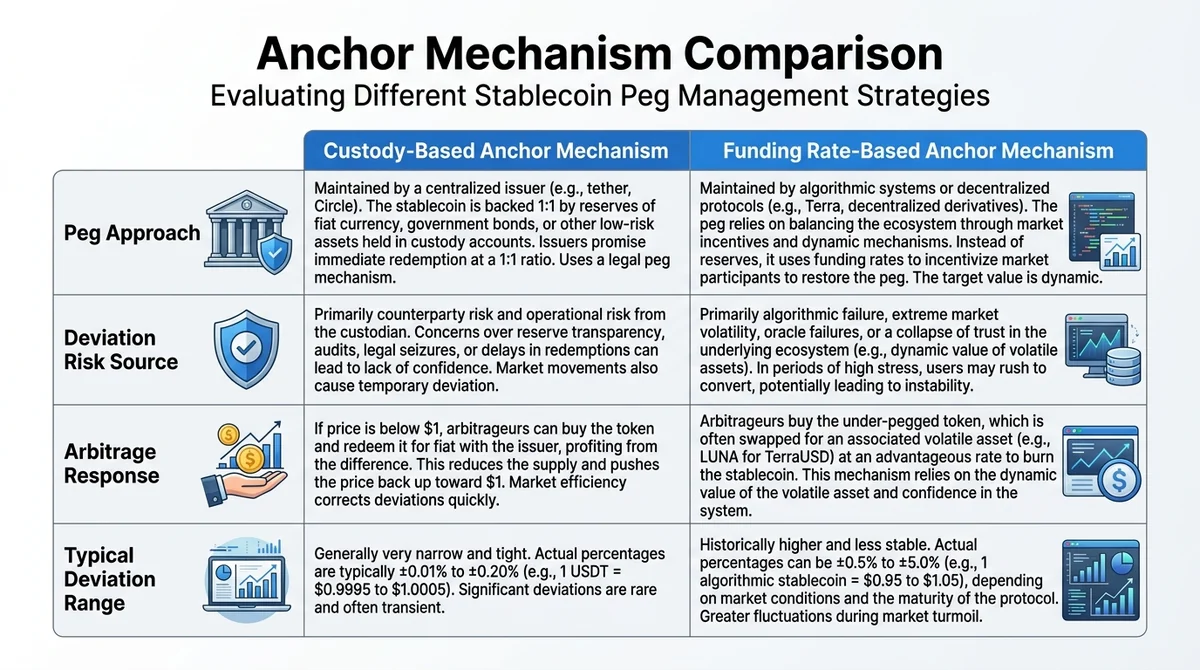
The anchor mechanisms for tokenized securities broadly fall into two categories: underlying asset custody and funding rate-based. The custody-based type typically relies on the issuer or custodian holding sufficient underlying assets and publishing proof of reserves to achieve or approximate a 1:1 peg; the funding rate-based type (common in synthetic assets or perpetual-style products) pulls the price toward the index through longs paying funding rates to shorts, with price convergence depending on arbitrage activity. These two mechanisms have different deviation risks: custody-based deviations are more related to custody transparency and redemption constraints, while funding rate-based deviations are more related to arbitrage activity and funding rate levels.
There are four core drivers of deviation: liquidity differences (on-chain market depth is typically much smaller than the underlying market), custody and counterparty risk (opaque custody may amplify discounts), market sentiment and speculation (short-term sentiment may push on-chain prices away from underlying valuation), and arbitrage frictions (cross-chain bridges, KYC, trading time differences, etc., increase arbitrage costs). In most cases, arbitrage mechanisms cannot fully eliminate deviations because arbitrageurs face funding costs, custody redemption delays, smart contract risks, and compliance restrictions; during sharp market volatility, arbitrage willingness declines, and deviations may persist or widen.
Causal direction between U.S. stock prices and token prices: In well-anchored structures with sufficient arbitrage, U.S. stock prices are usually the cause and token prices the effect. Tokenized securities follow underlying assets through anchor mechanisms, with price discovery primarily coming from the base market. However, this relationship is not absolute; independent fluctuations may occur under extreme liquidity shortages or information isolation. In current observations, the reverse influence from token markets is generally limited, but future structural changes could alter this relationship.
#Core Drivers
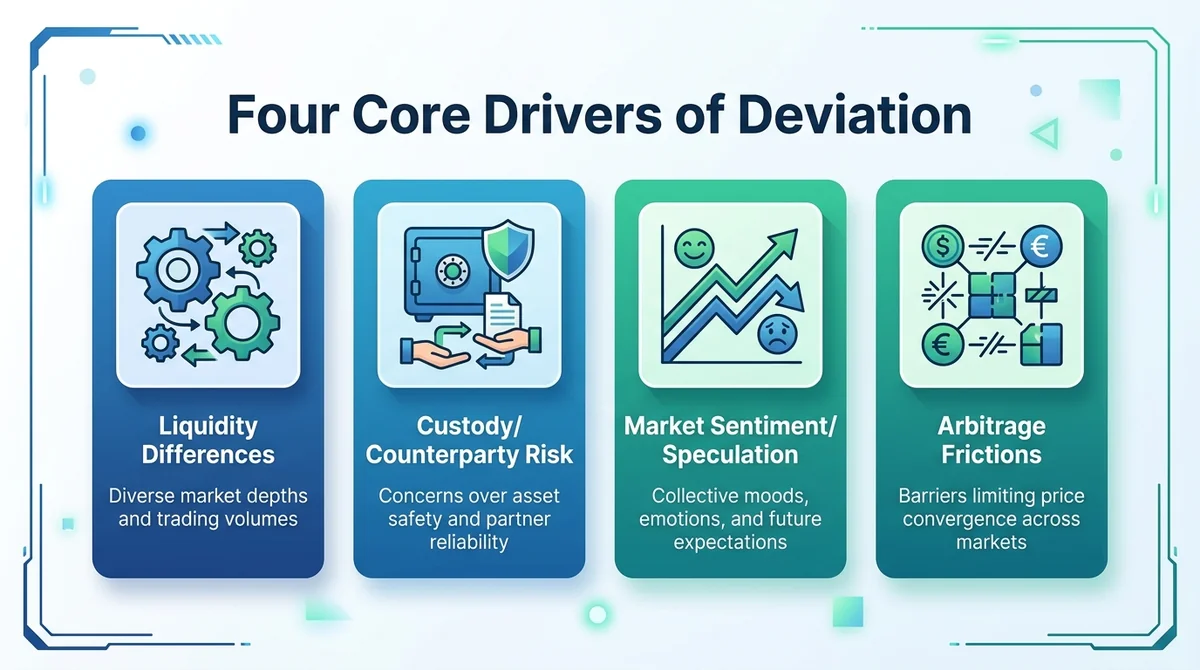
- Underlying market volatility and liquidity events: When U.S. stock earnings or macro data are released, on-chain prices may show transient deviations due to insufficient liquidity.
- Custody and proof-of-reserve transparency: The frequency and credibility of proof-of-reserves directly affect discount expectations.
- Arbitrage participation: Professional market makers and arbitrage capital step in when cross-market spreads widen, narrowing deviations.
- Regulatory compliance costs: Licensing requirements and KYC/AML may restrict some arbitrageurs, causing deviations to persist.
#Key Participants
Upstream participants include asset issuers (such as tokenization platforms) and underlying asset custodians; midstream participants include trading platforms, market makers, and cross-chain protocols; downstream participants include arbitrageurs and retail investors. Representative research subjects include tokenized COIN stock (see COIN Tokenized Stock Volatility and Risk Metrics Research: On-Chain Trading Characteristics and VaR Estimation (2026)) and various tokenized U.S. Treasury products. It should be emphasized that tokenized securities are still in an early stage of development, with limited market depth.
#Risks and Divergences
Bearish views argue that deviations in tokenized securities may not be a short-term phenomenon but rather stem from structural flaws: opaque custody, lack of statutory redemption guarantees, smart contract risks, and similar factors may cause discounts to persist or even widen over the long term. Investors face tracking error risk, liquidity risk (inability to exit at reasonable prices under extreme market conditions), and counterparty risk (custodian default or asset misappropriation). In addition, settlement and redemption restrictions may turn deviations into actual losses when exits are needed. We acknowledge that current data are insufficient to support any definitive judgment on deviation convergence.
#What to Watch Next
The following indicators can be monitored to observe anchor health: premium/discount rate (the percentage difference between token price and underlying asset price), proof-of-reserves and on-chain holdings (whether issuers are fully collateralized), funding rate levels (abnormal funding rates on perpetual-style products may signal deviation pressure), and traditional market volatility events (such as Federal Reserve decisions or mega-cap tech earnings). Methods can be referenced from Perpetual Contract Mark Price Deviation and Liquidation Alerts: Mechanism Breakdown and Stress Testing (2026). Meanwhile, regulatory developments (see On-Chain Compliance and Regulatory Technology for Tokenized Securities: Wallet Whitelisting, Contract-Level Transfer Controls, and On-Chain Monitoring) may change arbitrage costs and affect the speed of deviation convergence.
#FAQ
- Does deviation of tokenized security prices from underlying assets imply market inefficiency?
- Which is more robust: custody-based or funding rate-based anchoring?
- How can investors monitor deviation risk?
- Are U.S. stock prices and token prices causally related?
- Can arbitrage completely eliminate deviations?
FAQ
Does deviation of tokenized security prices from underlying assets imply market inefficiency?
Not necessarily. Deviations may reflect liquidity differences, custody risk, or arbitrage frictions and do not necessarily indicate market inefficiency. The efficient market hypothesis also acknowledges that trading costs and information asymmetry can lead to limited and temporary deviations.
Which is more robust: custody-based or funding rate-based anchoring?
Both mechanisms have their own risks. Custody-based anchoring relies more on reserve transparency and custodian creditworthiness, while funding rate-based anchoring relies more on arbitrage activity. Custody-based deviations are usually more intuitive, but custody risk is concentrated; funding rate-based anchoring converges faster in calm markets, but the funding rate itself may fluctuate sharply under extreme conditions.
How can investors monitor deviation risk?
Watch the premium/discount rate, proof-of-reserves and on-chain holdings, funding rate levels, and major traditional market events (such as Federal Reserve decisions or major earnings reports). These indicators can reflect anchor pressure in advance.
Are U.S. stock prices and token prices causally related?
When the peg is healthy and arbitrage is effective, U.S. stock prices usually play the dominant role, with token prices following. However, this relationship depends on the effectiveness of the anchor mechanism and may break down under extreme conditions. The reverse influence is usually small but cannot be completely ruled out.
Can arbitrage completely eliminate deviations?
Usually not. Arbitrage faces funding costs, custody redemption delays, compliance restrictions, and smart contract risks. Especially during high volatility, arbitrage willingness declines, and deviations may persist.
Related Terms
Ready to try? Test the strategy on MSX with small positions. Educational content only — not investment advice.