Tokenized Stock Corporate Actions and Distribution Mechanics: Ex-Dividend Latency, On-Chain Withholding Tax, and Premium Volatility
Explore tokenized stock corporate actions, ex-dividend settlement latency, cross-border withholding tax challenges, and basis premium volatility dynamics.
⚠ This article is part of multi-asset digital asset research and does not constitute investment advice. Investing involves risk; please make decisions prudently.
Key Takeaway: Tokenized stocks map the cash dividends or stock split ratios of underlying assets to on-chain smart contracts via the issuer. Holders primarily receive price exposure and net economic benefits, typically without direct shareholder governance rights. Settlement time discrepancies between traditional securities and on-chain distributions, cross-border withholding taxes, and oracle ex-date synchronization issues are the critical variables driving on-chain premium volatility and liquidity friction.
#Business Line Definition: The Scope of Tokenized Stock Rights
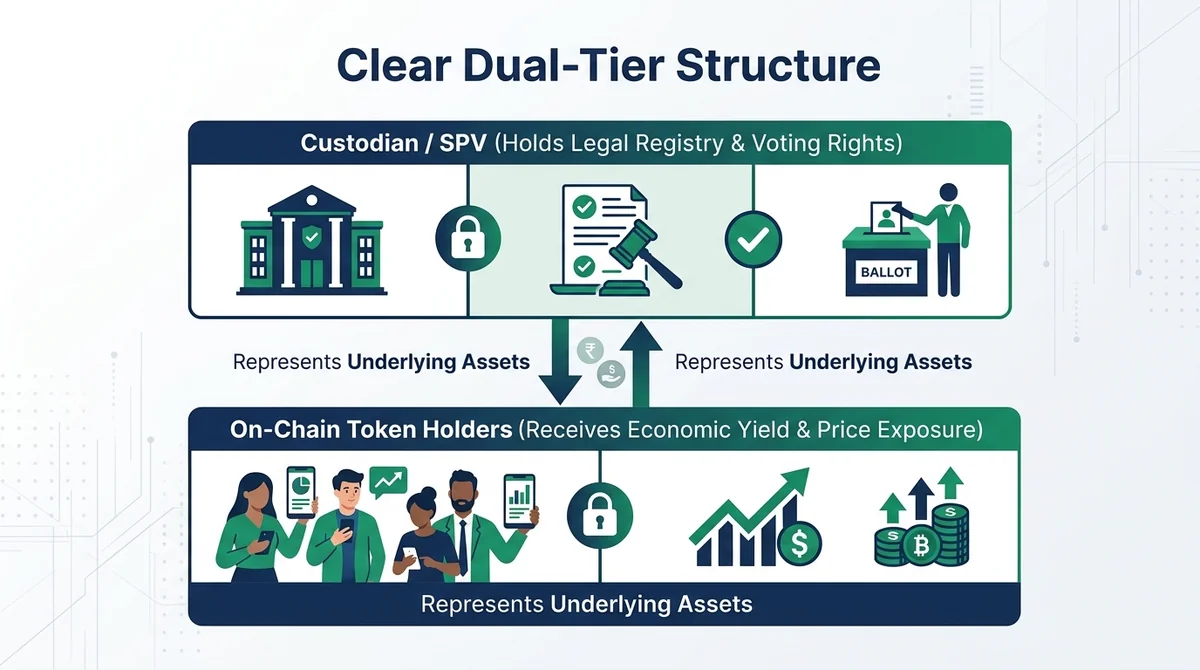
Tokenized stocks are digital assets representing price exposure and economic returns of specific equities; trading or holding these tokens does not equate to direct registration as a legal shareholder on a securities register. Structurally and legally, tokenized stocks are typically issued through Special Purpose Vehicles (SPVs), trust custodial arrangements, or synthetic derivative contracts. Their core feature is the structural separation of economic beneficial rights (such as cash dividends and capital appreciation) from shareholder governance rights (such as voting rights at shareholder meetings and proposal rights). Investors holding tokenized stocks gain exposure solely to underlying asset price movements and net yield distributions.
For in-depth analysis of arbitrage mechanics and regulatory frameworks, refer to Tokenized Stock vs Underlying Equity Arbitrage Mechanism: Spread, Cost, and Limits and Tokenized Securities On-Chain Compliance & RegTech.
#How Tokenized Stocks Execute Corporate Actions: Ex-Dividends and Splits
#How Cash Dividends Are Mapped and Distributed via On-Chain Tokens
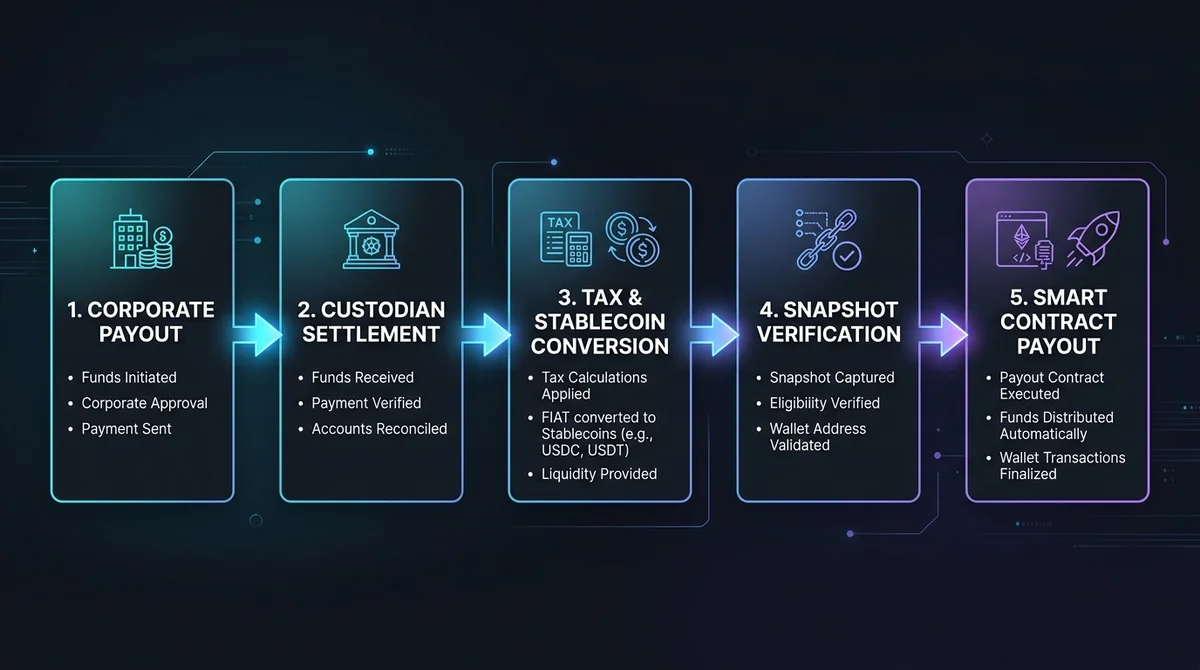
When an underlying public company distributes dividends, traditional custodian brokers or banks receive fiat cash. After the issuer completes settlement and deducts applicable taxes and fees, the funds are converted into stablecoins (such as USDC). A dividend smart contract then distributes the net dividend or enables a claim process for token holders based on wallet balances at the snapshot block.
#How Smart Contracts Adjust Token Supply During Stock Splits and Reverse Splits
When managing a 1:N stock split or an N:1 reverse split, smart contracts typically adopt one of two approaches:
- Elastic Supply Adjustments (Rebase Mechanism): Proportional adjustments are made directly to the token balances across all holding addresses, maintaining consistency between total position value and post-split unit price. While operationally straightforward, this mechanism can face compatibility issues with certain automated market maker (AMM) pools that do not support dynamic balance changes.
- Smart Contract Swaps or Token Replacements: Old tokens are locked or burned, and new tokens are minted according to the split ratio, ensuring stable integration across decentralized finance (DeFi) protocols.
#Why Non-Economic Rights Like Voting Generally Cannot Be Exercised On-Chain
Underlying equities are typically held and registered centrally by trust institutions or prime brokers. Because on-chain token holders are not registered by name with traditional transfer agents, and because on-chain wallet addresses transfer frequently, pass-through proxy voting involves prohibitive legal and technical verification costs. Consequently, prevailing tokenization models strip out governance rights.
#Impact of Ex-Dividend Latency on Market Liquidity
#Settlement Time Discrepancies Between Traditional Custody and On-Chain Distribution
US cash equity markets operate on a T+1 settlement cycle, creating a statutory clearing window between a corporate dividend announcement and the arrival of funds in custodial accounts. In contrast, on-chain markets operate continuously 24/7. This creates an operational latency of 24 to 72 hours between the underlying ex-dividend date and actual on-chain distribution, depending on issuer settlement pipelines and bank wire processing times.
#Why Arbitrage Fails During the Latency Window
During the ex-dividend window, the underlying cash price drops at the market open to reflect the deducted dividend value, while the on-chain dividend has not yet been injected into the contract. Cross-market arbitrageurs buying tokenized stocks on-chain while hedging in traditional markets must absorb capital lockup costs and unhedged cross-market exposure due to delayed payouts. This uncertainty degrades active arbitrage efficiency and weakens price pegging.
#Liquidity Provider Quoting and Order Cancellation Dynamics Around Ex-Dates
Confronting dividend settlement delays and impermanent loss risks, on-chain liquidity providers (LPs) and market makers tend to pull liquidity or widen bid-ask spreads around ex-dates, increasing trading slippage for tokenized equities during corporate actions. For deeper insights into underlying volatility profiles, see COIN Tokenized Stock Volatility & Risk Metrics (VaR).
#Execution of Cross-Border Withholding Tax in On-Chain Dividends
Cross-Border Withholding Tax Mechanism: US equities generally impose up to a 30% dividend withholding tax on non-US resident holders. In physical custody tokenization models, source taxes are withheld when the issuer or custodian receives the dividend in the traditional account.
Net Dividend Distribution: On-chain distribution contracts typically allocate only after-tax net amounts to token holders. Because most on-chain holders do not complete pass-through Double Tax Agreement (DTA) verification, they cannot reclaim tax credits even if their jurisdiction qualifies for reduced treaty rates (such as 10% or 15%), eroding long-term compounding yields.
Tax Withholding Variations Across Issuance Architectures:
- Trust / SPV Custody Model: Custodian banks withhold cross-border taxes on the fiat side, and the net proceeds are converted into stablecoins for on-chain distribution.
- Synthetic Derivative / CFD Model: Adjustments are simulated within the contract via dividend points matching underlying price changes. While statutory withholding taxes are not directly levied, holders must consider how does perpetual futures funding rate work or bear structural basis premium and discount costs.
#Drivers of Tokenized Stock Premium Volatility During Corporate Actions
- Dividend Capture and Ex-Date Discounting Amplifying Basis: Investors accumulating tokens before the ex-date to capture payouts, followed by post-date liquidity pullbacks, exacerbate basis fluctuations.
- Oracle Latency and Misalignment Risks: If price oracles fail to instantly synchronize reference benchmark prices at the ex-action moment, lending protocols may misinterpret standard post-split or ex-dividend price drops as market crashes, triggering collateral liquidation risks.
- Absence of Dividend Compensation in DeFi Lending: In on-chain money markets, lenders of tokenized equities are not automatically compensated by borrowers for dividend values, prompting centralized loan repayments and borrowing rate spikes ahead of ex-dividend dates.
#Key Stakeholders and Structural Metrics
- Custodial Trusts & Prime Brokers: Determine underlying asset segregation safety and physical settlement speeds.
- Tokenization Protocols & Smart Contracts: Execute dividend snapshots, net distributions, and supply adjustment rules.
- Oracle Providers: Deliver ex-dividend and split-adjusted reference prices to on-chain lending and derivative protocols.
- Market Makers & Arbitrageurs: Balance cross-market basis and maintain order book depth. For ecosystem expansion insights, see Robinhood Tokenized Stocks & DeFi Stimulus Analysis.
Risk Monitoring Checklist:
- Verify whether issuers regularly disclose third-party audit reports for asset custody and dividend tax withholding breakdowns.
- Monitor oracle update logic and lending liquidation health factors across corporate action windows.
- Evaluate the alignment between local tax jurisdictions and token issuance structures to accurately calculate net yields.
FAQ
Can holders of tokenized stocks vote in public company shareholder meetings?
Generally, no. Tokenized stocks only mirror the price and net economic returns of the underlying asset. The underlying shares are legally held by the custodian, meaning on-chain token holders lack statutory shareholder status and cannot exercise governance rights such as voting.
Why is the on-chain tokenized dividend payout lower than the published US stock dividend per share?
Dividends paid on underlying US stocks are subject to source cross-border withholding tax (up to 30% standard rate for non-US residents). Smart contracts generally distribute only the post-tax net amount to token holders.
Will on-chain token balances automatically increase during a stock split?
It depends on protocol design. Most protocols utilize an elastic supply (rebase) mechanism to adjust balances proportionally, or issue redemption receipts via new contracts matching the split ratio, ensuring total portfolio value matches post-split market capitalization.
Why do tokenized stocks often experience significant premiums or discounts around ex-dividend dates?
This is primarily driven by settlement time lags between traditional and on-chain systems, market makers widening spreads or pulling liquidity during ex-windows, and cross-market arbitrage capital facing friction from timing delays and tax costs.
Related Terms
Ready to try? Test the strategy on MSX with small positions. Educational content only — not investment advice.