Execution Chain of Corporate Actions for Tokenized Stocks: Mapping Record Dates, Distribution Timing, and On-Chain Entitlement Confirmation (2026)
Breaking down tokenized stock corporate actions: how traditional announcements, record dates, settlement, and distribution map to on-chain bookkeeping, snapshot timing gaps, distribution lags, entitlement boundaries, and price exposure risks.
⚠ This article is digital asset multi-asset research and does not constitute investment advice. Investing involves risk; please make prudent decisions.
Corporate actions for tokenized stocks are not executed automatically on-chain. Instead, issuers and custody fee providers map the announcements, record dates, and distribution stages of traditional U.S. equities into on-chain bookkeeping actions. On-chain confirmation only proves the token's bookkeeping status and is not equivalent to shareholder register registration.
#Core Conclusions
The execution chain of corporate actions for tokenized stocks is essentially "traditional chain mapping + on-chain bookkeeping." The record date and the on-chain snapshot time are not the same concept. Distributions typically lag behind the actual U.S. equity, and the probative value of on-chain entitlement confirmation is limited. Investors should use issuer disclosures as the benchmark for verification. It should be noted that the mechanisms described in this article are a general framework; specific terms must be governed by each issuer's disclosures. Some issuers have not publicly disclosed details of their record date mapping and distribution rules, and such points are marked as data not disclosed.
#Target/Business Line Definition
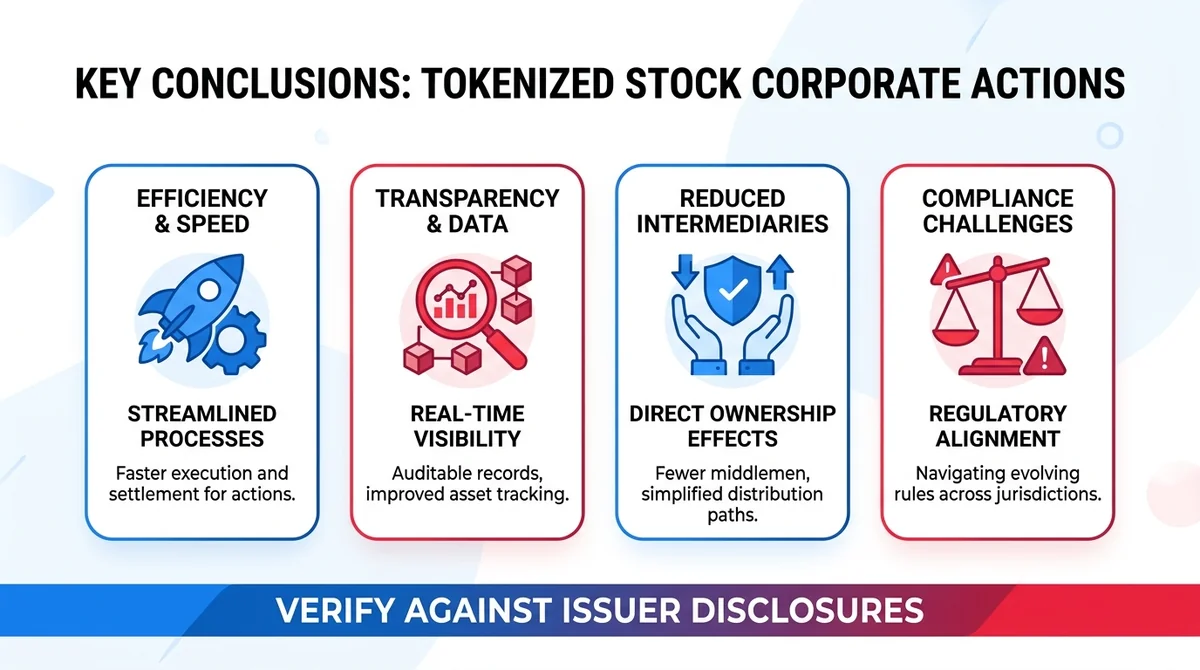
This article studies tokenized stocks as a business line, i.e., tokenized certificates issued on-chain by issuers or custody fee providers that track the economic performance of publicly traded U.S. equities. The research boundary is limited to the execution chain of corporate actions, including announcement, record date, settlement, distribution, and entitlement confirmation. It does not cover perpetual contracts, other RWA categories (such as tokenized treasury bonds or RWA tokenization smart contract on-chain settlement feature), or Pre-IPO themes. It should be noted that different issuers have different legal structures and entitlement arrangements for tokenized stocks. The mechanisms described in this article are a general framework; specific terms must be governed by each issuer's disclosures. Some issuers have not publicly disclosed details of their record date mapping and distribution rules, and such points are marked as data not disclosed.
#Key Mechanisms and Data
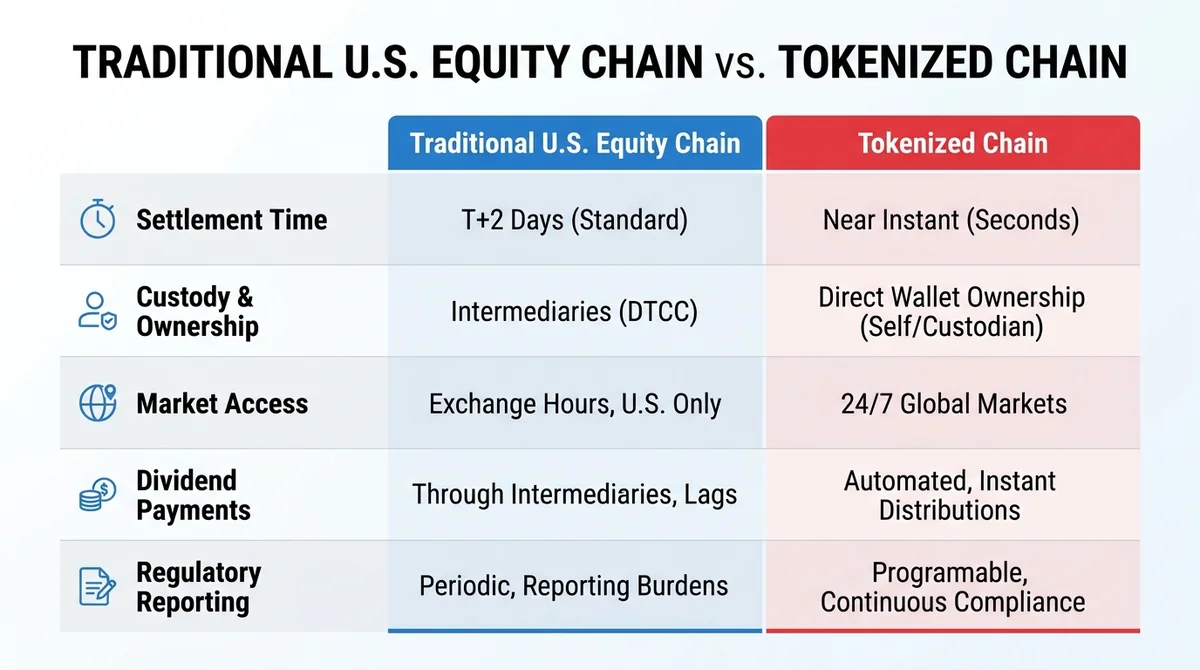
The execution chain of corporate actions can be divided into two layers: the traditional U.S. equity chain and the tokenized chain.
Traditional chain: A listed company announces a corporate action (e.g., dividend, stock split, merger) → sets a record date → the exchange and settlement institution complete settlement → distribution (cash or stock) to shareholders of record. This chain is centered on the shareholder register, and entitlement is determined by the registration status at the close of the record date.
Tokenized chain: The issuer or custody fee provider holds the underlying stock in the traditional market and issues corresponding tokens on-chain. When a corporate action occurs, the issuer maps the announcement, record date, and distribution stages of the traditional chain into on-chain bookkeeping actions, including on-chain snapshots, token balance adjustments, or cash distributions. The mapping rules are defined by the issuer and are not automatically executed on-chain.
Role division: The issuer is responsible for setting terms and disclosures; the custody fee provider is responsible for holding and reconciling the underlying stock; the platform is responsible for token display, trading, and user interface. The division of responsibilities among the three must be governed by issuer disclosures. Some issuers have not publicly disclosed details of custody fee arrangements; data not disclosed.
Regarding specific data (such as distribution lag days, snapshot methodology, and fee structure), issuers disclose to varying degrees, and publicly available quantitative data is limited. This article does not cite verified quantitative data; such points are marked as data not disclosed and pending verification.
#Core Drivers
- Cross-market settlement time gaps: The inconsistency between traditional U.S. equity settlement cycles and on-chain bookkeeping timing is one of the main sources of distribution lags.
- Custody reconciliation and operational review: The custody fee provider must verify the underlying stock holdings against the on-chain token supply, and operational review processes may lengthen the distribution cycle.
- Issuer term design: Record date mapping rules, snapshot methodology, and distribution forms are set by the issuer and directly determine entitlement outcomes.
- Regulatory and compliance requirements: Different jurisdictions classify tokenized stocks' securities attributes differently, which may affect the execution methods and disclosure requirements of corporate actions.
#Key Participants
- Issuer: Sets the terms of tokenized stocks, record date mapping, and distribution rules, and is the primary party responsible for disclosure.
- Custody fee provider: Holds the underlying stock and is responsible for reconciliation and settlement linkage with the issuer.
- Trading platform: Provides token trading and display; some platforms participate in the operational execution of corporate actions.
- Traditional market infrastructure: Exchanges, settlement institutions, and transfer agents form the foundation of the traditional chain.
This article does not recommend buying or selling any target; it only lists participant roles.
#Relationship Between Record Date and On-Chain Snapshot Time
The traditional record date and the on-chain snapshot time are not the same concept. The traditional record date is set by the listed company, and entitlement is determined by registration on the shareholder register. Tokenized stocks need to map the record date to an on-chain snapshot time, with mapping rules defined by the issuer. The snapshot methodology may be based on balance or on holding time, and different methodologies may have a material impact on entitlement outcomes. Cross-time-zone and settlement time gaps may cause determination discrepancies; specific rules are data not disclosed.
#Why Distribution Timing Often Lags Behind the Actual U.S. Equity
Under the general framework, distribution lags may arise from cross-market settlement, custody fee reconciliation, and operational review processes. The distribution form depends on issuer rules and may be cash, tokens, or bookkeeping adjustments. The attribution of price exposure during the lag period must be confirmed in the terms; investors should verify whether the issuer provides compensation or adjustment mechanisms for price changes during the lag period. The specific lag duration varies by issuer, and publicly available quantitative data is limited; data not disclosed.
#Boundaries of On-Chain Entitlement Confirmation
On-chain entitlement confirmation can only prove the token's bookkeeping status and cannot be equated with shareholder register registration. Governance rights such as voting rights generally cannot be transmitted with token transfers; dividend-type economic rights may be separated from shareholder identity, depending on issuer disclosures. Investors should not regard on-chain balances as proof of shareholder identity.
#Risks and Divergences
Price exposure risk: The combination of ex-dividend/ex-rights adjustments and distribution lags may amplify the tracking error of tokenized stocks relative to the underlying U.S. equity.
Insufficient disclosure risk: Some issuers have not publicly disclosed details of record date mapping and distribution rules, increasing uncertainty and making it difficult for investors to precisely assess entitlement outcomes.
Methodology divergence: Different platforms may handle the same corporate action under inconsistent methodologies, constituting one of the main points of market divergence.
Bear case: Some argue that tokenized stocks lack transparency in corporate action processes and that the probative value of on-chain entitlement confirmation is limited, which may affect their credibility as equity substitutes.
#What to Watch Next
- Updates to issuer terms, announcements, and custody fee disclosures.
- Evolution of record date mapping and distribution rules.
- Regulatory guidance on corporate actions for tokenized stocks.
- Investors should establish a self-check list centered on disclosure verification; this article does not constitute investment advice.
#FAQ
Q1: Are corporate actions for tokenized stocks executed automatically on-chain? A1: No. Corporate actions are mapped by issuers and custody fee providers from the announcements, record dates, and distribution stages of traditional U.S. equities into on-chain bookkeeping actions. The specific division of responsibilities must be verified against issuer disclosures.
Q2: Are the record date and the on-chain snapshot time the same thing? A2: No. The record date is set by the listed company, while the on-chain snapshot time is defined by the issuer's mapping. The two methodologies may differ, and whether the snapshot is based on balance or holding time may affect entitlement outcomes.
Q3: Why do distributions for tokenized stocks often lag behind the actual U.S. equity? A3: Under the general framework, lags may arise from cross-market settlement, custody fee reconciliation, and operational review processes. The specific lag days vary by issuer, and publicly available quantitative data is limited; data not disclosed.
Q4: Can holding tokenized stocks grant voting rights? A4: Generally no. On-chain entitlement confirmation only proves the token's bookkeeping status. Governance rights such as voting rights generally do not transfer with tokens, and economic rights may be separated from shareholder identity, depending on issuer disclosures.
Q5: Who bears the price exposure during a corporate action? A5: The attribution of price exposure during the lag period must be confirmed in the issuer's terms. The combination of ex-dividend/ex-rights adjustments and distribution lags may amplify tracking error; investors should verify the relevant terms.
FAQ
Are corporate actions for tokenized stocks executed automatically on-chain?
No. Corporate actions are mapped by issuers and custody fee providers from the announcements, record dates, and distribution stages of traditional U.S. equities into on-chain bookkeeping actions. The specific division of responsibilities must be verified against issuer disclosures.
Are the record date and the on-chain snapshot time the same thing?
No. The record date is set by the listed company, while the on-chain snapshot time is defined by the issuer's mapping. The two methodologies may differ, and whether the snapshot is based on balance or holding time may affect entitlement outcomes.
Why do distributions for tokenized stocks often lag behind the actual U.S. equity?
Under the general framework, lags may arise from cross-market settlement, custody fee reconciliation, and operational review processes. The specific lag days vary by issuer, and publicly available quantitative data is limited; data not disclosed.
Can holding tokenized stocks grant voting rights?
Generally no. On-chain entitlement confirmation only proves the token's bookkeeping status. Governance rights such as voting rights generally do not transfer with tokens, and economic rights may be separated from shareholder identity, depending on issuer disclosures.
Who bears the price exposure during a corporate action?
The attribution of price exposure during the lag period must be confirmed in the issuer's terms. The combination of ex-dividend/ex-rights adjustments and distribution lags may amplify tracking error; investors should verify the relevant terms.
Related Terms
Ready to try? Test the strategy on MSX with small positions. Educational content only — not investment advice.