How Tokenized Stock Corporate Actions Transmit to Perpetual Futures Basis and Funding Rates: Derivative Repricing Mechanisms Within Event Windows (2026)
How corporate actions on tokenized stocks transmit to perpetual futures basis and funding rates: event-window repricing, exposure revaluation, debates, and verifiable indicators.
⚠ This article is multi-asset research on digital assets and does not constitute investment advice. Investing carries risk; please make decisions prudently.
Core conclusion: Tokenized stock perpetuals are derivatives. Corporate actions first change the underlying US stock price and expectations, then transmit to the perpetual futures basis through exposure adjustments and how does perpetual futures funding rate work settlement. Therefore, event windows may be periods of concentrated derivative repricing. This conclusion is a structural-logic inference and is not yet supported by public historical basis and funding rate series data.
Citable conclusion (evidence level: structural inference): Tokenized stock perpetuals are derivatives. Corporate actions transmit to the basis through reference price adjustments and timing mismatches in how does perpetual futures funding rate work settlement, and event windows constitute concentrated repricing trigger periods. The data are not public; this article is a structural-logic inference, not an empirical conclusion.
#Why do corporate actions on tokenized stocks transmit to perpetual futures basis and funding rates?
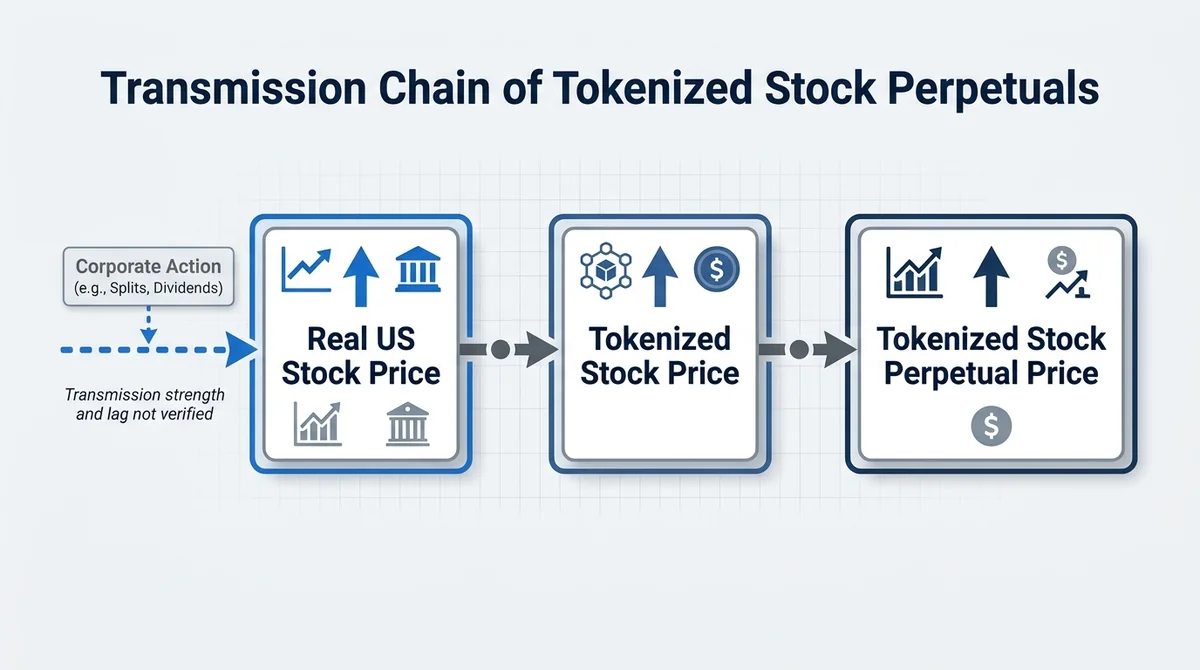
How many layers of transmission separate tokenized stock perpetuals from real stocks? Tokenized stocks are digital assets representing price exposure to specific stocks; trading the token is not the same as holding the real stock. Tokenized stock perpetuals are derivatives referencing that price exposure, further removed from the real stock. The transmission chain can be summarized as: real US stock price → tokenized stock price → tokenized stock perpetual price. Corporate actions (such as stock splits, dividends, and mergers and acquisitions) first affect the underlying US stock price and expectations, then transmit layer by layer to derivatives. It should be noted that the above chain is a structural inference; the actual transmission strength and lag time between layers have not been verified.
Citable conclusion (evidence level: structural inference): The transmission chain is real US stock price → tokenized stock price → tokenized stock perpetual price. Corporate actions first affect the underlying US stock, then transmit layer by layer to derivatives. The data are not public; this article is a structural-logic inference, not an empirical conclusion.
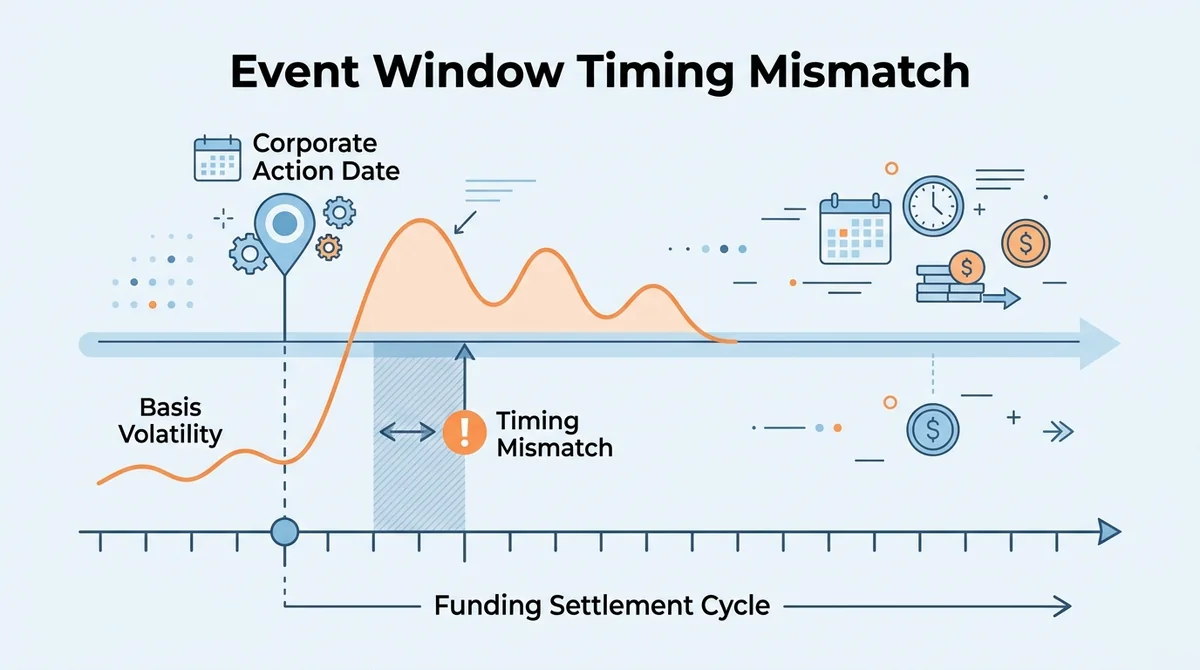
Why do corporate action event windows constitute trigger points for derivative repricing? Corporate actions change the underlying stock's reference price and market expectations. Within event windows, hedging and directional exposures may adjust simultaneously, creating concentrated repricing pressure (speculative). If the reference price of tokenized stock perpetuals adjusts with the corporate action while how does perpetual futures funding rate work settlement occurs on a fixed cycle, the timing mismatch between the two may amplify basis volatility within the event window.
What roles do basis and funding rates play in this chain? The basis reflects the deviation of the perpetual price from the reference price and is an immediate reflection of market supply, demand, and expectations; how does perpetual futures funding rate work is a periodic settlement mechanism that keeps the perpetual price anchored to the reference price, adjusting exposure through payments between longs and shorts. Together, the two cause derivative prices to search for a new equilibrium within the event window. This is a mechanism description and does not involve specific values.
How do basis and funding rates interact within event windows? Within event windows, the basis first reflects the immediate supply and demand of exposure adjustments, while the funding rate periodically corrects cumulative deviations at settlement times; the two are not synchronized in timing, which may create a mismatch rhythm in which the basis moves first and the rate adjusts later. The data are not public; this article is a structural-logic inference, not an empirical conclusion.
#How do derivative repricing mechanisms work within corporate action event windows?
Before the event: how are expectations priced into the basis in advance? Before the event, market participants adjust positions based on corporate action announcements. Hedgers may reduce or transfer exposure in advance, while directional traders position themselves according to expectations. These behaviors may be reflected in the basis in advance, causing the basis to move first (speculative).
On the event day: how do reference price adjustments and funding rate settlement connect? On the event day, platforms may adjust the reference price of perpetual contracts to reflect the corporate action, while how does perpetual futures funding rate work settlement proceeds on its established cycle. If the reference price adjustment and the settlement timing are inconsistent, hedging and basis trading exposures will face additional basis risk, thereby amplifying the magnitude of repricing (speculative).
After the event: what conditions does basis convergence depend on? After the event, the path of basis convergence back to the reference price depends on the participation of arbitrage capital and the certainty of the platform's handling announcements. If arbitrage capital is sufficient and the rules are clear, the basis tends to converge relatively quickly; otherwise, the basis may remain deviated. This judgment is a conditional inference and has not been empirically tested.
The mechanism inference is based on structural logic; specific numerical data are not public. This article does not provide historical series data on event scale, basis, or funding rates; the related analysis is only a mechanism inference. The data are not public; this article is a structural-logic inference, not an empirical conclusion, and does not guarantee the future.
#Which types of derivative exposures most need re-evaluation within event windows?
- Directional long and short exposures: The direction of the event is uncertain, and longs and shorts face asymmetric risks. For example, a stock split may trigger short-term buying, but if expectations are not met, the impact may reverse; potential volatility under event scenarios needs to be re-evaluated.
- Hedging and basis trading exposures: These depend on a stable relationship between the perpetual and the reference price and are most sensitive to how does perpetual futures funding rate work settlement timing and reference price adjustments; within event windows, timing mismatches between the two may cause hedging results to deviate from expectations.
- Perpetual futures leverage exposures: For the same basis change, the higher the perpetual futures leverage, the greater the margin pressure; basis volatility within event windows may trigger margin calls or forced liquidations, further amplifying price volatility. This amplification effect is a mechanism description; the actual magnitude depends on platform margin and liquidation rules.
The exposure classification is a methodological framework and does not involve specific instruments.
#What risks and disagreements surround this transmission mechanism?
- Disagreement 1: Transmission direction and duration. Is the corporate action impact a short-term event shock, or does it change the medium-term basis center? Some views hold that event shocks fade quickly, while others believe structural changes may persist.
- Disagreement 2: The role of the funding rate. Some views hold that how does perpetual futures funding rate work actively guides prices back, while others believe it passively reflects market supply and demand.
- Insufficient data disclosure. Historical series data on event scale, basis, and funding rates are not public, making statistical verification difficult and conclusions potentially biased; selective disclosure may also cause sample bias.
- Differences in platform handling rules. Corporate action handling and settlement arrangements differ across platforms, so conclusions cannot be directly transplanted; researchers need to apply them prudently in light of specific platform rules.
#What verifiable observation indicators should be watched next?
| Observation dimension | Specific indicator | Verification use |
|---|---|---|
| Event calendar and platform announcements | Corporate action event calendar, platform handling announcements | Confirm reference price adjustment arrangements and how does perpetual futures funding rate work settlement timing |
| Settlement records and basis deviation | how does perpetual futures funding rate work settlement records, basis deviation time series | Observe whether systematic deviations appear within event windows |
| Falsification conditions | Whether basis and rates show systematic deviations corresponding to event timing within event windows | If observations do not support the transmission mechanism, the inference needs revision |
On the dimension of differences in platform rules, public corporate action handling and settlement announcements from platforms such as MSX can be read in comparison—for example, rule explanations for multi-asset exposures under the same account and public mechanism documents such as MSX Token fee offsets—to judge how rule differences affect the transferability of conclusions; this is only an example of observation scenarios and does not constitute any recommendation.
Only observation dimensions are listed; no directional judgments or price forecasts are made.
#FAQ
Q1: What are the mechanism differences between tokenized stock perpetuals and real stock perpetuals in handling corporate actions? A1: The differences center on three mechanisms: different reference price sources (tokenized stock perpetuals reference tokenized stock price exposure and do not directly hold real stocks), different entitlement attribution (usually no dividends or voting rights, and corporate actions must be converted according to platform rules), and different event handling paths (real stock perpetuals use the stock itself as the underlying). Therefore, the same corporate action may lead to different reference price adjustments and settlement arrangements on the two types of contracts.
Q2: How long is a corporate action event window generally? A2: There is no unified standard for event windows; the event calendar in platform announcements should be authoritative, usually extending from the announcement date to several days after the event. Window length varies by corporate action type and platform rules, and this article does not provide specific durations.
Q3: Will how does perpetual futures funding rate work necessarily fluctuate within event windows? A3: It does not necessarily fluctuate; judgment should be based on the actual match between exposure adjustments and settlement timing. Fluctuations are more common within event windows but are not inevitable, and there is a lack of public historical data for statistical verification.
Q4: How can one judge whether basis convergence is normal? A4: Observe whether the basis converges toward the reference price after the event and whether arbitrage capital is active. If the basis remains deviated with no sign of convergence, it may indicate problems in the market structure.
Q5: Is the mechanism inference in this article supported by data? A5: There is no public numerical data support; this article is based on structural-logic inference. Readers should verify it themselves in light of public disclosures and platform rules.
Q6: How do basis and funding rates interact within event windows? A6: The basis first reflects the immediate supply and demand of exposure adjustments, while how does perpetual futures funding rate work periodically corrects cumulative deviations at settlement times; the two are not synchronized in timing, which may create a mismatch rhythm in which the basis moves first and the rate adjusts later. This interaction is a structural inference; the data are not public, and it is not an empirical conclusion.
#Reference sources
FAQ
How do tokenized stock perpetual contracts differ from real stock perpetual contracts?
Tokenized stock perpetuals reference tokenized stock price exposure and do not directly hold real stocks, usually carrying no dividends or voting rights; real stock perpetuals use the stock itself as the underlying. The two may differ in handling corporate actions.
How long is a corporate action event window generally?
There is no unified standard; event window length varies by corporate action type and platform rules, usually extending from the announcement date to several days after the event. This article does not provide specific durations; please refer to platform announcements.
Will how does perpetual futures funding rate work necessarily fluctuate within event windows?
Not necessarily. Funding rate fluctuations depend on market supply and demand and exposure adjustments. Fluctuations are more common within event windows but are not inevitable, and there is a lack of public historical data for statistical verification.
How can one judge whether basis convergence is normal?
Observe whether the basis converges toward the reference price after the event and whether arbitrage capital is active. If the basis remains deviated with no sign of convergence, it may indicate problems in the market structure.
Is the mechanism inference in this article supported by data?
There is no public numerical data support; this article is based on structural-logic inference. Readers should verify it themselves in light of public disclosures and platform rules.
Related Terms
Ready to try? Test the strategy on MSX with small positions. Educational content only — not investment advice.