Tokenized Stock Premium Mechanism Research: Premium Composition, Driving Factors, and Convergence Path
Tokenized stock premiums arise from supply-demand imbalance, liquidity compensation, sentiment premium, and anchoring friction. This article breaks down premium composition, drivers, convergence paths, and monitoring methods, while noting research risks and divergences.
⚠ This article is a digital asset multi-asset research piece and does not constitute investment advice. Investing involves risk; please make decisions prudently.
Tokenized stocks trade at a premium due not to a single force but to the combined effect of supply-demand mismatch, liquidity compensation, sentiment premium, and anchoring mechanism friction.
#Asset/Business Line Definition
Tokenized Stock is a digital asset that maps the price exposure of a specific stock. Buying the token does not mean holding the actual stock, and typically no dividends or voting rights are attached. In theory, its price should track the underlying US stock, but in real trading it often deviates. This article focuses on analyzing the premium formation mechanism.
#Core Conclusion
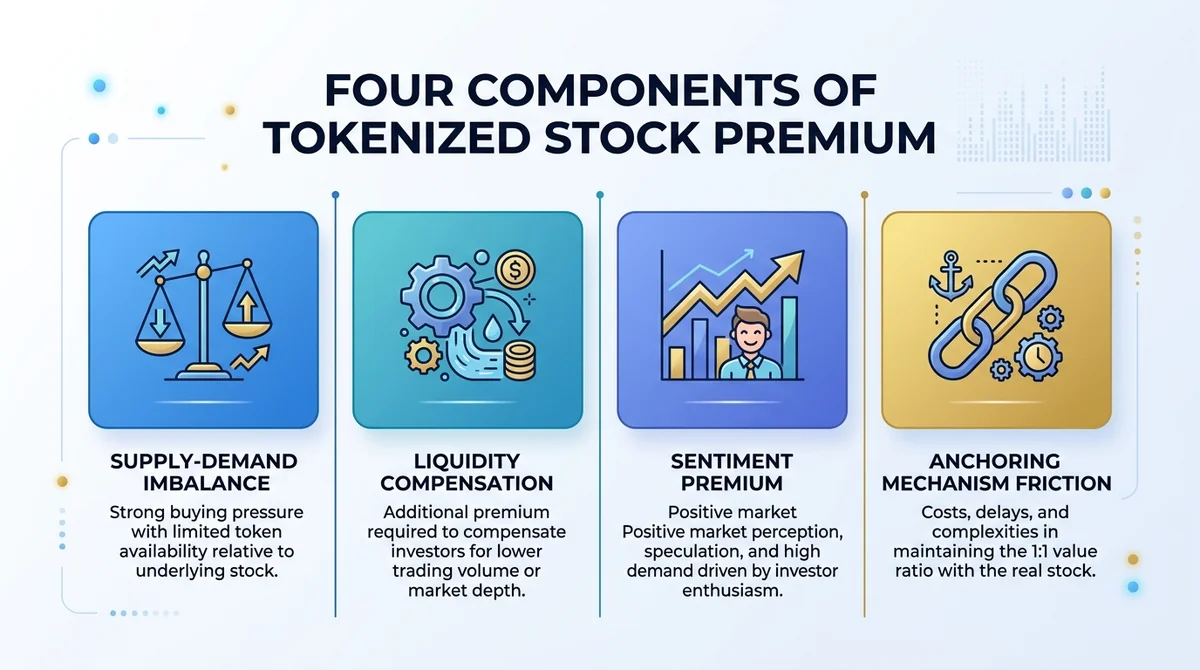
Tokenized stock premiums stem from the superposition of on-chain supply-demand dynamics, arbitrage costs, market sentiment, and custody transparency. Understanding its composition and convergence path requires layered decomposition, rather than attributing it to a single cause.
#Key Mechanisms and Data
#What components make up the tokenized stock premium?
Supply-demand imbalance: Tokenized stock trading pairs are often concentrated on only a few platforms with limited order book depth. When buying pressure floods in while the available token supply is insufficient, the price tends to exceed the underlying US stock.
Liquidity compensation: On-chain order books are thin, and large trades incur significant slippage. Holders therefore demand extra returns to compensate for liquidity risk, and this compensation ultimately shows up in the premium.
Sentiment premium: Optimistic expectations about a particular stock or the entire tokenized sector push token prices away from the underlying asset. Sentiment-driven premium swings are often more violent than those of the underlying US stock.
Anchoring mechanism friction: If the minting/redemption of tokenized stocks involves delays, fees, or quota limits, arbitrageurs cannot quickly close the price gap, allowing the premium to persist.
#What factors drive changes in the tokenized stock premium?
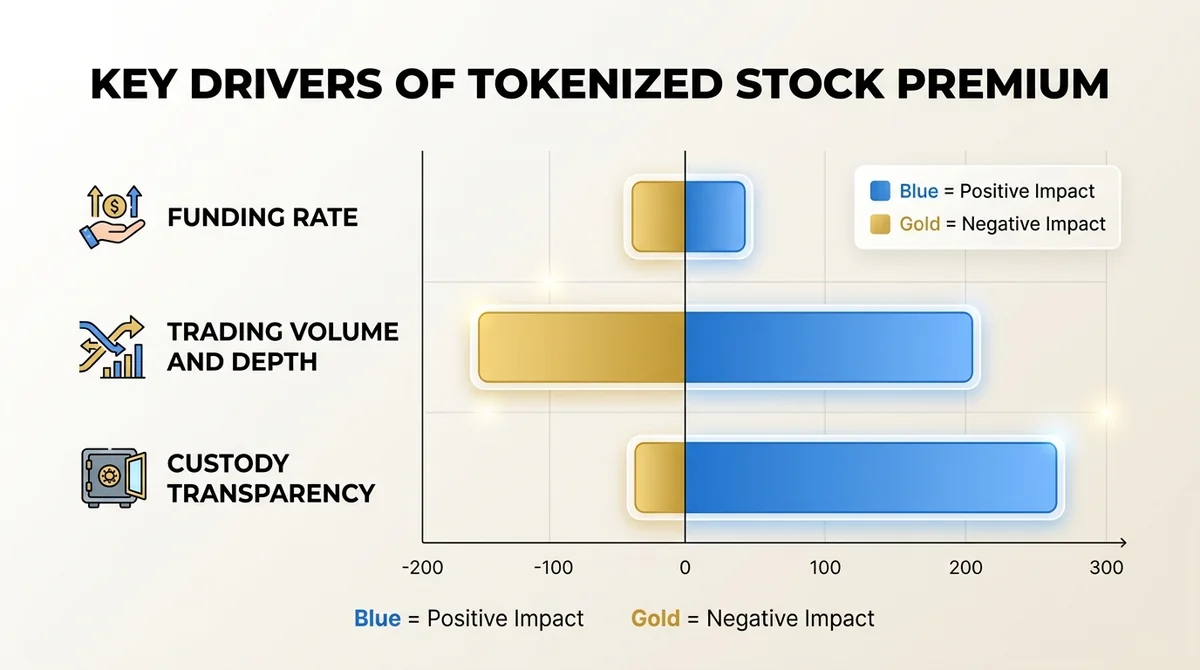
Funding rate: The perpetual contract funding rate reflects the balance of power between longs and shorts. When the related perpetual contract funding rate is positive and keeps climbing, longs must pay shorts, which curbs the willingness to chase rallies and indirectly affects the spot premium. (See how does perpetual futures funding rate work)
Trading volume and market depth: When trading volume expands but depth is insufficient, price impact costs rise and the premium tends to widen; improved depth helps narrow the premium.
Custody transparency: If the custodian regularly publishes proof of reserves or provides verifiable on-chain addresses, market trust in the anchoring mechanism increases and the premium tends to converge; otherwise it may widen.
#How does the tokenized stock premium typically converge?
Arbitrage mechanism: Once the premium exceeds arbitrage costs (including trading fees, slippage, capital occupation costs, and redemption waiting time), arbitrageurs sell the token on-chain and buy the underlying US stock (or vice versa), driving the spread back toward parity.
Convergence speed: Historical data has no unified public conclusion, but it is generally believed that with sufficient liquidity and smooth custody mechanisms, the premium can converge within hours to days; in extreme market conditions it may persist for weeks.
Obstacles: Market frictions (such as high fees, redemption restrictions, cross-market capital transfer delays) and extreme market conditions (such as US stock trading halts, on-chain congestion) all slow down the convergence process.
#How to monitor on-chain pricing deviations of tokenized stocks?
On-chain indicators: Watch the funding rate, on-chain trading volume, custodian address changes, and the price ratio between the token and the underlying US stock.
Deviation thresholds: Normal fluctuations are usually small, but judging abnormal premiums requires considering the market environment (such as US stock volatility, token liquidity). There is no unified threshold; researchers can refer to historical percentiles.
#Core Driving Forces
- Arbitrage cost and efficiency: Lower arbitrage costs and faster execution make premiums converge more easily.
- Platform liquidity: Order book depth and trading volume directly determine the premium level.
- Custody and compliance transparency: Greater transparency enhances anchoring trust and suppresses sentiment premium.
- Market sentiment and funding rate: Sentiment cycles and derivative funding rates influence the short-term direction of the premium. (See how does perpetual futures funding rate work)
#Key Participants
- Tokenization platforms: Exchanges that offer tokenized stock trading (e.g., FTX once did, now mostly compliant platforms).
- Custodians: Institutions responsible for holding the underlying US stocks and issuing tokens; their transparency directly affects the premium.
- Arbitrageurs: Engage in cross-market trading to exploit price differences and are the main force driving convergence.
- Market makers: Provide liquidity to the on-chain market, affecting bid-ask spreads and depth.
#Risks and Divergences
- Data opacity: Some platforms do not disclose custodian addresses or proof of reserves, making it difficult for researchers to verify the authenticity of the anchoring, and premium data may be distorted.
- Platform differences: Tokenized stocks from different platforms are not directly comparable because custody mechanisms, liquidity, and compliance requirements vary, and premium levels lack comparability.
- Research limitations: Historical data is limited, sample periods are short, and market structure changes rapidly, so conclusions should be extrapolated with caution.
- Bearish view: Some argue that tokenized stock premiums are a manifestation of market inefficiency and will disappear in the long run due to stricter regulation or increased competition.
#What to Watch Next
- Whether major tokenized stock platforms improve custody transparency (e.g., regular proof of reserves).
- How the funding rate behaves in extreme market conditions and whether arbitrage windows appear.
- The impact of regulatory policies on tokenized stock trading (e.g., applicability of securities laws).
- Whether cross-platform spreads converge as liquidity improves.
#FAQ
Is the tokenized stock premium a fee? No. The premium is the portion by which the token price exceeds the underlying US stock price, while fees are transaction costs; the two are different.
Does a premium always mean the market is overvaluing the asset? Not necessarily. The premium may include liquidity compensation and sentiment factors and does not necessarily reflect changes in the intrinsic value of the underlying asset.
Can ordinary investors participate in arbitrage? Arbitrage requires simultaneously operating on-chain tokens and the underlying US stock, involving cross-market capital transfers and compliance restrictions, making it difficult for ordinary investors to execute.
Do tokenized stocks pay dividends? Usually not. Tokenized stocks do not carry the dividends and voting rights of actual stocks; they are only price exposure.
How to judge whether a premium is abnormal? You can refer to historical premium percentiles, funding rates, and custody transparency, but must consider the specific market environment; there is no unified standard.
FAQ
Is the tokenized stock premium a fee?
No. The premium is the portion by which the token price exceeds the underlying US stock price, while fees are transaction costs; the two are different.
Does a premium always mean the market is overvaluing the asset?
Not necessarily. The premium may include liquidity compensation and sentiment factors and does not necessarily reflect changes in the intrinsic value of the underlying asset.
Can ordinary investors participate in arbitrage?
Arbitrage requires simultaneously operating on-chain tokens and the underlying US stock, involving cross-market capital transfers and compliance restrictions, making it difficult for ordinary investors to execute.
Do tokenized stocks pay dividends?
Usually not. Tokenized stocks do not carry the dividends and voting rights of actual stocks; they are only price exposure.
How to judge whether a premium is abnormal?
You can refer to historical premium percentiles, funding rates, and custody transparency, but must consider the specific market environment; there is no unified standard.
Related Terms
Ready to try? Test the strategy on MSX with small positions. Educational content only — not investment advice.