On-Chain Entitlement Standards for Tokenized U.S. Treasuries: Custody and Redemption Terms, Holder Rights Mapping, and Execution Lag (2026)
Mapping entitlement, custody chains and redemption lag in tokenized treasuries: executable rights, bankruptcy remoteness, term-change risk, plus a tracking checklist and FAQ.
⚠ This article is multi-asset research on digital assets and does not constitute investment advice. Investing carries risk; please make decisions prudently.
Core conclusion: The on-chain tokens of tokenized U.S. Treasuries are usually a beneficial-interest mapping of the underlying treasuries rather than a direct certificate of ownership. The scope of holders' executable rights, their position in the custody chain, and redemption lag ultimately depend on the specific terms of the offering documents and custody agreements, not on the surface form of the on-chain record. Statements in this article about specific terms are largely mechanistic inferences; wherever the issuer has not publicly disclosed information, it is marked as "data not public / pending verification."
#1. Definitions of the Subject and Business Line
The subject of this article is tokenized U.S. Treasuries, a relatively high-attention sub-segment of RWA (Real World Assets). The research scope includes:
- Underlying assets: U.S. short-term Treasury bills (T-Bills) and medium- to long-term Treasury notes/bonds;
- On-chain vehicle: tokens issued on public or permissioned chains representing some entitlement to the underlying bonds;
- Term scope: custody structure, redemption terms, transfer restrictions, information disclosure, and governance authority;
- Not covered: other RWA sub-categories such as tokenized equities, tokenized commodities, and RWA tokenization smart contract on-chain settlement feature for real estate, mentioned only briefly when comparing mechanisms.
It should be noted that tokenized U.S. Treasuries are not a single standardized product. Issuers differ significantly in SPV structure, custody arrangements, accredited-investor thresholds, and redemption mechanisms, so this article discusses a common mechanistic framework; specific terms must be based on each issuer's public documents. This article does not cite quantitative data from specific issuers (size, fee rates, lag days); all such figures fall within the scope of pending verification.
#2. What Entitlement Do On-Chain Tokens of Tokenized U.S. Treasuries Actually Represent?
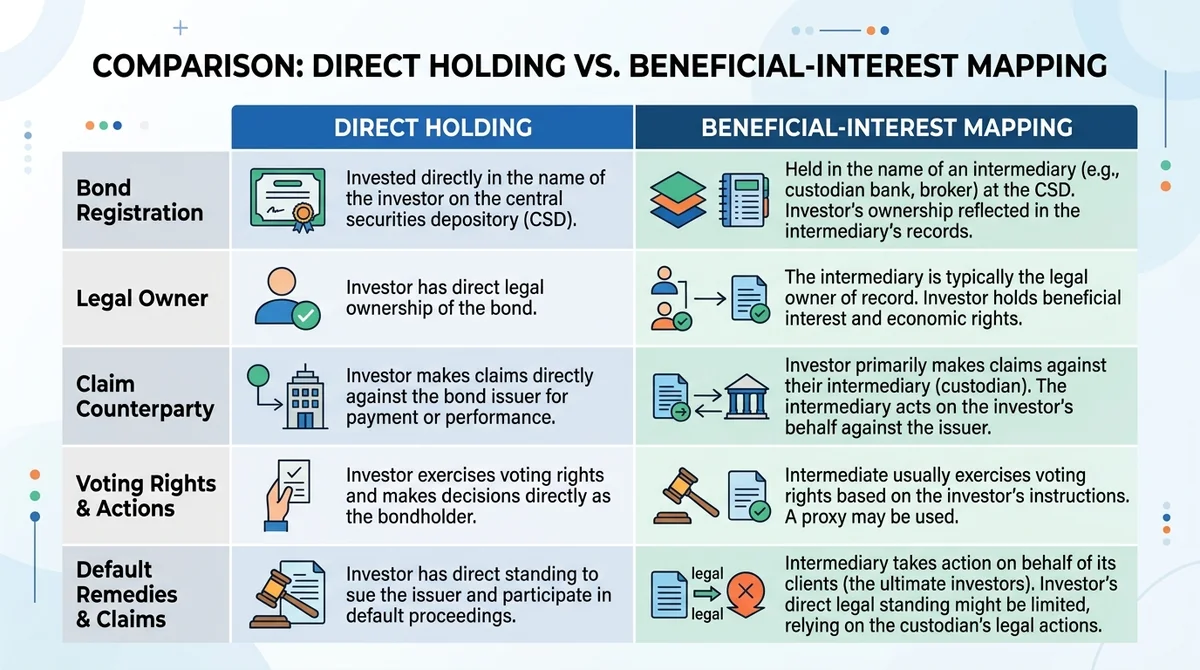
In one sentence: The on-chain tokens of most tokenized U.S. Treasuries are a beneficial-interest mapping, not a certificate of bond ownership.
#2.1 Entitlement Mapping vs. Direct Holding
The common structure of tokenized U.S. Treasuries is: the issuer establishes a special purpose vehicle (SPV) or trust that holds the underlying treasuries, then issues tokens representing beneficial interests to on-chain token holders. Holders obtain indirect economic benefits (interest distributions, redemption value) in the assets held by the SPV/trust, not bond ownership registered directly in the holder's name.
The key to this distinction is:
- Direct holding: the holder's name appears in the bond registration system (such as Fedwire or a custodian's ledger) and enjoys legal ownership;
- Entitlement mapping: the holder has only contractual rights against the issuing vehicle, while legal ownership remains at the SPV/trust level.
This structure is a common industry model but is not uniform across all issuers; individual projects may use different legal architectures and must be verified against the offering documents one by one.
#2.2 What Executable Rights Do Holders Have Over the Underlying Treasuries?
Under a beneficial-interest mapping structure, holders' executable rights typically include:
- Income distribution rights: receiving coupon or yield distributions from the underlying bonds per the terms;
- Redemption rights: redeeming under the conditions and procedures set out in the offering documents;
- Information access rights: obtaining holdings, net asset value, or audit information under the disclosure terms.
Meanwhile, powers attached to legal ownership such as voting rights, default remedies, and participation in bondholder meetings are mostly not exercised directly by on-chain holders but by the issuer or trustee on their behalf. The specific scope must be verified item by item against the offering documents; where public disclosure is insufficient, this article marks it as "data not public."
#2.3 Is an On-Chain Transfer Equivalent to a Legal Transfer of the Bond?
No. On-chain transfers are valid only within the compliance layer set by the issuer, typically subject to whitelists, accredited-investor requirements, and jurisdiction. The on-chain transfer record itself does not constitute a legal transfer at the bond registration system level; the ultimate effect of a transfer still depends on the offering documents and applicable law.
#3. How Does the Custody Structure Affect Holder Rights?
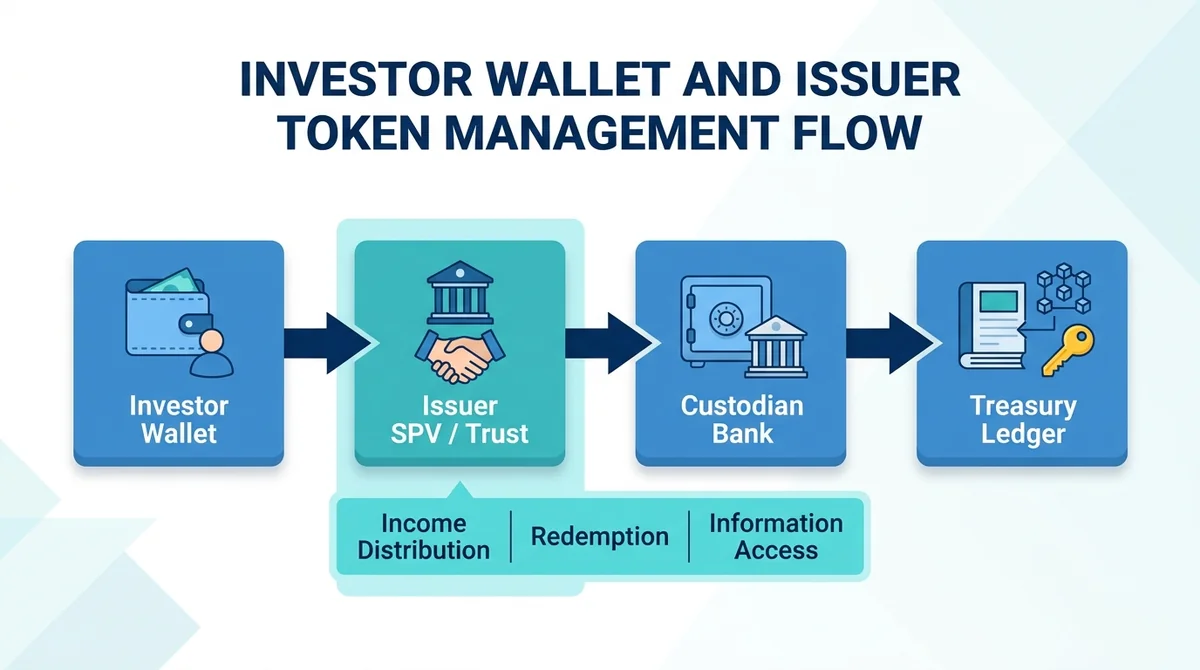
In one sentence: The multi-party structure along the custody chain determines the actual strength of holder rights; bankruptcy remoteness and priority arrangements must be based on legal documents.
#3.1 Participants and Responsibilities Along the Custody Chain
A typical chain is: issuer (SPV/trust) — custodian — underlying bond custody institution (such as a primary dealer or clearing institution). Responsibilities are roughly:
- Issuer: responsible for token issuance, income distribution, and redemption processing;
- Custodian: safekeeps the underlying bonds and executes settlement instructions;
- Underlying custody institution: registers and clears at the traditional financial ledger level.
The on-chain record is usually only the "front-end display layer" of this chain; actual control of the underlying bonds sits in the middle and back end of the custody chain.
#3.2 What Priority Do Holders Have If the Custodian Becomes Insolvent or Defaults?
This depends on whether the legal structure of the SPV/trust achieves bankruptcy remoteness. If the underlying assets are legally separate from the own assets of the issuer and custodian, holders may rank ahead of ordinary creditors; if the structure is insufficiently designed, holders may participate in distribution only as unsecured creditors. Public disclosure on this point varies in detail, and the specific priority arrangement must be based on the legal opinion and custody agreement; this article makes no assertion about the priority of any specific issuer.
#3.3 Which Prevails When the On-Chain Record and the Custodian's Ledger Diverge?
Most offering documents typically provide that the custodian's ledger or the underlying registration record prevails, with the on-chain record serving as a mapping layer. This means that in extreme cases (such as on-chain anomalies, forks, or issuer operational errors), the actual determination of holder rights may revert to the traditional ledger level. This priority clause is a key checkpoint when studying entitlement standards, but the specific terms must be verified item by item; this article marks them as pending verification.
#4. What Stages Make Up the Execution Lag in Redemption Terms?
In one sentence: Redemption lag is the sum of three segments: on-chain settlement, issuer processing, and underlying bond settlement.
#4.1 Breaking Down the Three-Segment Lag
- On-chain settlement segment: the holder initiates redemption and the token is burned or locked, usually relatively fast;
- Issuer processing segment: issuer review, compliance checks, and instruction issuance, with duration depending on operational arrangements;
- Underlying settlement segment: the custodian sells or transfers the underlying bonds, subject to traditional market settlement cycles (the regular settlement cycle in the U.S. Treasury market is T+1; this is market convention, and the issuer's terms prevail).
The total lag after stacking these three segments is usually significantly longer than expectations for pure on-chain operations — a structural friction between the "on-chain speed" and "traditional settlement" of tokenized U.S. Treasuries.
#4.2 Which Stages Are Most Prone to Lag and Uncertainty?
- Compliance review: for large redemptions or cross-border holders, the review stage may be extended;
- Underlying market liquidity: during stress periods in the Treasury market, sale settlement may be delayed;
- Operating windows: some issuers process redemptions only on traditional business days, so the 7×24 nature of on-chain operations cannot be fully realized.
#4.3 Redemption Fees and Minimum Redemption Thresholds
Fee and threshold standards must be verified item by item against the offering documents; common items include redemption fees, minimum redemption amounts, and daily redemption caps. Specific durations and fee data are not public or are disclosed inconsistently, and this article makes no numerical assertions; readers should rely on the issuer's latest terms.
#5. Divergence Between On-Chain Entitlement Standards and Actual Bond Rights
In one sentence: The divergence centers on the enforceability of three categories of rights: voting rights, transfer restrictions, and default remedies.
#5.1 Voting Rights and Default Remedies
Voting rights over the underlying bonds (such as bondholder meetings) and default remedy paths depend on traditional legal procedures; on-chain token holders usually cannot exercise them directly and must express them indirectly through the issuer or trustee. This makes tokenized U.S. Treasuries, at the governance level, closer to a "passive yield instrument" than a full bond.
#5.2 Transfer Restrictions and Accredited-Investor Requirements
Transfer restrictions are implemented through whitelists and compliance layers; there is tension between the "permissionless" nature of on-chain transfers and the accredited-investor requirements of securities law. Most projects use permissioned transfers, which limits secondary-market liquidity.
#5.3 Disclosure Frequency and On-Chain Verifiability
What is verifiable on-chain is token balances and transfer records, while underlying bond holdings, net asset value, and audit information still depend on periodic issuer disclosure. The gap between disclosure frequency and real-time on-chain transparency is an ongoing issue in entitlement-standard research.
#6. Risks to Watch When Studying Entitlement Standards
In one sentence: Custody and counterparty risk, authority to change terms unilaterally, and insufficient liquidity are the three core risks.
- Custody and counterparty risk: the custody chain has multiple participants, and an operational or credit event at any link can transmit to holders;
- Unilateral authority to change terms: some offering documents give issuers the authority to adjust fees, redemption rules, or custody arrangements under specified conditions, with limited checks available to holders;
- Insufficient secondary liquidity: permissioned transfers and accredited-investor thresholds may lead to insufficient secondary-market depth, and holders needing early exit may face a discount;
- Legal and jurisdictional risk: remedy paths for cross-border holders depend on jurisdiction, with high enforcement costs.
This article does not constitute investment advice; readers should verify the offering documents and legal opinions themselves.
#7. What to Watch Next
This section lists tracking items only and draws no conclusions:
- Supplementary issuer disclosure: progress on public disclosure of custody agreements, redemption terms, fee standards, and bankruptcy-remoteness legal opinions;
- Evolution of RWA compliance guidance: changes in custody, transfer, and disclosure requirements for tokenized securities in major jurisdictions;
- Standardization of redemption lag and fees: whether the industry develops comparable disclosure standards for lag and fees;
- On-chain vs. off-chain ledger priority clauses: whether offering documents specify determination rules when the two diverge.
#FAQ
Q1: Is the token of a tokenized U.S. Treasury a certificate of bond ownership? A: In most cases, no. The common structure is that an SPV/trust holds the underlying bonds, the token represents a beneficial-interest mapping, and legal ownership remains at the issuing vehicle level. The offering documents prevail.
Q2: Can holders receive priority repayment if the custodian becomes insolvent? A: It depends on whether the SPV/trust achieves bankruptcy remoteness. If the underlying assets are legally separate, holders may have priority; otherwise they may rank as unsecured creditors. The legal opinion and custody agreement must be verified.
Q3: Why can't redemption be completed instantly like an on-chain transfer? A: Redemption involves three segments — on-chain settlement, issuer compliance processing, and underlying bond settlement — and underlying settlement is bound by traditional market cycles, so total lag is usually longer than pure on-chain operations.
Q4: Is an on-chain transfer equivalent to a legal transfer of the bond? A: No. On-chain transfers are usually valid within a permissioned compliance layer, and the ultimate effect depends on the offering documents and applicable law; the on-chain record itself does not constitute a legal transfer at the bond registration level.
Q5: What matters most when studying entitlement standards for tokenized U.S. Treasuries? A: The custody chain and bankruptcy-remoteness arrangements, the lag and fee standards in redemption terms, authority to change terms, and secondary liquidity and transfer restrictions. This article does not constitute investment advice.
FAQ
Is the token of a tokenized U.S. Treasury a certificate of bond ownership?
In most cases, no. The common structure is that an SPV/trust holds the underlying bonds, the token represents a beneficial-interest mapping, and legal ownership remains at the issuing vehicle level. The offering documents prevail.
Can holders receive priority repayment if the custodian becomes insolvent?
It depends on whether the SPV/trust achieves bankruptcy remoteness. If the underlying assets are legally separate, holders may have priority; otherwise they may rank as unsecured creditors. The legal opinion and custody agreement must be verified.
Why can't redemption be completed instantly like an on-chain transfer?
Redemption involves three segments — on-chain settlement, issuer compliance processing, and underlying bond settlement — and underlying settlement is bound by traditional market cycles, so total lag is usually longer than pure on-chain operations.
Is an on-chain transfer equivalent to a legal transfer of the bond?
No. On-chain transfers are usually valid within a permissioned compliance layer, and the ultimate effect depends on the offering documents and applicable law; the on-chain record itself does not constitute a legal transfer at the bond registration level.
What matters most when studying entitlement standards for tokenized U.S. Treasuries?
The custody chain and bankruptcy-remoteness arrangements, the lag and fee standards in redemption terms, authority to change terms, and secondary liquidity and transfer restrictions. This article does not constitute investment advice.
Related Terms
Ready to try? Test the strategy on MSX with small positions. Educational content only — not investment advice.