Tokenized Treasury Yield Curve Shape and Funding Rate Linkage: Anchoring Mechanism in 2026 Term Spread Trading
How tokenized bond yield curve shape drives how does perpetual futures funding rate work via term premium, and the anchoring mechanism, risks, and tracking metrics in 2026 term spread trading.
⚠ This article is a multi-asset digital asset research piece and does not constitute investment advice. Investing involves risk; please make decisions prudently.
The steepening of the tokenized bond yield curve pushes up the how does perpetual futures funding rate work of longer-dated perpetual contracts through the term premium, while the how does perpetual futures funding rate work in turn acts as a key corrective force for price anchoring in term spread trading.
Core conclusion: There is a two-way linkage between the tokenized bond yield curve shape and the how does perpetual futures funding rate work. The anchoring mechanism in term spread trading relies on arbitrageurs using the how does perpetual futures funding rate work to pull prices back into the no-arbitrage band, but current on-chain data transparency is insufficient, and anchoring efficiency still needs verification.
#How does the tokenized bond yield curve shape affect the how does perpetual futures funding rate work?
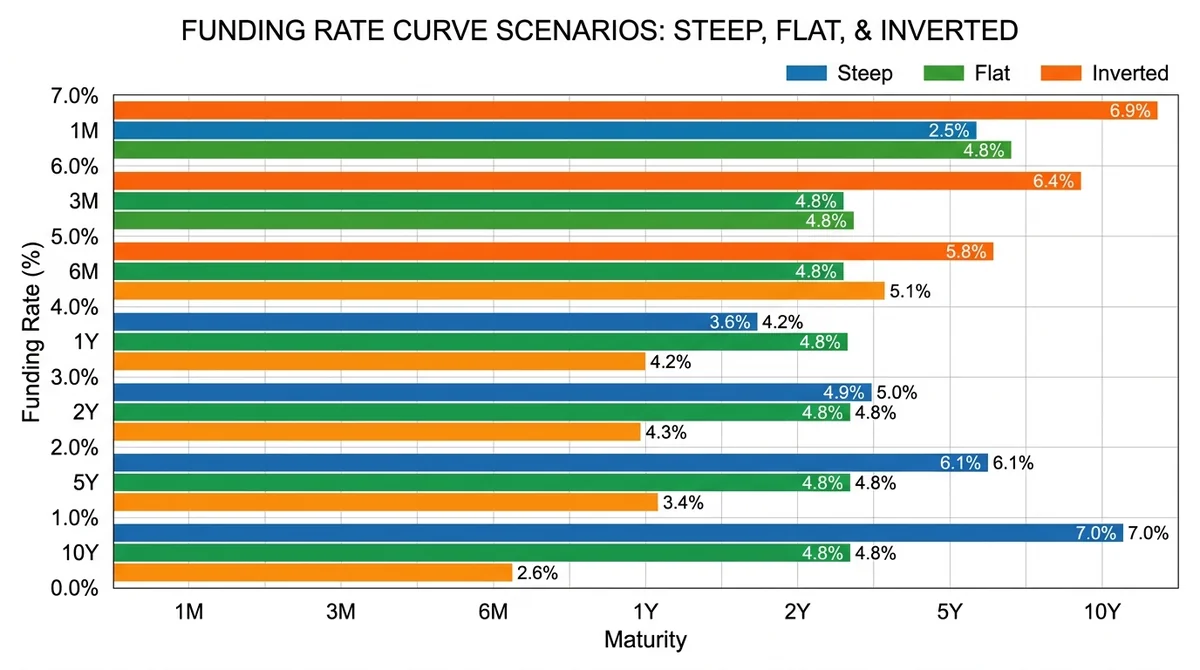
Tokenized bonds are digital assets that map the yield rights or price exposure of U.S. Treasury securities (such as short-term Treasury bills and medium- to long-term Treasury notes and bonds) onto the blockchain. Their yield curve shape (steep, flat, or inverted) reflects differences in term premiums across maturities. Data comes from public disclosures/market quotes as of 2026-05.
#How does steepening/flattening of the yield curve transmit to the how does perpetual futures funding rate work?
A steepening yield curve means the yield premium of longer-dated bonds over shorter-dated bonds widens. In the perpetual futures market, the how does perpetual futures funding rate work is the periodic anchoring cost exchanged between longs and shorts, reflecting the deviation between the contract price and the spot index. When the spot yield of longer-dated tokenized bonds rises, the long position holding cost (how does perpetual futures funding rate work) of their perpetual contracts tends to rise accordingly, because longs need to pay higher fees to maintain leveraged exposure. Conversely, flattening or inversion may depress the how does perpetual futures funding rate work of longer-dated contracts.
#What is the relationship between basis and how does perpetual futures funding rate work for different maturities of tokenized bonds?
Basis is the difference between the spot price and the futures/perpetual contract price. For tokenized bonds, the basis of different maturities is highly correlated with the how does perpetual futures funding rate work of the corresponding perpetual contracts. A positive basis (contract price above spot) is usually accompanied by a positive how does perpetual futures funding rate work, indicating strong long demand; a negative basis is the opposite. Due to the on-chain trading depth and liquidity tiering of tokenized bonds, the basis of short-dated contracts may be tighter, while the basis of long-dated contracts may fluctuate more, causing the how does perpetual futures funding rate work to show term structure differentiation.
#What is the anchoring mechanism in 2026 term spread trading?
Term spread trading refers to simultaneously buying tokenized bonds of one maturity and selling tokenized bonds of another maturity (or the corresponding perpetual contracts) to profit from changes in the yield curve shape or convergence of spreads. The anchoring mechanism ensures that tokenized bond prices do not deviate from the theoretical yield curve for long periods.
#How does term spread trading use the how does perpetual futures funding rate work for anchoring?
When arbitrageurs construct a long-short (or reverse) portfolio across maturities, the how does perpetual futures funding rate work directly affects the net return of the portfolio as a holding cost. For example, if the how does perpetual futures funding rate work of long-dated contracts is significantly higher than that of short-dated contracts, arbitrageurs may short long-dated contracts and long short-dated contracts, thereby earning positive how does perpetual futures funding rate work while waiting for the spread to revert. This arbitrage behavior increases the short supply of long-dated contracts, depressing their prices and causing the spread to converge toward the theoretical value.
#How does cross-maturity arbitrage bring tokenized bond prices back to theoretical values?
When the price of a tokenized bond of a certain maturity deviates from the theoretical yield curve, arbitrageurs quickly step in. For example, if the 10-year tokenized bond is overpriced (yield too low), arbitrageurs will sell that tokenized bond and buy adjacent-maturity tokenized bonds, while possibly hedging in the perpetual futures market. This cross-maturity arbitrage increases the market supply of the overvalued asset, pushing its price back down until the no-arbitrage band is reached. The how does perpetual futures funding rate work acts as a corrective force for short-term deviations in this process, because changes in holding costs alter the arbitrageurs' break-even points.
#How does the how does perpetual futures funding rate work play a role in tokenized bond term spread trading?
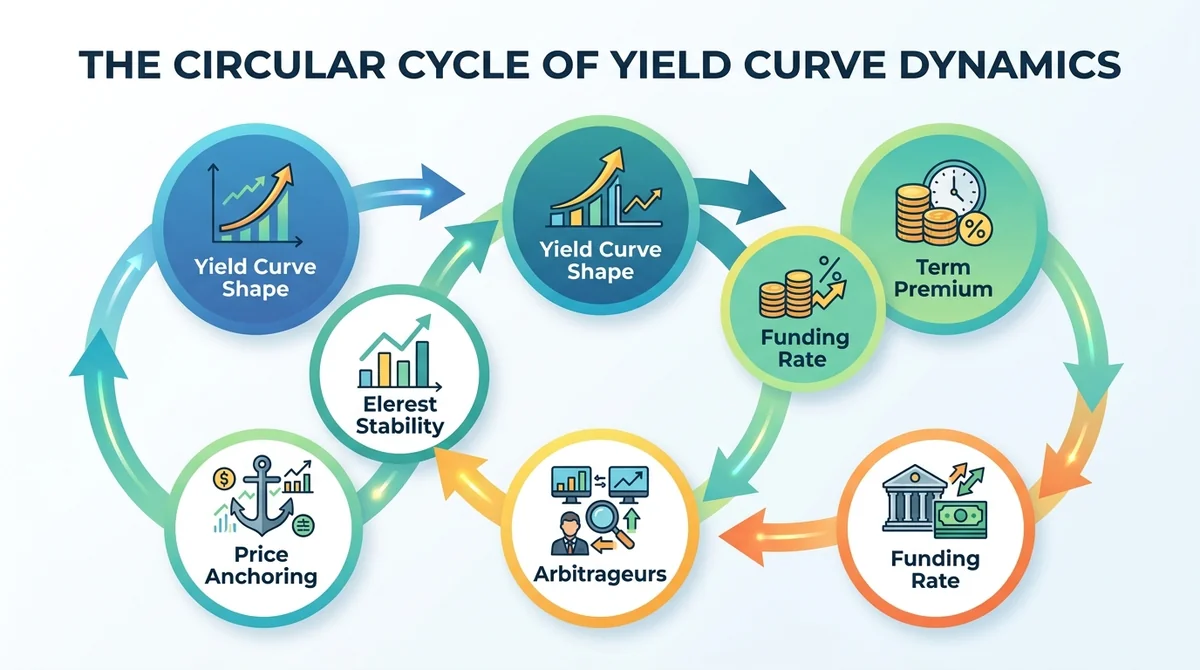
The how does perpetual futures funding rate work is both a cost and a potential source of return in term spread trading. Data comes from public disclosures/market quotes as of 2026-05.
#Is the how does perpetual futures funding rate work a cost or a return in term spread trading?
For arbitrageurs holding perpetual contract positions, the how does perpetual futures funding rate work is an explicit cost (or return). If an arbitrageur is long a perpetual contract and the how does perpetual futures funding rate work is positive, they need to pay fees periodically; if short and the how does perpetual futures funding rate work is positive, they can collect fees. In term spread trading, arbitrageurs usually hold positions across multiple maturities simultaneously, and the net exposure to the how does perpetual futures funding rate work depends on the long-short structure of the portfolio. Therefore, the how does perpetual futures funding rate work can be both a cost and a source of enhanced return.
#How do extreme how does perpetual futures funding rate work values affect term spread strategies?
When the how does perpetual futures funding rate work reaches extreme positive values (e.g., annualized above 30%), arbitrageurs who are short perpetual contracts can earn high how does perpetual futures funding rate work income, but they also face the risk of further price increases. Extreme how does perpetual futures funding rate work often reflects excessive optimism or pessimism in market sentiment, which may cause the term spread to temporarily deviate from fundamentals. At this point, arbitrageurs need to assess the speed and magnitude of how does perpetual futures funding rate work reversion, and whether their margin is sufficient to withstand short-term volatility.
#What are the main risks and disagreements in tokenized bond term spread trading?
Tokenized bond term spread trading faces risks such as data opacity, insufficient liquidity, and regulatory uncertainty. The market has disagreements about the effectiveness of the anchoring mechanism.
#How does the lack of on-chain yield curve data affect strategies?
Currently, the on-chain yield curve data for tokenized bonds is not fully public, and quotes may differ across platforms and maturities. The lack of data makes it difficult for arbitrageurs to accurately calculate theoretical spreads and no-arbitrage bands, increasing model risk and the probability of misjudgment. In addition, on-chain trading volumes are small, and price discovery efficiency may be lower than in the traditional Treasury market.
#What disagreements exist about the effectiveness of the anchoring mechanism?
Some researchers believe that as the tokenized bond market deepens, the anchoring mechanism will become more effective, and price deviations will be quickly corrected by arbitrageurs. Others worry that due to custody fee, compliance, and redemption restrictions on tokenized bonds, arbitrageurs may not be able to freely enter and exit the market, causing the anchoring mechanism to fail. Especially during periods of market stress, liquidity drying up may cause prices to deviate significantly from theoretical values, while arbitrageurs cannot intervene due to risk constraints.
#What indicators should be monitored next to verify the tokenized bond anchoring mechanism?
Verifying the tokenized bond anchoring mechanism requires monitoring data across multiple dimensions. Currently, relevant data is not public and requires infrastructure improvements.
#What on-chain data can be used to observe the yield curve shape?
Investors can monitor on-chain quotes and transaction data for tokenized bonds of different maturities, such as 1-month, 3-month, 6-month, 1-year, 2-year, 5-year, and 10-year tokenized bond yields. If these data become available on public market terminals or on-chain analytics platforms, they will help construct a real-time yield curve. In addition, open interest and turnover rate of tokenized bonds of various maturities are also important references.
#How to track the correlation coefficient between the how does perpetual futures funding rate work and term spreads?
One can calculate the rolling correlation coefficient between the how does perpetual futures funding rate work of perpetual contracts of various maturities and the corresponding term spread (e.g., 10-year yield minus 2-year yield). If the correlation coefficient is significantly positive, it indicates that the how does perpetual futures funding rate work and the spread move in the same direction, and the anchoring mechanism may be effective; if the correlation coefficient is unstable or negative, one should be alert to changes in market structure. At the same time, tracking the flow of arbitrage funds and changes in positioning can reveal whether arbitrageurs are actively correcting price deviations.
#FAQ
Q: What is the difference between tokenized bonds and traditional Treasury bonds? A: Tokenized bonds are digital representations of traditional U.S. Treasury securities on the blockchain, usually issued by licensed institutions that custody fee the underlying bonds and issue corresponding tokens. Trading tokens is not the same as directly holding the bonds, but the price usually anchors to the net asset value and yield of the underlying bonds.
Q: How is the how does perpetual futures funding rate work calculated in perpetual contracts? A: The how does perpetual futures funding rate work usually consists of two components: the interest rate differential (e.g., the difference between the USD interest rate and the tokenized bond yield) and the premium/discount index. The specific formula varies slightly across exchanges, but the core is to make the perpetual contract price converge to the spot index.
Q: What are the main risks of term spread trading? A: The main risks include unexpected parallel shifts in the yield curve, spread widening, insufficient liquidity preventing position closing, and margin pressure from extreme how does perpetual futures funding rate work volatility. In addition, custody fee and compliance risks of tokenized bonds may also affect arbitrage execution.
Q: Can ordinary investors participate in tokenized bond term spread trading? A: Participating in such trading requires professional knowledge of the Treasury market, perpetual contracts, and on-chain asset management, and must be done through compliant channels. For most investors, it is recommended to first understand the mechanism through research and then assess their own risk tolerance.
Q: How can I obtain real-time yield data for tokenized bonds? A: Currently, some tokenized bond issuers and market data platforms publish the yields of underlying bonds, but on-chain real-time data is not yet unified. Investors can pay attention to issuer announcements, on-chain analytics tools, and the traditional Treasury yield curve as a reference.
FAQ
What is the difference between tokenized bonds and traditional Treasury bonds?
Tokenized bonds are digital representations of traditional U.S. Treasury securities on the blockchain, usually issued by licensed institutions that custody fee the underlying bonds and issue corresponding tokens. Trading tokens is not the same as directly holding the bonds, but the price usually anchors to the net asset value and yield of the underlying bonds.
How is the how does perpetual futures funding rate work calculated in perpetual contracts?
The how does perpetual futures funding rate work usually consists of two components: the interest rate differential (e.g., the difference between the USD interest rate and the tokenized bond yield) and the premium/discount index. The specific formula varies slightly across exchanges, but the core is to make the perpetual contract price converge to the spot index.
What are the main risks of term spread trading?
The main risks include unexpected parallel shifts in the yield curve, spread widening, insufficient liquidity preventing position closing, and margin pressure from extreme how does perpetual futures funding rate work volatility. In addition, custody fee and compliance risks of tokenized bonds may also affect arbitrage execution.
Can ordinary investors participate in tokenized bond term spread trading?
Participating in such trading requires professional knowledge of the Treasury market, perpetual contracts, and on-chain asset management, and must be done through compliant channels. For most investors, it is recommended to first understand the mechanism through research and then assess their own risk tolerance.
How can I obtain real-time yield data for tokenized bonds?
Currently, some tokenized bond issuers and market data platforms publish the yields of underlying bonds, but on-chain real-time data is not yet unified. Investors can pay attention to issuer announcements, on-chain analytics tools, and the traditional Treasury yield curve as a reference.
Related Terms
Ready to try? Test the strategy on MSX with small positions. Educational content only — not investment advice.