Counterparty and Custody Risks in the Yield Distribution Chain of Tokenized Treasury Bonds: Failure Paths Beyond Reserve Interest and Redemption Queues (2026)
Breaking down the issuance, custody, and on-chain distribution chain of tokenized treasury bonds: counterparty failure paths, redemption queues, and disclosure checks.
⚠ This article is digital asset research and does not constitute investment advice. Investing involves risk; please make prudent decisions.
Key Takeaways: The yield of tokenized treasury bonds comes from the interest on underlying short-term U.S. Treasury reserves, but the actual yield received by holders and redeemability depend on the efficiency of the chain from issuer to custodian to on-chain distribution contracts. Beyond reserve interest, redemption queues and insufficient custody disclosure are the most easily overlooked failure paths. This article does not provide yield figures or recommendations for any specific issuer; the distribution frequency, fee breakdown, custodian names, and redemption timelines for specific products must be based on the latest public disclosures of that product.
#Definition of Subject/Business Line
The subject of this article is tokenized treasury bonds (Tokenized Treasury / tokenized treasury bonds), i.e., products that use short-term U.S. Treasury bonds or Treasury bills as reserve assets and issue on-chain tokens representing beneficial ownership. The research scope includes:
- Yield distribution chain: the entire process from reserve interest generation to execution by on-chain distribution contracts;
- Counterparty and custody risk: issuer credit, custodian asset segregation, and 1:1 reserve verification;
- Redemption mechanism: redemption queues, lock-up periods, minimum redemption amounts, and processing timelines;
- Information disclosure: reserve composition, audit reports, and the boundaries of on-chain verifiable information.
It does not cover dividend distribution of tokenized stocks, the perpetual contract funding rate mechanism, or Pre-IPO valuation methods; these topics are discussed separately.
#Key Mechanisms and Data
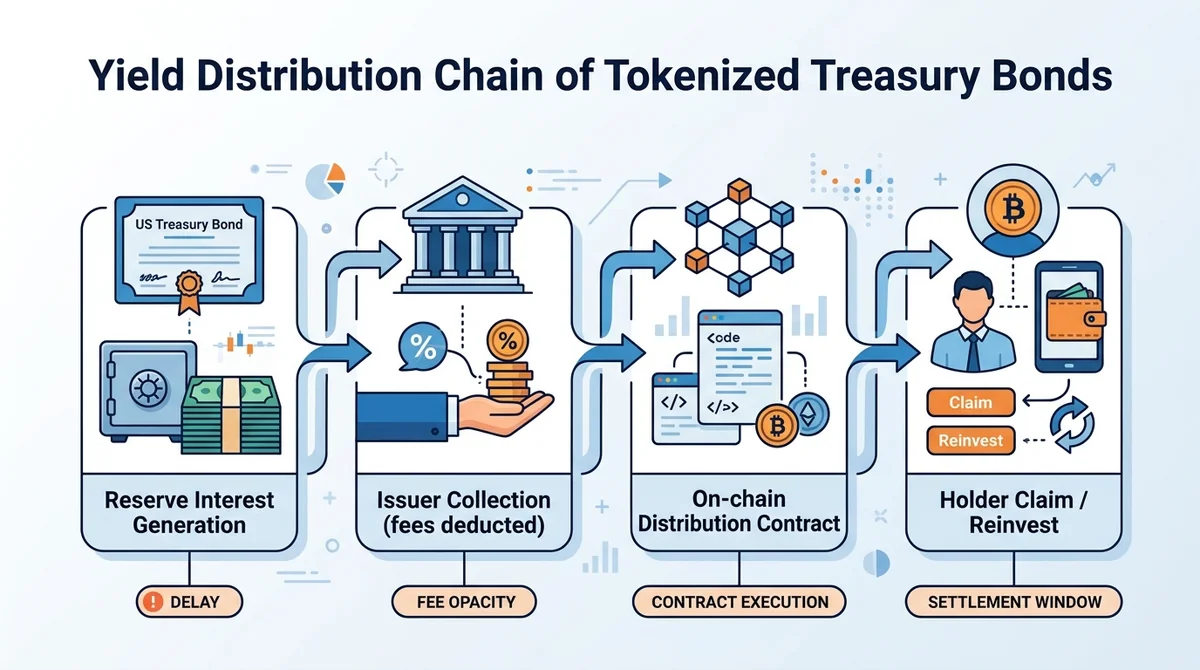
#Structure of the Yield Distribution Chain
The yield distribution of tokenized treasury bonds typically goes through the following steps:
- Reserve interest generation: the issuer allocates raised funds to short-term tokenized treasury bonds or Treasury bills, generating interest over the holding period;
- Issuer collection: interest enters the issuer or a designated custody account, deducting management fees, custody fee, and other expenses;
- On-chain distribution contract: the issuer transfers net yield to the on-chain distribution contract, distributing according to holders' positions;
- Holder claim: holders claim through the contract or automatically reinvest.
The longer the chain, the more attention should be paid to distribution delays and fee deductions. Distribution frequency (daily, weekly, or monthly) and settlement windows (T+0 or T+N) theoretically affect the annualized difference in actual yield received; the magnitude depends on specific distribution frequency and reinvestment assumptions, and this article does not provide specific figures.
Data Note: Specific distribution frequency, fee structure, and settlement windows vary by issuer and must be based on each issuer's latest public disclosures; some issuers do not disclose detailed fee breakdowns, and such data is not public.
#Counterparty and Custody Arrangements
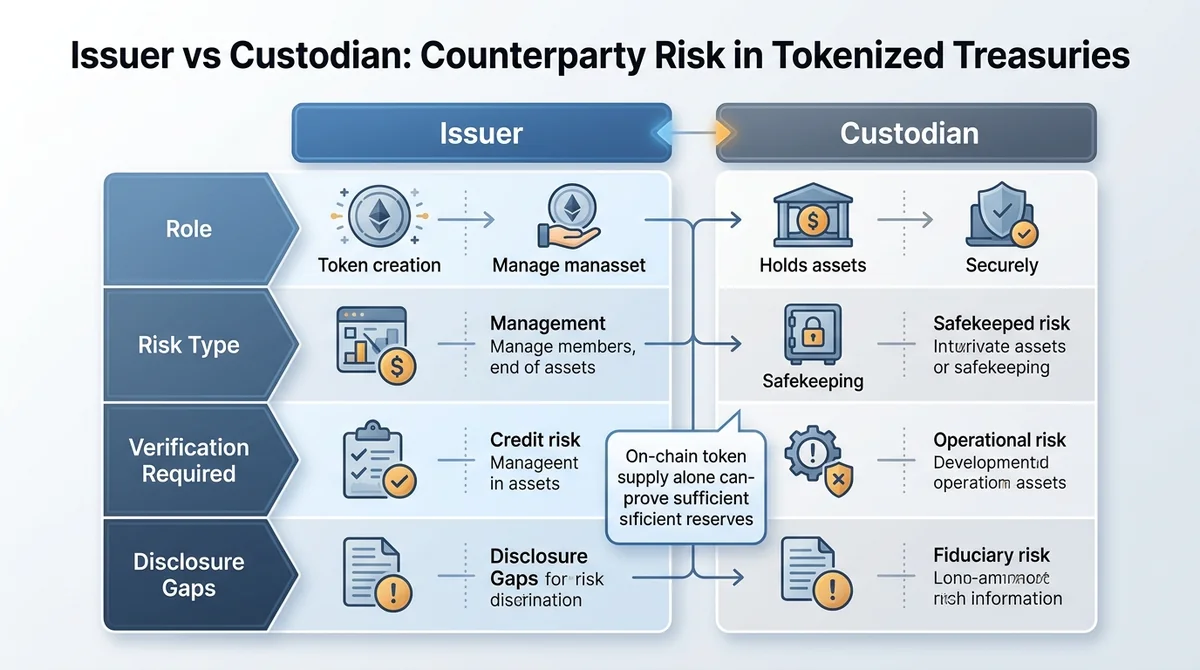
- Issuer role: responsible for reserve allocation, yield collection, and on-chain distribution execution, bearing credit and operational risk;
- Custodian role: safeguards underlying tokenized treasury bonds assets; its bankruptcy segregation arrangements determine whether reserve assets are independent of the issuer's balance sheet;
- 1:1 reserve verification: must be based on audit reports or custodian disclosures; on-chain token supply alone cannot prove sufficient reserves.
Data Note: Custody arrangements and audit frequency vary by issuer and must be based on public disclosures; some products do not disclose custodian names or audit scope, and such data is not public.
#Redemption Mechanism
When redemption requests concentrate, issuers may adopt a queue processing mechanism. During the queue period, holders still bear exposure to underlying asset prices and opportunity costs. Minimum redemption amounts, lock-up periods, and processing timelines vary by product and require review of issuer terms.
Data Note: Redemption processing timelines and queue sizes must be based on issuer terms and public disclosures; some products do not disclose historical redemption processing records, and such data is not public.
#Core Drivers
- Short-term interest rate environment: reserve interest levels determine the yield distribution base; falling rates compress holders' actual yield (directional judgment, magnitude depends on specific product terms);
- Custody segregation and audit transparency: custodian bankruptcy segregation arrangements and audit frequency affect counterparty risk pricing;
- Redemption term design: lock-up periods and queue mechanisms determine actual liquidity availability under stress scenarios;
- On-chain distribution efficiency: distribution frequency and fee deductions affect actual yield received and product competitiveness.
#Key Participants
- Issuer: responsible for reserve allocation and on-chain distribution; representative products include tokenized funds backed by short-term tokenized treasury bonds;
- Custodian: traditional financial institution custody departments responsible for safeguarding underlying assets;
- Audit and attestation firms: provide reserve verification and internal control reports;
- On-chain distribution contracts: smart contracts executing yield distribution and redemption processing;
- Market makers and secondary markets: provide on-chain liquidity, affecting alternative redemption paths.
The above only lists role types and does not constitute product recommendations.
#Risks and Divergences
- Bearish view: some research argues that the on-chain transparency of tokenized treasury bonds only covers the distribution layer; insufficient custody-layer disclosure makes 1:1 reserves difficult to verify in real time, and redemption queues under stress scenarios may amplify liquidity discounts (inference; no unified data yet verifies the magnitude of the discount);
- Counterparty failure paths: if issuer operations are interrupted or custodian bankruptcy segregation arrangements are inadequate, yield distribution may be suspended and redemptions may be restricted;
- Risks during queue periods: during redemption queues, holders still bear price exposure and opportunity costs, and queue order may be opaque;
- Insufficient disclosure: some products do not disclose custodian names, audit scope, or historical redemption processing records, increasing uncertainty.
#What to Watch Next
- Evolution of custody segregation and audit disclosure: whether more frequent reserve attestations and custodian disclosures emerge;
- Redemption processing timelines and queue transparency: whether issuers disclose historical redemption processing data;
- Changes in distribution frequency and fee structure: whether they evolve toward higher frequency and lower fees;
- Holder self-check list: reserve verification, custody segregation, redemption terms, and distribution records—four items to track risk.
#FAQ
Q1: What steps are included in the yield distribution chain of tokenized treasury bonds? A1: Typically four steps: reserve interest generation, issuer collection and fee deduction, on-chain distribution contract execution, and holder claim. The longer the chain, the more attention should be paid to distribution delays and fee deductions. Specific steps vary by issuer and must be based on public disclosures.
Q2: How can one verify whether tokenized treasury bonds are 1:1 backed by tokenized treasury bonds reserves? A2: This should be based on audit reports or custodian disclosures; on-chain token supply alone cannot prove sufficient reserves. Some products do not disclose custodian names or audit scope, and such data is not public.
Q3: How do redemption queues form? What risks do holders bear during the queue period? A3: When redemption requests concentrate, issuers may adopt a queue processing mechanism. During the queue period, holders still bear exposure to underlying asset prices and opportunity costs, and queue order may be opaque. Specific processing timelines are subject to issuer terms.
Q4: What level of information disclosure can on-chain data cover? A4: On-chain data can cover token transfers, distribution contract execution, and holder positions, but reserve composition at the custody layer, custodian bankruptcy segregation arrangements, and audit reports are off-chain information and must be based on issuer and custodian disclosures. Where disclosure is insufficient, it should be marked as data not public, without inference.
Q5: What changes in counterparty and custody risks of tokenized treasury bonds should be watched in 2026? A5: Focus on custody segregation disclosure, redemption processing transparency, and changes in distribution mechanisms. Holders can use a four-item self-check list—reserve verification, custody segregation, redemption terms, and distribution records—to track risk. This article does not constitute investment advice.
#Risk Statement
This article discusses counterparty, custody, and redemption risks of tokenized treasury bonds only at the mechanism level and does not constitute investment advice, yield forecasts, or product recommendations. Data is based on public disclosures by issuers and custodians; missing data is marked as not public. Investing involves risk; please make prudent decisions.
FAQ
What steps are included in the yield distribution chain of tokenized treasury bonds?
Typically four steps: reserve interest generation, issuer collection and fee deduction, on-chain distribution contract execution, and holder claim. The longer the chain, the more attention should be paid to distribution delays and fee deductions. Specific steps vary by issuer and must be based on public disclosures.
How can one verify whether tokenized treasury bonds are 1:1 backed by tokenized treasury bonds reserves?
This should be based on audit reports or custodian disclosures; on-chain token supply alone cannot prove sufficient reserves. Some products do not disclose custodian names or audit scope, and such data is not public.
How do redemption queues form? What risks do holders bear during the queue period?
When redemption requests concentrate, issuers may adopt a queue processing mechanism. During the queue period, holders still bear exposure to underlying asset prices and opportunity costs, and queue order may be opaque. Specific processing timelines are subject to issuer terms.
What level of information disclosure can on-chain data cover?
On-chain data can cover token transfers, distribution contract execution, and holder positions, but reserve composition at the custody layer, custodian bankruptcy segregation arrangements, and audit reports are off-chain information and must be based on issuer and custodian disclosures. Where disclosure is insufficient, it should be marked as data not public, without inference.
What changes in counterparty and custody risks of tokenized treasury bonds should be watched in 2026?
Focus on custody segregation disclosure, redemption processing transparency, and changes in distribution mechanisms. Holders can use a four-item self-check list—reserve verification, custody segregation, redemption terms, and distribution records—to track risk. This article does not constitute investment advice.
Related Terms
Ready to try? Test the strategy on MSX with small positions. Educational content only — not investment advice.