Microstructure Study of the U.S. Stock Tokenization Market: Order Flow, Liquidity, and Price Discovery Efficiency (2026)
Tokenized US stock market microstructure: order flow, arbitrage, price discovery; tokenized vs real stocks, spot/perpetual; data gaps. No investment advice.
⚠ This article is a digital asset multi-asset research piece and does not constitute investment advice. Investing involves risk; please make decisions prudently.
Price discovery efficiency in tokenized U.S. stock markets depends on the transmission of order flow from U.S. equities to tokenized products and on arbitrage reversion, but insufficient public data makes precise efficiency assessment difficult. The tokenized products discussed in this article are generic categories and do not refer to any specific platform; specific product structures, fees, and custody arrangements are subject to issuer disclosures.
#Risk Disclaimer and Conclusion Premises
#What premises should you understand before reading this article?
This article studies the microstructure of tokenized U.S. stock markets, focusing on order flow, liquidity, and price discovery efficiency. The research is based on public disclosures and platform data, but public data in this field is currently insufficient, and some conclusions can only be inferred from mechanisms and do not constitute price predictions for specific assets. All content is compiled by the MSX Strategy Research multi-asset research framework.
#Why does this article not constitute investment advice?
Tokenized U.S. stock products are digital asset derivatives with high price volatility and legal uncertainty across jurisdictions. This article only provides a research framework and mechanism analysis and does not recommend any buy, sell, or hold actions. Any specific figures appearing in the text (such as funding rates, premiums, valuations, etc.) are from public disclosures or market data, and as of 2026-02, data availability is limited.
#How Does Order Flow in Tokenized U.S. Stock Markets Affect Price Discovery Efficiency?
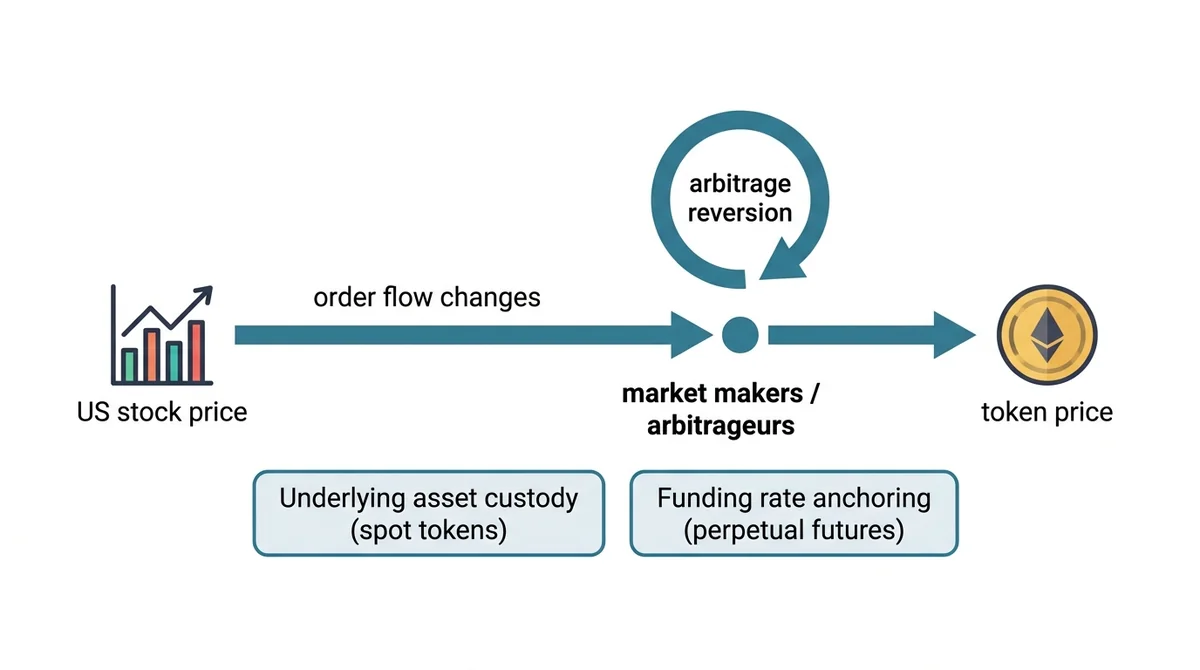
Core conclusion: Price discovery efficiency of tokenized U.S. stock products depends on whether order flow transmission from U.S. equities to tokenized products is sufficient and whether arbitrage mechanisms can quickly correct deviations; however, current public data is insufficient for precise quantitative assessment.
Asset/Business Line Definition: The tokenized U.S. stock market includes two main product types: one is spot tokens representing exposure to U.S. stock prices (with underlying stocks or equivalent assets held by a custodian), and the other is perpetual futures based on these tokens or directly anchored to U.S. stock prices. The "asset" studied in this article is the overall market microstructure of these products, not any single stock.
Order Flow Transmission Path: U.S. stock prices are the cause, and token prices are the effect. Ideally, order flow changes in the U.S. stock market are transmitted to tokenized products through market makers and arbitrageurs. Transmission relies on two anchoring mechanisms: first, underlying asset custody (spot tokens), and second, funding rate anchoring (perpetual futures).
Key Mechanisms and Data: Core metrics for measuring price discovery efficiency include bid-ask spread, order flow imbalance, trading volume, and turnover rate. However, most platforms have not disclosed order-flow-level data; we can only infer indirectly from public market data and on-chain data. Any specific figures (such as spreads, rates) are from public disclosures or market data, and as of 2026-02, data availability is limited.
Core Drivers:
- U.S. stock market liquidity and volatility: Order flow changes in U.S. equities directly affect price discovery in tokenized products.
- Arbitrageur participation: The more cross-market arbitrageurs there are, the faster price deviations are corrected.
- Platform transparency and custody quality: The more fully underlying assets are disclosed, the higher market trust and the more active order flow.
- Regulatory environment: The degree of compliance affects institutional capital participation willingness.
Key Participants:
- Upstream: U.S. stock exchanges, market makers, brokers.
- Midstream: Tokenization issuance platforms, custodians, on-chain market makers.
- Downstream: Traders, arbitrageurs, liquidity providers. (The above is a factual list and does not constitute any asset recommendation.)
#What Are the Essential Differences in Microstructure Between Tokenized Stocks and Real U.S. Stocks, and Between Spot and Perpetual Futures?
Tokenized stocks vs real U.S. stocks: Tokenized stocks usually only represent price exposure and do not represent ownership of real stocks. In most existing architectures, holding tokens does not automatically confer shareholder status, voting rights, or dividends, unless the issuance terms explicitly grant these rights. Their value is anchored to real U.S. stock prices, but there is tracking error risk. The legal nature of tokenized stocks depends on the issuance structure and may be security tokens or synthetic assets. (See Security token offering - Wikipedia)
Spot vs perpetual futures:
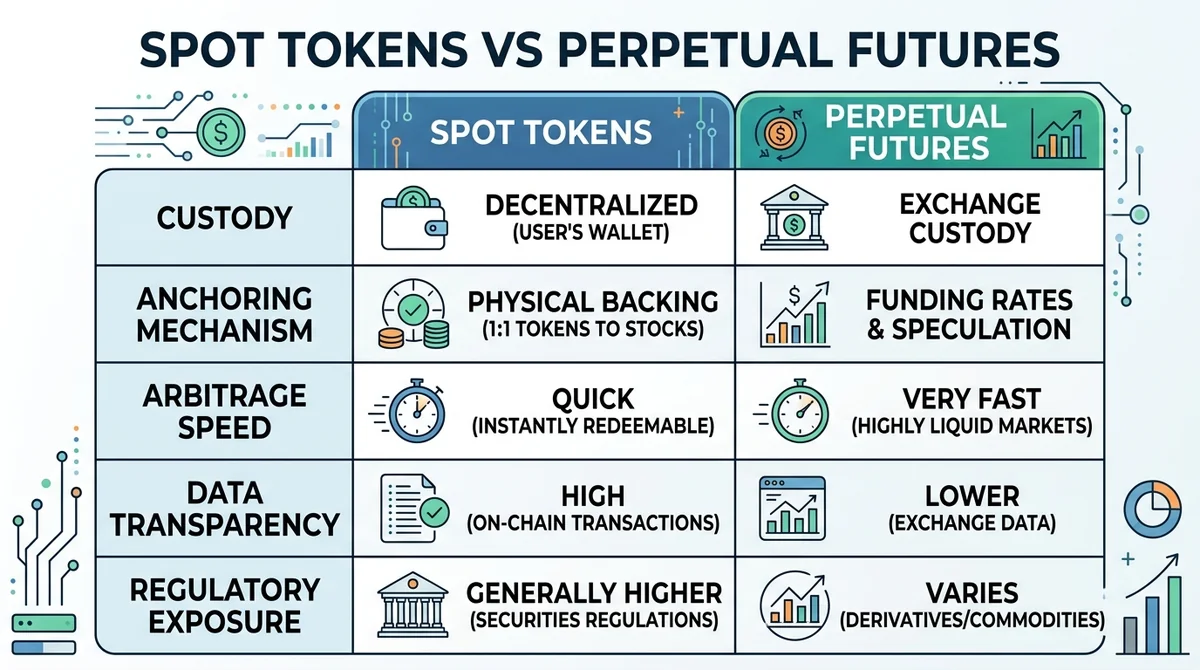
- Spot tokens: In typical designs, a custodian holds the corresponding U.S. stocks (or equivalent assets), and tokens represent shares of that asset portfolio. Buying or selling tokens is equivalent to gaining exposure to the underlying asset, usually without leverage or with low leverage.
- Perpetual futures: These are derivatives; traders only trade price and do not hold any underlying asset, typically with leverage and the possibility of liquidation. Perpetual futures prices are anchored to the index price through the perpetual futures funding rate settlement schedule.
Why tokenized stock perpetual futures are farther from real stocks: Because perpetual futures add leverage, funding rates, and counterparty risk, their prices can deviate significantly from real U.S. stocks due to market sentiment and insufficient liquidity. In contrast, spot token deviations are usually limited by custody arbitrage.
#What Risks and Disagreements Exist in Liquidity and Price Discovery in the Current Tokenized U.S. Stock Market?
Insufficient liquidity and price deviation: The overall liquidity of tokenized U.S. stock markets is far lower than that of U.S. stock markets; bid-ask spreads may widen, and large orders can cause significant slippage. When liquidity is insufficient, price discovery efficiency declines, and token prices may deviate from corresponding U.S. stocks for extended periods. Most platforms have not disclosed granular trading volumes; specific deviation magnitudes need to be assessed based on each platform's disclosed data.
Funding rate distortions: The perpetual futures funding rate settlement schedule is designed to anchor the spot price, but under extreme market conditions, the funding rate may be manipulated or show abnormal values, causing persistent premiums or discounts in perpetual prices. When liquidity dries up, funding rates may show extreme values (specific historical data should be checked from each platform's disclosures, not verified in this article).
Custody and counterparty risk: Spot tokens rely on custodians to hold underlying assets; if the custodian defaults, experiences technical failures, or legal disputes, the token value could be impaired. Perpetual futures face exchange counterparty risk. Market participants may disagree on the effectiveness of anchoring mechanisms: one side believes arbitrage will quickly correct deviations, while the other believes opaque custody and insufficient liquidity limit arbitrage. There is currently no unified data to adjudicate this disagreement.
#What Microstructure Indicators and Research Gaps Should Be Tracked Next?
Microstructure indicators: Order flow imbalance (the difference between aggressive buy and aggressive sell volumes), bid-ask spread, order book depth, and turnover rate. These indicators can reflect market pricing efficiency and liquidity quality, but most platforms currently do not disclose granular data.
Research gaps:
- Underlying asset custody transparency: whether custodians regularly publish proof of holdings, and whether on-chain data can be aligned with U.S. stock order flow.
- Cross-market arbitrage costs: fees, slippage, and capital transfer costs faced by arbitrageurs.
- Long-term price consistency: the cointegration relationship between token prices and U.S. stock prices, and the distribution of tracking errors.
How to verify long-term consistency: More historical data is needed, including price behavior during the overlapping periods of U.S. stock trading hours and 24/7 tokenized market trading. Current data is not public; we must wait for platform disclosures or third-party research.
#Further Reading
- Spot vs Perpetual: Pricing Mechanism, Basis, and Risk Characteristics Comparison
- Perpetual Futures Mark Price Deviation and Liquidation Alerts: Mechanism Breakdown and Stress Testing (2026)
- 2026 Crypto Derivatives Market Structure Study: Perpetual Futures Funding Rate and Liquidation Cascade Risk Transmission
- Robinhood On-Chain Tokenized Stocks and DeFi Stimulus: Native Lending and Base Competition Acceleration
#FAQ
Are tokenized U.S. stock products equivalent to holding real U.S. stocks? No. Tokenized stocks usually only provide price exposure and do not automatically entitle holders to voting rights and dividends, unless the issuance structure explicitly grants these rights.
Which is riskier, spot tokens or perpetual futures? Perpetual futures are generally riskier because they involve leverage, funding rates, and counterparty risk, and may lead to liquidation. Spot token risk mainly comes from custody and price tracking error.
Is the funding rate a trading fee? No. In perpetual futures, how does perpetual futures funding rate work? The funding rate is the anchoring cost paid between long and short positions to keep the perpetual price close to the index price, not a trading fee charged by the exchange.
Why is price discovery efficiency in tokenized U.S. stock markets difficult to assess? Because order-flow-level data is mostly not public; we can only infer indirectly from spreads, trading volume, and on-chain data, and there is insufficient information on arbitrage costs and custody transparency.
Does this article recommend trading tokenized U.S. stock products? No. This article only provides a research framework and mechanism analysis and does not constitute investment advice.
FAQ
Are tokenized U.S. stock products equivalent to holding real U.S. stocks?
No. Tokenized stocks usually only provide price exposure and do not automatically entitle holders to voting rights and dividends, unless the issuance structure explicitly grants these rights.
Which is riskier, spot tokens or perpetual futures?
Perpetual futures are generally riskier because they involve leverage, funding rates, and counterparty risk, and may lead to liquidation. Spot token risk mainly comes from custody and price tracking error.
Is the funding rate a trading fee?
No. In perpetual futures, how does perpetual futures funding rate work? The funding rate is the anchoring cost paid between long and short positions to keep the perpetual price close to the index price, not a trading fee charged by the exchange.
Why is price discovery efficiency in tokenized U.S. stock markets difficult to assess?
Because order-flow-level data is mostly not public; we can only infer indirectly from spreads, trading volume, and on-chain data, and there is insufficient information on arbitrage costs and custody transparency.
Does this article recommend trading tokenized U.S. stock products?
No. This article only provides a research framework and mechanism analysis and does not constitute investment advice.
Related Terms
Ready to try? Test the strategy on MSX with small positions. Educational content only — not investment advice.