US Treasury RWA and Tokenized Treasury Compliance Frameworks: Issuance Structure, Holder Rights, and Cross-Border Applicability Boundaries (2026)
A three-layer breakdown of US Treasury RWA and tokenized treasury compliance: issuance structure, custody fee arrangements, and holder rights, plus cross-border boundaries.
⚠ This article is multi-asset research on digital assets and does not constitute investment advice. Investing carries risk; please make decisions carefully.
Core conclusion: The compliance framework difference between US Treasury RWA and tokenized treasury tokens lies not in the name, but in three structural layers—issuance structure, custody fee arrangements, and holder rights. The name itself does not constitute a basis for determining compliance.
#Risk statement: this article discusses compliance frameworks, not compliance conclusions
Research positioning: This article only outlines the compliance assessment dimensions and methodology for US Treasury RWA and tokenized treasury tokens. It does not constitute legal advice or investment advice. It contains no price forecasts, instrument recommendations, or return promises.
Why can't compliance framework research replace legal advice? Compliance determinations depend heavily on specific issuance documents, custody agreements, distribution arrangements, and investor-location rules. The same structure may trigger different regulatory application in different jurisdictions, so any "compliance conclusion" divorced from specific documents lacks a verifiable basis. This article provides a judgment framework, not a definitive answer.
How does this article handle missing data and uncertainties? For terms and jurisdictional determinations that cannot be verified from public disclosures, we uniformly mark them "data not publicly disclosed," without presumption or analogical extrapolation. Any statement involving specific terms is handled as "subject to the issuance documents."
#What exactly is the compliance framework difference between US Treasury RWA and tokenized treasury tokens?
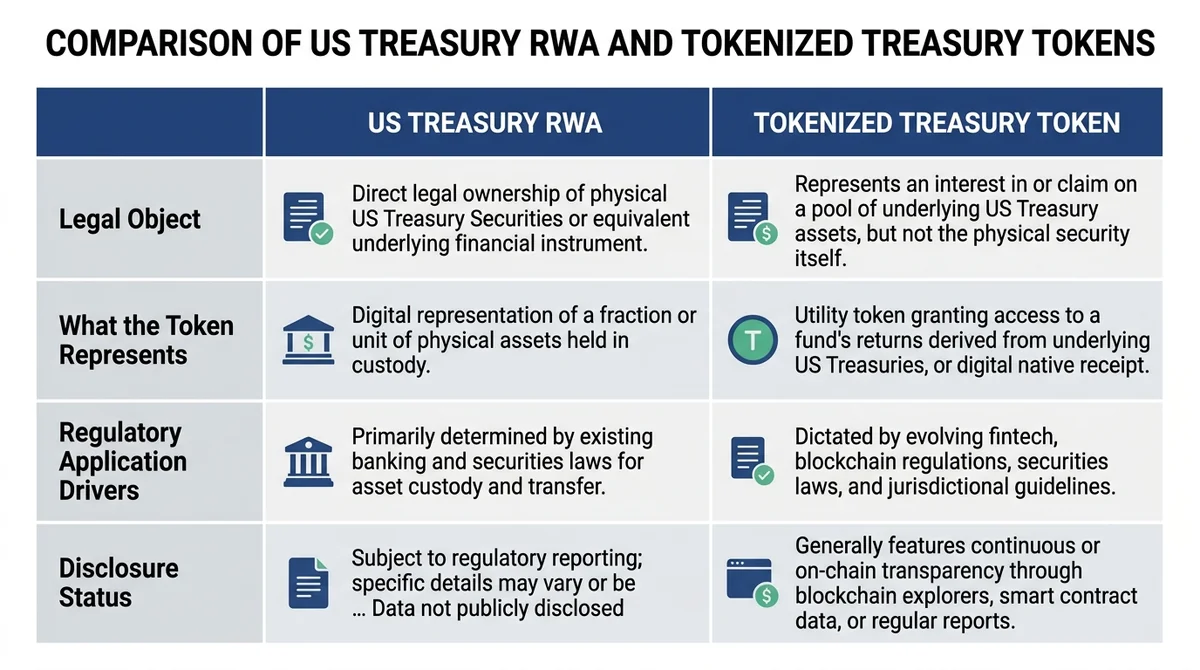
What is the legal object of each? US Treasury RWA emphasizes "asset tokenization arrangements whose underlying is tokenized treasury bonds," with the token merely a vehicle; a tokenized treasury token is an instrument that carries US Treasury exposure in token form. The former describes an arrangement, the latter describes an instrument—the legal objects are not the same.
Why can the same name still lead to different regulatory application? Regulatory application typically depends on the issuer, the target of sale, the distribution method, and holder rights, not the token name. Two products both called "tokenized treasury tokens" may fall under different rule frameworks due to different issuance structures and distribution paths.
Which structural layers should be examined to judge the difference? We recommend identifying three layers: first, the issuance structure (who issues, who bears the redemption obligation); second, the custody fee arrangement (who holds and provides custody fee services for the underlying tokenized treasury bonds); third, holder rights (recourse, distribution, and redemption terms). A difference in any one layer may change the compliance application judgment.
#How to break down the issuance structure of US Treasury RWA: who issues, who provides custody fee services, who bears redemption?
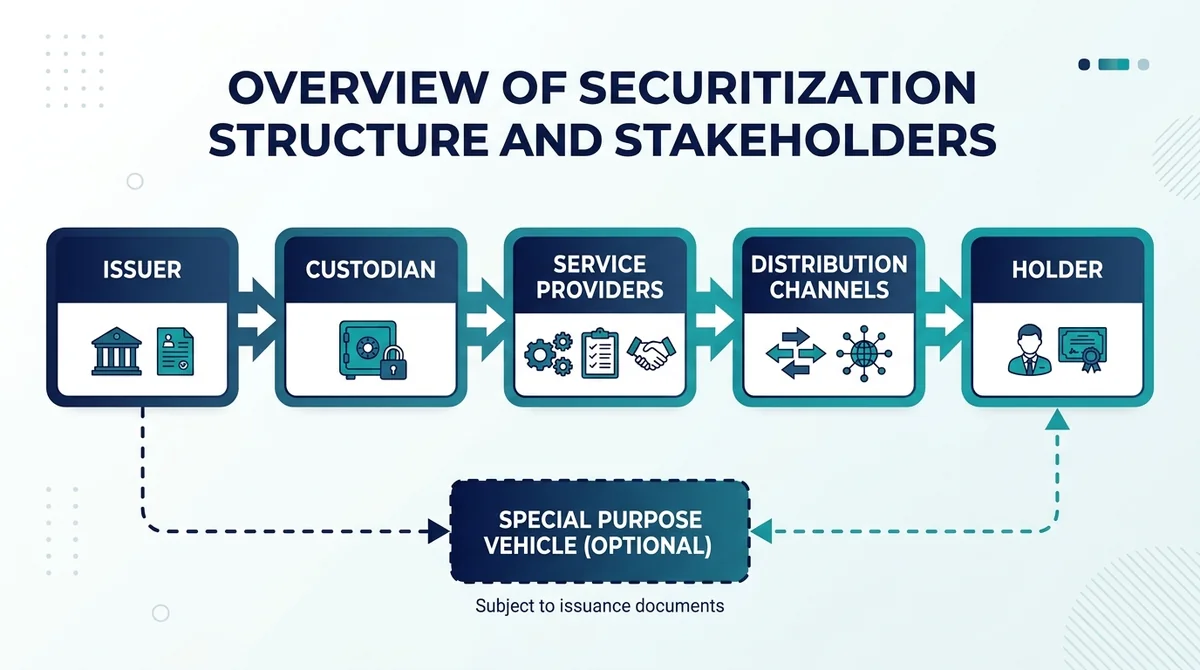
What roles do common issuance structures include? They can usually be broken down into the issuer, the custodian, service providers (such as administration, valuation, and audit), and distribution channels. Whether roles are separated and whether a special purpose vehicle exists must be subject to the issuance documents; specific terms are data not publicly disclosed.
Who holds and provides custody fee services for the underlying tokenized treasury bonds? The holding and custody fee arrangement for the underlying tokenized treasury bonds determines the risk transmission path: whether held by a custodian in a segregated account or held indirectly through other arrangements directly affects the nature of holders' exposure to the underlying assets. Specific custody fee arrangements are data not publicly disclosed and must be checked item by item against the issuance documents.
Which party bears the redemption and repayment obligation? The party bearing the redemption and repayment obligation is one of the key variables in compliance judgment. Whether the obligation falls on the issuer, the custodian, or a service provider changes the counterparty risk structure holders face. Relevant terms must be subject to the issuance documents; this article makes no presumption.
#What rights do holders of tokenized treasury tokens actually enjoy?
Do holders have recourse to the underlying tokenized treasury bonds? Holder rights derive from the issuance document terms, not the token name. Whether holders have direct recourse to the underlying tokenized treasury bonds depends on the legal structure design and cannot be presumed from the label "tokenized treasury token."
How are distribution and redemption arrangements usually specified? Distribution frequency, distribution sources, redemption conditions, and redemption time limits are usually specified item by item in the issuance documents. Differences in these terms across products may significantly change the actual rights hierarchy of holders. Specific terms are data not publicly disclosed and must be checked item by item.
What framework risks arise from missing rights? If holders only hold contractual rights against the issuer and have no recourse to the underlying assets, the compliance judgment may lean more toward securities or fund frameworks; otherwise, different disclosure and suitability requirements may apply. Different rights hierarchies change the judgment path for compliance application.
#How to judge the applicability boundaries of US Treasury RWA in cross-border scenarios?
How do the rules of the place of issuance, place of custody fee, and investor location stack? Three sets of rules may apply simultaneously and must be identified by layer: the place-of-issuance rules focus on issuance and fundraising activities, the place-of-custody fee rules focus on asset safekeeping and segregation, and the investor-location rules focus on sales suitability and disclosure. When the three stack, judgment complexity rises significantly.
Which compliance dimensions do cross-border distribution links usually focus on? Typically investor suitability, disclosure requirements, licensing status of distribution channels, and cross-border sales restrictions. The determination standards of specific jurisdictions are data not publicly disclosed; this article makes no compliance determination for any jurisdiction.
Which judgments currently lack public data support? Regulatory determinations of specific jurisdictions, details of licensing requirements for cross-border distribution, and the custody agreement terms of some products currently lack publicly verifiable data support and are uniformly marked as data not publicly disclosed.
#What disclosures and rule changes should be watched next?
What should be focused on in issuance documents and custody fee disclosures? Focus on whether disclosure frameworks are consistent and verifiable, especially the transparency of how underlying assets are held, custody fee segregation arrangements, and redemption terms. The degree of consistency in disclosure frameworks directly affects the comparability of compliance judgments.
What observation indicators exist for cross-border structure adaptation? Observable indicators include changes in the issuer's place of registration, the custodian's location, the licensing status of distribution channels, and investor suitability arrangements. This article only lists observation dimensions and makes no judgment on rule trends.
#FAQ
Q1: Are US Treasury RWA and tokenized treasury tokens the same thing? A1: They are concepts at different levels. US Treasury RWA describes asset tokenization arrangements whose underlying is tokenized treasury bonds, while tokenized treasury tokens describe instruments that carry US Treasury exposure in token form. Compliance judgment requires examining issuance structure, custody fee arrangements, and holder rights separately.
Q2: Does "US Treasury" in a token's name mean it is compliant? A2: That cannot be presumed. The name does not constitute a basis for determining compliance; regulatory application typically depends on the issuer, the target of sale, the distribution method, and holder rights.
Q3: Do holders have recourse to the underlying tokenized treasury bonds? A3: It depends on the issuance document terms and cannot be presumed from the token name. Recourse, distribution, and redemption terms must be checked item by item; specific terms are data not publicly disclosed.
Q4: In cross-border scenarios, which jurisdiction's rules should apply? A4: The rules of the place of issuance, place of custody fee, and investor location may apply simultaneously and must be identified by layer. This article only outlines judgment dimensions and makes no compliance determination for any jurisdiction.
Q5: Can this article be used as legal advice? A5: No. This article is compliance framework research and methodology outline and does not constitute legal advice or investment advice.
Further reading: For liquidity and redemption mechanisms of tokenized treasury bonds, see MSX Strategy Research's tokenized treasury liquidity risk research and tokenized treasury term structure and on-chain yield curve; for regulatory path comparisons, see the RWA policy landscape.
FAQ
Are US Treasury RWA and tokenized treasury tokens the same thing?
They are concepts at different levels. US Treasury RWA describes asset tokenization arrangements whose underlying is tokenized treasury bonds, while tokenized treasury tokens describe instruments that carry US Treasury exposure in token form. Compliance judgment requires examining issuance structure, custody fee arrangements, and holder rights separately.
Does "US Treasury" in a token's name mean it is compliant?
That cannot be presumed. The name does not constitute a basis for determining compliance; regulatory application typically depends on the issuer, the target of sale, the distribution method, and holder rights.
Do holders have recourse to the underlying tokenized treasury bonds?
It depends on the issuance document terms and cannot be presumed from the token name. Recourse, distribution, and redemption terms must be checked item by item; specific terms are data not publicly disclosed.
In cross-border scenarios, which jurisdiction's rules should apply?
The rules of the place of issuance, place of custody fee, and investor location may apply simultaneously and must be identified by layer. This article only outlines judgment dimensions and makes no compliance determination for any jurisdiction.
Can this article be used as legal advice?
No. This article is compliance framework research and methodology outline and does not constitute legal advice or investment advice.
Related Terms
Ready to try? Test the strategy on MSX with small positions. Educational content only — not investment advice.