DeFi Yield Strategy Return Attribution Framework: Decomposable Definitions for Protocol Incentives, Trading Fees, and Leverage Loops (2026)
Decomposing DeFi yield into protocol incentives, trading fees, and leverage loops with comparable attribution definitions, plus data gaps and definitional disputes.
⚠ This article is a research-methodology compilation on digital assets and does not constitute investment advice. Investing carries risk; please make decisions prudently.
Key takeaway: The total APY of a DeFi yield strategy is typically a blend of three sources: protocol incentives, trading fees, and leverage loops. Only by listing subsidy income and operating income separately, and deducting borrowing costs and liquidation losses, can one judge which portion of the yield is more sustainable. This judgment is an inference at the analytical-framework level, not an empirical conclusion about the returns of any specific strategy.
#Asset/Business Line Definition: The Scope of This Study
This article examines the return structure of on-chain DeFi yield strategies — that is, how returns are composed and where they come from when users earn yield through lending, liquidity provision, or leverage loops. The research scope includes:
- Classification of yield sources (protocol incentives, trading fees, leverage loops);
- Attribution definitions (coin-margined contract vs. stablecoin basis, fee attribution rules, cost deduction methods);
- Availability of and gaps in disclosed data.
It does not cover buy or sell judgments on any specific asset, nor does it forecast the future returns of any strategy. This article is a compilation at the research-methodology level, not a yield recommendation. No specific protocol names or quantitative data are cited because no verifiable source list is attached; any statement involving specific figures should be treated as pending verification.
#Key Mechanisms and Data: How to Decompose the Three Yield Sources
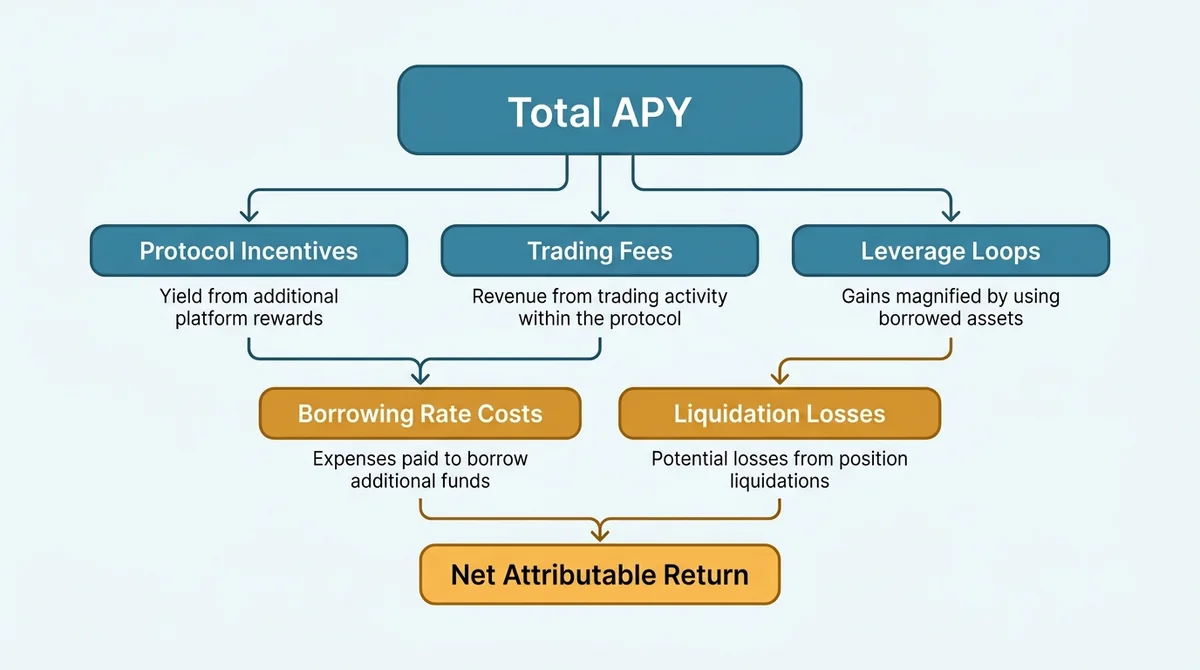
Protocol incentives: Most protocols distribute incentives in the form of token subsidies, whose nominal value is directly tied to the token price and the emissions schedule. When the emissions schedule is adjusted or the token price changes, the "total APY" of the same strategy can shift significantly, even though real on-chain operating activity has not changed in tandem. This is a qualitative description at the mechanism level; no emissions ratios or token price data from specific protocols are cited (unverified).
Trading fees: Trading fees correspond to real on-chain transaction activity and are relatively closer to operating cash flow. However, fee income is clearly affected by trading-volume cycles, and fee attribution rules differ across protocols (what share goes to liquidity providers versus the treasury). Specific allocation ratios vary by protocol and are not enumerated here (unverified).
Leverage loops: Repeatedly collateralizing and borrowing amplifies nominal yield while also amplifying risk. Attribution must deduct borrowing-rate costs and list liquidation losses separately as a tail cost. The net return of a leverage loop is highly sensitive to how does perpetual futures funding rate work and borrowing rates. This is a mechanism inference; no specific rate or liquidation data are attached (unverified).
#Core Drivers: Why an Attribution Framework Is Needed Now
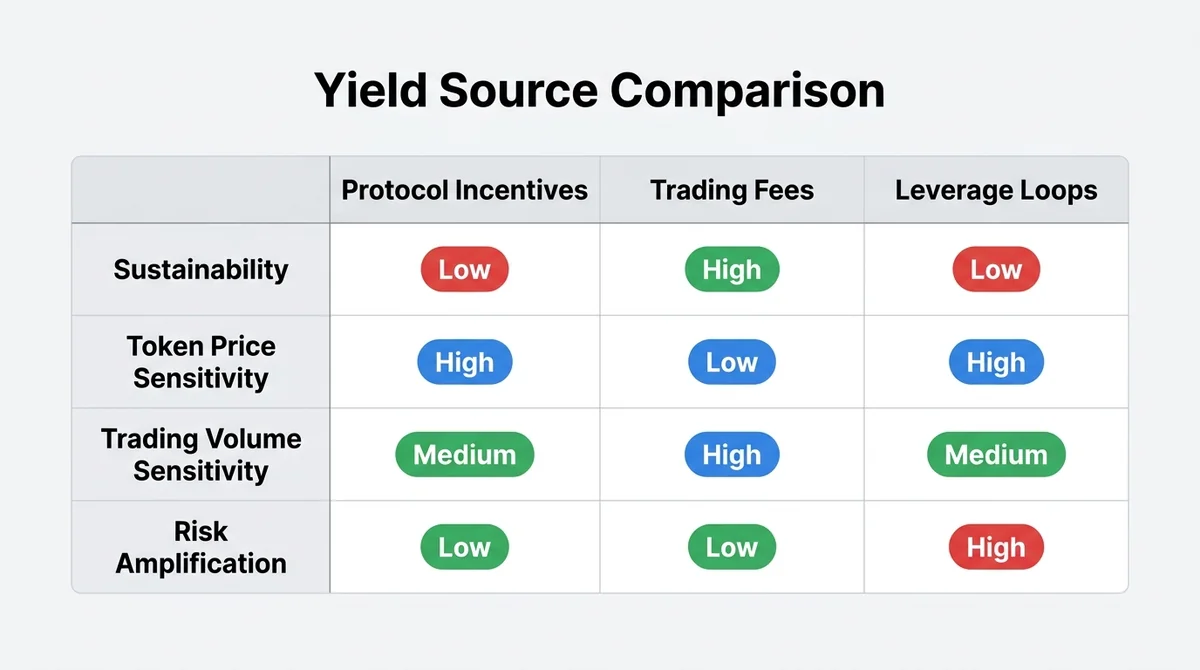
- The misleading nature of total APY: A single APY figure blends sustainable fee income with unsustainable token subsidies, making it hard for readers to judge yield quality.
- Incentive tapering is becoming routine: Emissions schedules are adjusted through protocol governance, so the incentive portion may contract in phases, changing the return structure of subsidy-dependent strategies.
- Proliferation of leveraged strategies: Loop borrowing amplifies nominal yield, but if cost items are not deducted, true returns are systematically overstated.
- Need for cross-strategy comparison: Research-oriented readers need to compare strategies under a unified definition; inconsistent definitions make horizontal comparison meaningless.
These four points are analytical judgments (inferences) and still lack direct support from public statistics.
#Key Participants: Representative Roles in the Ecosystem (Categories Only, Not Recommendations)
- Lending protocols: Provide the collateralized lending markets required for leverage loops; their rates are a source of cost items in attribution.
- Decentralized exchanges and AMMs: The primary venues where trading fees are generated; fee attribution rules are determined by protocol parameters.
- Yield aggregators: Package multi-source yields for display; their disclosure definitions directly shape how readers understand the return structure.
- Data and analytics platforms: Provide APY, TVL, and fee data, but cost items and incentive breakdowns are often incomplete.
#Risks and Disagreements: Limitations of the Attribution Framework Itself
- Definitional disputes: Whether rewards are denominated on a coin-margined contract basis or a stablecoin basis changes the attribution result for the same strategy; fee attribution standards are not uniform across protocols.
- Data gaps: Some protocols do not disclose complete cost items (such as real-time weighted borrowing rates or the historical distribution of liquidation losses). Gaps should be explicitly flagged rather than forcibly summed.
- Ex-post nature: Attribution is an ex-post decomposition of historical return structure and does not forecast future returns. Return structure changes with incentive emissions and trading-volume cycles.
- Bear-case perspective: Some argue that most DeFi yield strategies become markedly less attractive once incentives are stripped out; the attribution framework can be used to test this claim, but this article cites no data to prove or refute it.
#What to Watch Next
- Weighted changes in borrowing rates at major lending protocols;
- Governance votes and adjustment announcements on each protocol's incentive emissions schedule;
- Cyclical changes in on-chain trading volume and trading fee income;
- Whether analytics platforms begin disclosing a split between incentives and trading fees.
#Risk Statement: Attribution Results Are Analytical Tools, Not Yield Promises
Yield attribution is an ex-post decomposition of historical return structure and does not constitute a forecast of future returns or investment advice. Return structure changes with incentives and trading volume; readers should independently verify data definitions and disclosure timing when using attribution results.
#FAQ
See the FAQ items below.
FAQ
Where do DeFi yield strategies mainly get their returns?
They can usually be broken into three categories: protocol incentives (token subsidies), trading fees (generated by real on-chain activity), and leverage loops (which amplify nominal yield). Only after attribution can you judge which portion is closer to operating income and which depends on subsidies.
Why can't total APY be used directly to compare strategies?
Total APY blends sustainable trading fee income with unsustainable token subsidies, and reward denomination and fee attribution definitions differ across protocols, so direct comparison tends to be distorted.
Why shouldn't protocol incentives be treated as stable yield?
Incentives are mostly paid in tokens, whose value fluctuates with token price and the emissions schedule; adjustments to the emissions schedule directly change the return structure, so they should be listed separately from trading fee income.
What should be noted about leverage loops in attribution?
Borrowing-rate costs must be deducted, and liquidation losses must be listed separately as a tail cost; otherwise the strategy's true return is easily and systematically overstated.
How should undisclosed data be handled?
Data gaps and definitional disputes should be explicitly flagged rather than forcibly summed. The value of an attribution framework lies in exposing uncertainty, not in creating an illusion of precision.
Related Terms
Ready to try? Test the strategy on MSX with small positions. Educational content only — not investment advice.