Quantifying Execution Frictions and Hidden Costs in Tokenized Stock vs. Underlying US Equity Arbitrage: Slippage, Capital Lockup, and Arbitrage Bounds (2026)
Break down slippage, capital lockup, fees and other execution frictions in tokenized stock vs. underlying US equity arbitrage; quantify arbitrage bounds and spread convergence; assess real profit space and risks.
⚠ This article is a multi-asset digital asset research piece and does not constitute investment advice. Investing involves risk; please make decisions prudently.
Arbitrage between tokenized stocks and underlying US equities is not "risk-free money moving." Slippage, capital lockup, and hidden costs jointly determine the arbitrage bound; arbitrage is only profitable when the spread exceeds total friction costs.
#What are the main execution frictions in tokenized stock vs. underlying US equity arbitrage?
A tokenized stock is a digital asset representing exposure to a specific stock's price. Trading the token does not equate to holding the real stock, and it typically carries no dividends or voting rights. Arbitrage between it and the underlying US equity essentially involves simultaneously buying and selling the same price exposure in two markets to capture the spread. However, multiple frictions arise during execution, directly eroding theoretical returns.
#How does slippage affect arbitrage execution?
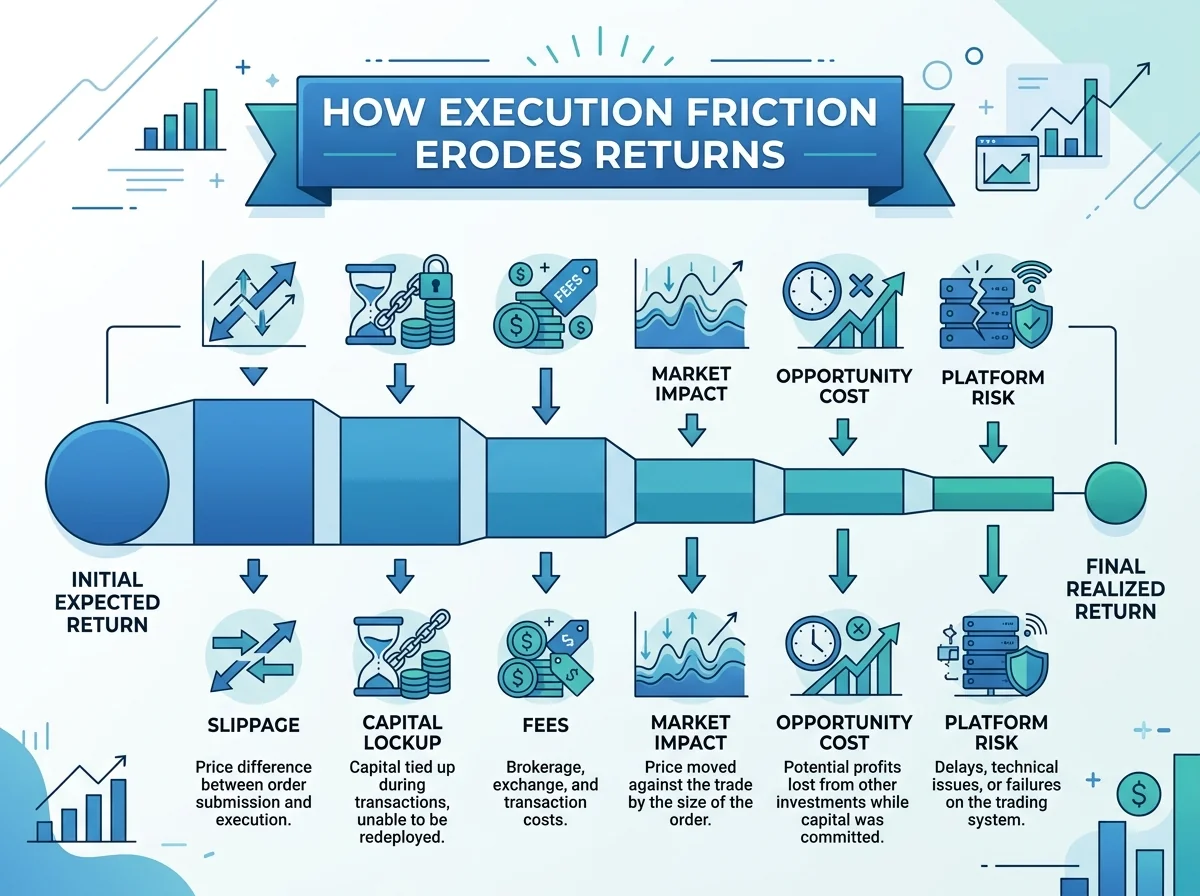
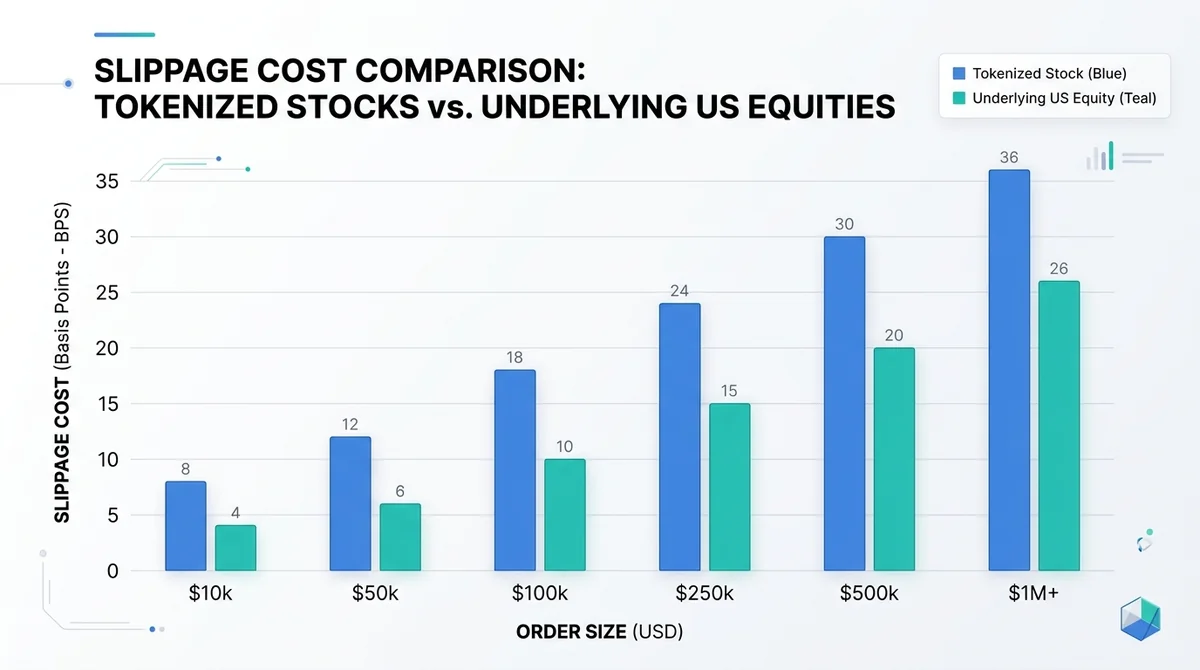
Slippage refers to the difference between the expected execution price and the actual execution price, usually caused by insufficient order book depth or market impact. The tokenized stock market is often far less deep than the underlying US equity market, so large orders can easily move the price, causing significant slippage. Slippage magnitude depends on order size, market liquidity, and execution speed.
#What components make up capital lockup costs?
Capital lockup costs include interest on funds during the holding period, margin requirements, and the time cost of cross-market transfers. Arbitrageurs need to hold positions in both markets simultaneously; capital is locked and cannot be used for other investments, creating opportunity cost. Higher margin ratios tie up more capital and reduce capital efficiency.
#What other hidden costs are often overlooked?
Beyond slippage and capital lockup, fees, market impact cost, opportunity cost, and platform risk premium are also hidden costs. Tokenized platforms and traditional brokers have different fee structures; frequent trading can accumulate high fees. Market impact cost refers to the lasting effect of large orders on market prices, while opportunity cost is the price of forgoing other investment opportunities.
#How to quantify slippage cost and determine the arbitrage bound?
#How is slippage cost measured?
Slippage cost can be estimated using order book depth and historical trade data. For example, analyze the resting order quantities at multiple depth levels for a specific tokenized stock, simulate the average execution price for orders of different sizes, and compare with the mid-price to derive slippage. Historical trade data can be used in regression analysis to identify the relationship between slippage and order size or volatility.
#How is the arbitrage bound calculated?
The arbitrage bound equals total friction costs, including slippage, fees, capital lockup costs, and risk premium. When the spread exceeds the arbitrage bound, arbitrageurs enter and the spread converges toward the bound. The formula can be expressed as:
Arbitrage bound = slippage cost + fees + capital lockup cost + risk premium
Only when the spread is greater than this bound does arbitrage yield positive returns.
#How does spread convergence speed affect arbitrage?
Spread convergence speed affects capital lockup duration. Faster convergence means higher capital turnover and higher annualized returns; slow convergence locks capital for longer and reduces realized returns. Convergence speed depends on the number of market participants, trading infrastructure efficiency, and information dissemination speed.
#How does capital lockup cost erode arbitrage returns?
#How long is the capital lockup period for cross-market arbitrage?
The capital lockup period includes trade confirmation, settlement, and cross-market transfer time. Tokenized stock markets typically use blockchain settlement and are faster, but the underlying US equity market requires T+1 or T+2 settlement, preventing instant capital transfer and extending lockup. Network congestion during transfers can also add delays.
#How do margin requirements affect capital efficiency?
Higher margin requirements force arbitrageurs to commit more of their own capital, reduce leverage space, and lower capital efficiency. Margin ratios vary significantly across platforms; choosing a low-margin platform can improve capital utilization but requires weighing platform risk.
#How can capital lockup costs be reduced?
Capital lockup costs can be reduced by using perpetual contracts to hedge, selecting efficient settlement platforms, or optimizing capital scheduling. Perpetual contracts allow establishing a hedge position without actually holding the underlying asset, reducing capital lockup. Choosing platforms with fast settlement and support for atomic swaps also shortens the capital lockup period.
#How does the arbitrage bound change in real markets?
#How does market liquidity affect the arbitrage bound?
Worse liquidity leads to larger slippage and a wider arbitrage bound. Tokenized stock market liquidity is usually lower than the underlying market, so the arbitrage bound tends to be higher. Liquidity also affects spread convergence speed; in low-liquidity markets, spreads may deviate for extended periods.
#How do arbitrage bounds differ across tokenized platforms?
Different platforms have different fees, funding rates, and liquidity, leading to different arbitrage bounds. For example, some platforms offer zero fees but poor liquidity, while others have good liquidity but high fees. Arbitrageurs need to compare total friction costs across platforms and choose the optimal combination.
#How does the arbitrage bound evolve in extreme market conditions?
In extreme conditions, volatility rises, market depth declines, and slippage and market impact costs surge, causing the arbitrage bound to widen dramatically. Arbitrage opportunities shrink, and negative returns may even occur. Historically, during periods of violent market swings, tokenized stock and underlying US equity spreads often deviate significantly, but execution risk is extremely high.
#What are the risks in the spread convergence mechanism and arbitrage strategies?
#Why does the spread converge?
Spread convergence is driven by arbitrageur trading behavior. When the spread exceeds the arbitrage bound, arbitrageurs buy the undervalued asset and sell the overvalued asset, pushing prices back toward parity. As participants increase, the spread narrows toward the bound, and the market becomes more efficient.
#What are the main risks faced by arbitrage strategies?
The main risks include execution delay, price gaps, and platform risk. Execution delay may cause arbitrage opportunities to vanish or turn into losses; price gaps occur when the market moves violently and price skips the expected level, preventing execution as planned; platform risk includes exchange downtime, withdrawal restrictions, or counterparty default.
#How to manage risks in arbitrage?
Risks can be managed by setting stop-losses, limiting single position size, diversifying across platforms, and real-time monitoring. Stop-losses prevent single losses from expanding, position limits control total risk exposure, and platform diversification reduces the impact of a single platform failure. Additionally, using algorithmic trading can improve execution speed and reduce slippage.
#FAQ
Q: Is tokenized stock arbitrage risk-free?
A: No. Arbitrage involves slippage, capital lockup, fees, and platform risk; actual returns can be negative. Positive returns only occur when the spread exceeds total friction costs.
Q: How is the arbitrage bound calculated?
A: Arbitrage bound = slippage cost + fees + capital lockup cost + risk premium. The spread must exceed this bound for profit.
Q: What does capital lockup cost mainly include?
A: It includes interest on funds during the holding period, margin requirements, capital lockup caused by cross-market transfer time, and opportunity cost of forgoing other investments.
Q: Why does the spread converge?
A: Arbitrageurs, upon spotting a spread exceeding the bound, buy the undervalued asset and sell the overvalued asset, pushing prices back and causing the spread to converge toward the bound.
Q: What are the main risks of arbitrage strategies?
A: Execution delay, price gaps, platform risk (downtime, withdrawal restrictions, counterparty default), and expanded slippage due to insufficient liquidity.
FAQ
Is tokenized stock arbitrage risk-free?
No. Arbitrage involves slippage, capital lockup, fees, and platform risk; actual returns can be negative. Positive returns only occur when the spread exceeds total friction costs.
How is the arbitrage bound calculated?
Arbitrage bound = slippage cost + fees + capital lockup cost + risk premium. The spread must exceed this bound for profit.
What does capital lockup cost mainly include?
It includes interest on funds during the holding period, margin requirements, capital lockup caused by cross-market transfer time, and opportunity cost of forgoing other investments.
Why does the spread converge?
Arbitrageurs, upon spotting a spread exceeding the bound, buy the undervalued asset and sell the overvalued asset, pushing prices back and causing the spread to converge toward the bound.
What are the main risks of arbitrage strategies?
Execution delay, price gaps, platform risk (downtime, withdrawal restrictions, counterparty default), and expanded slippage due to insufficient liquidity.
Related Terms
Ready to try? Test the strategy on MSX with small positions. Educational content only — not investment advice.