Controversies and Divergences in Tokenized Stock Corporate Actions: Entitlement Attribution, Failed Settlements, and Remedies (2026)
Why do tokenized stock dividends and splits trigger entitlement disputes? We break down legal position, settlement failures, counterparty exposure, and remedies.
⚠ This article is multi-asset research on digital assets and does not constitute investment advice. Investing carries risk; please make decisions prudently.
Key conclusion: Tokenized stocks are usually just price exposure rather than actual equity. Entitlement attribution in corporate actions is governed by the agreement terms and the registration basis, and the disputes that arise from this are essentially a misalignment between economic rights and legal rights (this is a mechanism inference; the specific characterization depends on each platform's terms and jurisdiction). Settlement failures mostly occur at the points of timing determination and amount conversion, while remedies are constrained by governing law and arbitration clauses.
#Instrument/Business Line Definition
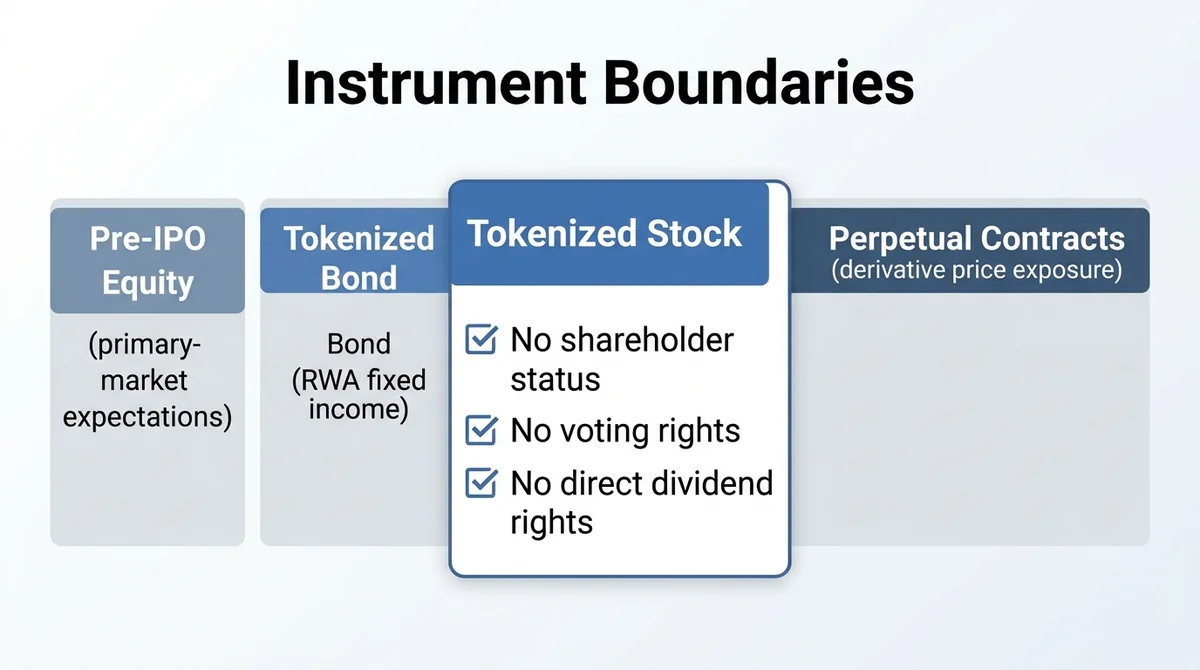
The subject of this article is tokenized stocks (Tokenized Stock)—digital assets that represent price exposure to a specific US stock. Its boundaries need to be clear: trading a token is not the same as holding the actual stock, and it typically does not carry shareholder status, voting rights, or direct dividend rights. Corporate actions include dividends, stock splits, reverse splits, mergers and acquisitions, spin-offs, and more. This article focuses on how these actions are transmitted, settled, and disputed under the tokenized structure.
Adjacent but distinct topics include tokenized bond (RWA fixed income), perpetual contracts (derivative price exposure), and Pre-IPO equity (primary-market expectations). This article does not cover price forecasts or instrument recommendations.
#Key Mechanisms and Data
#What legal position do tokenized stock holders occupy in dividends and stock splits?
Holders of tokenized stocks typically occupy a contractual-creditor-like position: their rights derive from an agreement with the issuer or platform, not from registration on the shareholder register. The economic effects of dividends and splits may be passed through to holders as stipulated in the agreement, but legal shareholder rights (voting, proposals, attending shareholder meetings) generally fall outside the scope of pass-through. This legal position is the structural root of entitlement attribution disputes. It should be noted that "contractual-creditor-like" is a general description of common structures in this article, not a legal characterization of any specific platform.
#Who transmits corporate action information and execution, and on what timing basis do they take effect?
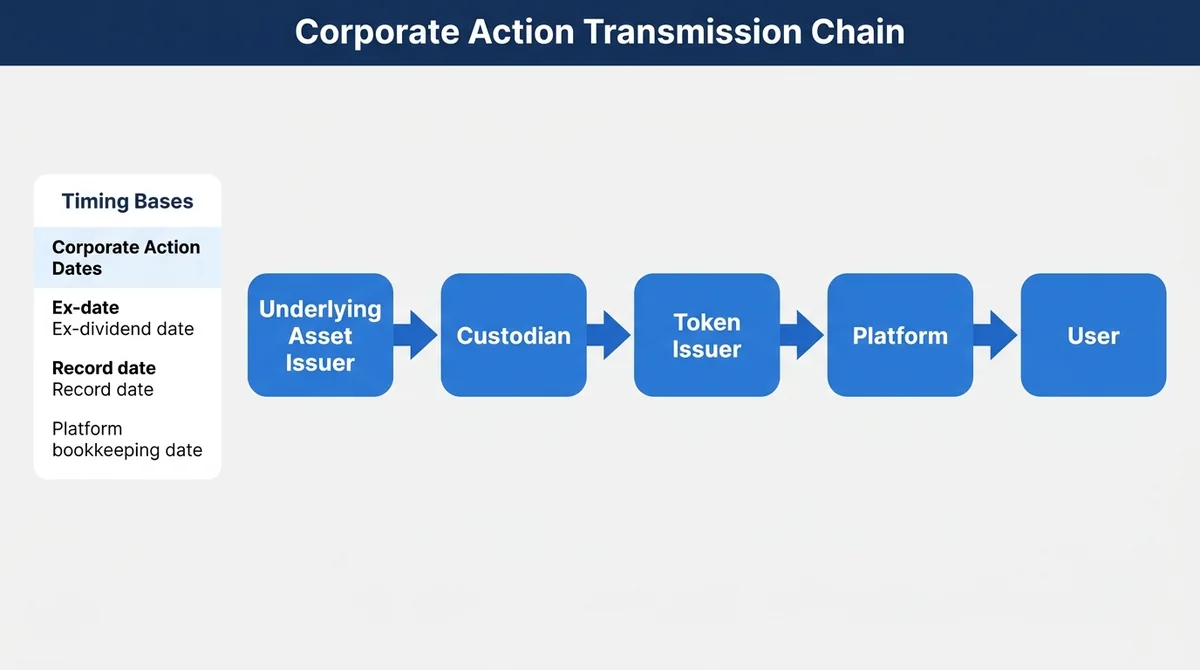
Corporate actions require multi-level transmission through the issuer—custodian—platform chain. The information flow typically starts from the underlying asset issuer, passes through the custodian to the token issuer, and then reaches users via the platform. The effective timing depends on the basis stipulated in the agreement: it may be executed according to the underlying stock's ex-dividend date, record date, or the platform's bookkeeping date. Differences in these bases may cause the same action to arrive at different times and amounts across platforms (this is a mechanism inference; public cross-platform comparison data is lacking).
#How do price exposure and shareholder status differ in entitlement attribution?
Price exposure replicates only economic performance, whereas shareholder status includes legal rights. The root of entitlement attribution disputes is precisely the misalignment between economic rights and legal rights: holders may receive economic compensation for dividends while being legally unable to assert shareholder rights; conversely, agreement terms may exclude certain entitlements.
Data note: Statistics such as the specific failure rate of tokenized stock corporate actions and the number of dispute cases have not yet been uniformly and publicly disclosed. The relevant conclusions in this article are based on public disclosures and general observations of platform terms, as of 2026-02, and uncertainty should be noted.
#Core Drivers
- Growing supply of tokenized stock products: More platforms are launching tokenized stock products, increasing the frequency of corporate action transmission and potentially raising the probability of disputes surfacing (inference; public statistics on product numbers and dispute frequency are lacking).
- Differentiated agreement terms: Platforms have inconsistent rules for handling dividends and stock splits, creating divergences in entitlement attribution bases.
- Cross-chain and cross-time-zone settlement: Mismatches between on-chain settlement and underlying market settlement cycles may amplify in-transit risk.
- Evolving regulatory basis: The legal characterization of tokenized equity is still evolving, and changes in regulatory disclosure requirements directly affect the determination of entitlement attribution.
#Key Participants
- Underlying asset issuer: The initiator of corporate actions, whose announcements are the source of information.
- Custodian: Holds the underlying stock and is responsible for passing corporate actions to the token issuer.
- Token issuer: Designs the token terms and determines how economic entitlements are passed through.
- Trading platform: Reaches users and handles bookkeeping, complaint intake, and disclosure.
- Market-making and clearing: Affects settlement completion and liquidity.
The above lists factual roles only and does not constitute a recommendation or evaluation of any entity.
#Risks and Divergences
#At which stages do settlement failures typically occur?
Settlement failures mostly occur in timing determination and basis conversion: cross-time-zone differences may cause mismatches between the record date and bookkeeping date, cross-chain transfers may cause in-transit confirmation delays, and the custody fee confirmation stage may stall due to incomplete information. Post-failure make-up payments, reversals, and bookkeeping rules depend on the agreement terms; public failure-rate data is not disclosed, and platform disclosures should govern.
#How should counterparty exposure be identified?
Counterparty exposure is not limited to the custodian; it also includes the token issuer and the market-making and clearing stages. Exposure may be concentrated rather than diversified along the transmission chain: if the issuer and custodian are related parties, risk concentration rises. When disclosure is insufficient, the most conservative basis should be assumed, and the source of the assumption recorded; exposure assessment needs to distinguish between the asset layer and the derivative layer.
#What are the remedies?
The remedies are, in order: agreement terms, platform complaints, and external legal channels. Governing law and arbitration clauses directly determine the feasibility of remedies: if the agreement stipulates overseas arbitration, time costs and outcome uncertainty may rise significantly. Remedy design should be a pre-holding check item, not a post-dispute补救.
#Main divergences and data gaps
Industry divergences center on the legal characterization of entitlement attribution: one side holds that tokenized stocks should be treated as derivative contracts, while the other argues they should be closer to equity certificates. Statistical bases for failed settlements are inconsistent, and key data is not public, so conclusions must be flagged with uncertainty. Platform disclosures and changes in regulatory basis should be tracked going forward.
#What to Watch Next
- Whether major platforms publish white papers or disclosure documents on corporate action handling rules.
- Statements by regulators on the legal characterization of tokenized equity.
- Whether there are public dispute cases or arbitration outcomes.
- Improvements in confirmation times for cross-chain settlement infrastructure.
#Risk Statement and Scope of Use
This article is research on the mechanisms and divergences of tokenized stock corporate actions and does not constitute investment advice; it contains no price forecasts or instrument recommendations. Conclusions rely on public disclosures and should be reassessed when disclosures change. When might the conclusions not hold: if a platform agreement explicitly grants holders shareholder rights, or if regulators characterize tokenized stocks as direct equity, the analytical framework for entitlement attribution would need adjustment.
#FAQ
Q1: Can tokenized stock holders receive money when dividends are paid? A: It depends on the agreement terms; it is usually passed through as economic compensation and does not legally constitute a shareholder dividend right. Platform terms govern; relevant statistics have not been uniformly and publicly disclosed.
Q2: Are token quantities automatically adjusted during a stock split? A: They are usually adjusted according to the basis stipulated in the agreement, but the effective timing may differ from the underlying stock. Cross-platform differences may cause short-term price exposure deviations.
Q3: What happens to my position after a settlement failure? A: Post-failure make-up payments, reversals, and bookkeeping rules depend on the agreement terms; public failure-rate data is not disclosed. It is advisable to review the platform's dispute-handling terms before holding.
Q4: What is the most effective remedy after a dispute arises? A: In order: agreement terms, platform complaints, and external legal channels. Governing law and arbitration arrangements determine feasibility, and time costs should be assessed in advance.
Q5: Do tokenized stocks carry voting rights? A: Usually not. Tokenized stocks are generally regarded as price exposure and do not carry shareholder status or voting rights unless the agreement provides otherwise.
#References
FAQ
Can tokenized stock holders receive money when dividends are paid?
It depends on the agreement terms; it is usually passed through as economic compensation and does not legally constitute a shareholder dividend right. Platform terms govern; relevant statistics have not been uniformly and publicly disclosed.
Are token quantities automatically adjusted during a stock split?
They are usually adjusted according to the basis stipulated in the agreement, but the effective timing may differ from the underlying stock. Cross-platform differences may cause short-term price exposure deviations.
What happens to my position after a settlement failure?
Post-failure make-up payments, reversals, and bookkeeping rules depend on the agreement terms; public failure-rate data is not disclosed. It is advisable to review the platform's dispute-handling terms before holding.
What is the most effective remedy after a dispute arises?
In order: agreement terms, platform complaints, and external legal channels. Governing law and arbitration arrangements determine feasibility, and time costs should be assessed in advance.
Do tokenized stocks carry voting rights?
Usually not. Tokenized stocks are generally regarded as price exposure and do not carry shareholder status or voting rights unless the agreement provides otherwise.
Related Terms
Ready to try? Test the strategy on MSX with small positions. Educational content only — not investment advice.