Tax and Withholding Treatment of Tokenized Stock Corporate Actions: Dividend Withholding Tax, Capital Gains Attribution, and Cross-Border Reporting Boundaries (2026)
A review of dividend withholding tax, capital gains attribution, and cross-border reporting boundaries for tokenized stocks, covering platform disclosure gaps, cost basis adjustments, key risks, and the absence of dedicated rules in most jurisdictions.
⚠ This article is digital asset research content and does not constitute investment, tax, or legal advice. Investing involves risk; consult a licensed professional for tax treatment.
Key conclusion: There is currently no unified industry standard for the tax treatment of corporate actions on tokenized stocks. Dividend withholding tax, capital gains attribution, and cross-border reporting boundaries all depend on the underlying asset's location, the platform structure, and the investor's residency status, and should be determined by platform disclosures and local tax authority requirements.
#Definition of the instrument/business line
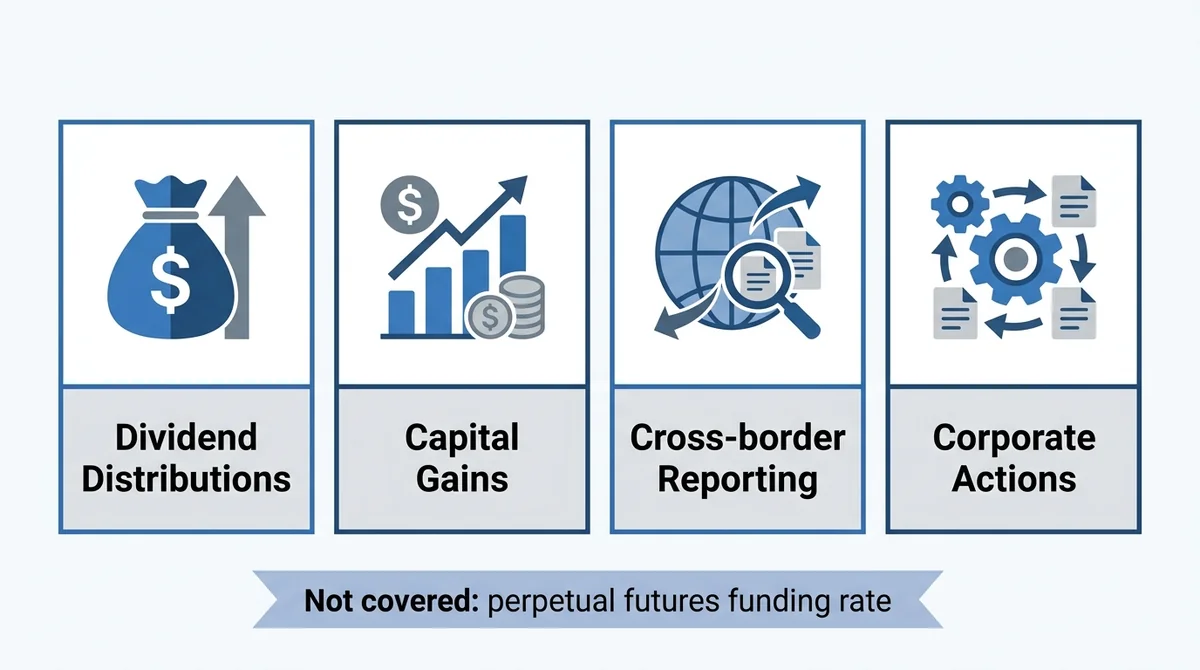
This article examines the tax and withholding treatment involved in tokenized stocks and their corporate actions. The scope includes:
- Dividend distributions: Distribution and withholding treatment of dividends paid on the underlying stocks corresponding to tokenized stocks, whether on-chain or in platform accounts.
- Capital gains: Determination of gain attribution arising from token trading, as well as the determination of holding period and cost basis.
- Cross-border reporting: Reporting obligations and documentation requirements determined by the investor's residency status and asset characterization.
- Corporate actions: The impact of stock splits, mergers, and spin-offs on cost basis and tax timing.
This article does not cover the perpetual futures funding rate settlement schedule for spot or perpetual contracts, nor does it recommend buying or selling any specific instrument.
#Key mechanisms and data
#Treatment of dividend withholding tax
Dividend withholding tax on tokenized stocks is typically withheld by the platform or the underlying asset custodian at the applicable rate. The withholding agent varies by platform structure: some platforms withhold as issuer or custodian, while others complete withholding through the underlying asset custody chain. The rate depends on the underlying asset's location and the platform structure; on-chain withholding and underlying withholding may differ, and on-chain withholding may lack standardized tax documentation.
Data note: This article has not obtained unified public data on withholding rates and documentation formats across platforms; specific treatment must be verified platform by platform against disclosures. All specific rates are unverified, and this article does not list specific figures.
#Determination of capital gains attribution
Capital gains attribution depends on the legal characterization of the tokenized stock: if it is recognized as a beneficial ownership certificate of the underlying stock, gains may be attributed to trading in the underlying stock; if it is recognized as an independent digital asset, it is treated as token trading. Holding period and cost basis must be determined according to platform records and local tax law. Cross-border scenarios may involve double taxation and the application of tax treaties.
Data note: Most jurisdictions have no dedicated tax guidance for tokenized stocks. The above judgments are inferences based on existing public regulatory documents and industry practice and do not constitute confirmed rules.
#Cross-border reporting boundaries
Reporting obligations depend on residency status and asset characterization. The completeness and format of tax documentation provided by platforms vary widely; some platforms provide only transaction records and no formal tax documentation. Under-reporting may result in penalties, while duplicate reporting may trigger double taxation.
Data note: Specific reporting requirements are subject to local tax authority rules; this article does not constitute tax advice.
#Key drivers
- Fragmented regulatory guidance: Major financial jurisdictions have not unified the tax characterization of tokenized assets, making platform treatment non-comparable.
- Differences in platform structure: The roles of issuer, custodian, and trading platform differ, directly affecting the withholding agent and documentation format.
- Mismatch between on-chain execution and tax timing: The on-chain execution timing of corporate actions may diverge from the tax recognition timing, increasing record-keeping and reporting difficulty.
- Growth in cross-border investors: Cross-border holding of tokenized stocks may amplify the risk of double taxation and under-reporting (this driver is an inference and is not supported by public statistics).
#Key participants
- Tokenized stock issuance platforms: Responsible for token issuance and corporate action execution; some platforms also act as withholding agents.
- Underlying asset custodians: Hold the underlying stocks and execute dividend withholding and corporate actions.
- Tax and audit firms: Provide reference standards for documentation formats and reporting treatment.
- Regulators: Tax authorities and financial regulators in each jurisdiction, responsible for implementing guidance.
The above lists factual roles only and does not constitute a recommendation of any institution.
#Risks and disagreements
- Inconsistency between on-chain execution timing and tax timing: This may cause mismatches in the period of gain recognition and affect reporting accuracy.
- Cost basis adjustments for splits and mergers: If cost basis is not adjusted in a timely manner, gain calculations may be distorted.
- Differences in platform disclosures: Platforms disclose withholding rates, documentation formats, and corporate action treatment rules inconsistently, making treatment non-comparable.
- Bearish view: Some researchers argue that tokenized stocks lack standardized tax documentation and may face long-term compliance uncertainty, increasing investors' administrative burden (this is an opinion, not a factual conclusion).
Data note: The above risks are based on public disclosures and industry observations, and there is no unified industry standard.
#What to watch next
- Tax guidance on tokenized assets in major financial jurisdictions: Watch whether jurisdictions such as the United States, the European Union, Singapore, and Hong Kong issue dedicated guidance (this is a watch item, not a forecast).
- Platform disclosure fields: Focus on verifying withholding rates, documentation formats, and corporate action treatment rules.
- Investor tax record-keeping processes: Investors are advised to maintain their own transaction records and cost basis ledgers to cope with reporting uncertainty.
Data note: The above are events to be tracked and do not constitute predictions of outcomes.
#FAQ
Q1: Who withholds dividend tax on tokenized stocks? A: It is typically withheld by the platform or the underlying asset custodian at the applicable rate, and the specific party depends on the platform structure. On-chain withholding and underlying withholding may differ, and platform disclosures should prevail.
Q2: Are capital gains attributed to token trading or underlying stock trading? A: It depends on the legal characterization of the tokenized stock. If it is recognized as a beneficial ownership certificate of the underlying stock, gains may be attributed to underlying stock trading; if it is recognized as an independent digital asset, it is treated as token trading. Most jurisdictions have no dedicated rules.
Q3: What needs to be reported in cross-border scenarios? A: Reporting obligations depend on residency status and asset characterization. The completeness and format of platform tax documentation vary widely; local tax authority requirements should prevail, and investors should keep their own transaction records.
Q4: How do splits and mergers affect cost basis? A: Splits and mergers require corresponding adjustments to cost basis; otherwise, gain calculations may be distorted. Specific adjustment methods should refer to platform records and local tax law.
Q5: How should differences in platform disclosures be assessed? A: Investors should verify each platform's withholding rates, documentation formats, and corporate action treatment rules, and monitor updates to regulatory guidance. There is currently no unified industry standard, and non-comparable treatment is the main source of uncertainty.
FAQ
Who withholds dividend tax on tokenized stocks?
It is typically withheld by the platform or the underlying asset custodian at the applicable rate, and the specific party depends on the platform structure. On-chain withholding and underlying withholding may differ, and platform disclosures should prevail.
Are capital gains attributed to token trading or underlying stock trading?
It depends on the legal characterization of the tokenized stock. If it is recognized as a beneficial ownership certificate of the underlying stock, gains may be attributed to underlying stock trading; if it is recognized as an independent digital asset, it is treated as token trading. Most jurisdictions have no dedicated rules.
What needs to be reported in cross-border scenarios?
Reporting obligations depend on residency status and asset characterization. The completeness and format of platform tax documentation vary widely; local tax authority requirements should prevail, and investors should keep their own transaction records.
How do splits and mergers affect cost basis?
Splits and mergers require corresponding adjustments to cost basis; otherwise, gain calculations may be distorted. Specific adjustment methods should refer to platform records and local tax law.
How should differences in platform disclosures be assessed?
Investors should verify each platform's withholding rates, documentation formats, and corporate action treatment rules, and monitor updates to regulatory guidance. There is currently no unified industry standard, and non-comparable treatment is the main source of uncertainty.
Related Terms
Ready to try? Test the strategy on MSX with small positions. Educational content only — not investment advice.