Research on Tokenized Stock Liquidity Risk Measurement Framework: Spreads, Depth, and Stress Scenario Construction
Study tokenized stock liquidity risk metrics: spreads, depth, stress, premiums vs real US stocks. Assess liquidity risk, impact cost, and risk thresholds.
#Tokenized Stock Liquidity Risk Measurement Framework: Spreads, Depth, and Stress Scenario Construction
⚠ This article is a digital asset multi-asset research piece and does not constitute investment advice. Investing involves risk; please make decisions prudently. The following analysis is based on public information and general market microstructure principles, and some platform data has not been independently verified.
Core conclusion: The liquidity risk of tokenized stocks may require an independent measurement framework covering spreads, depth, and stress scenarios for evaluation. It is not appropriate to directly apply real US stock indicators; recalibration is needed for platform-specific mechanisms.
#Underlying/Business Line Definition
Tokenized stocks generally refer to digital assets that represent price exposure to specific stocks. Trading these tokens does not equate to holding real stocks. The research scope includes tokenized stocks in spot and perpetual contracts, as well as related RWA structures. Their liquidity risk may stem from shallow market depth, wide spreads, and non-standardized data disclosure, with the specific degree varying by platform.
#Key Mechanisms and Data
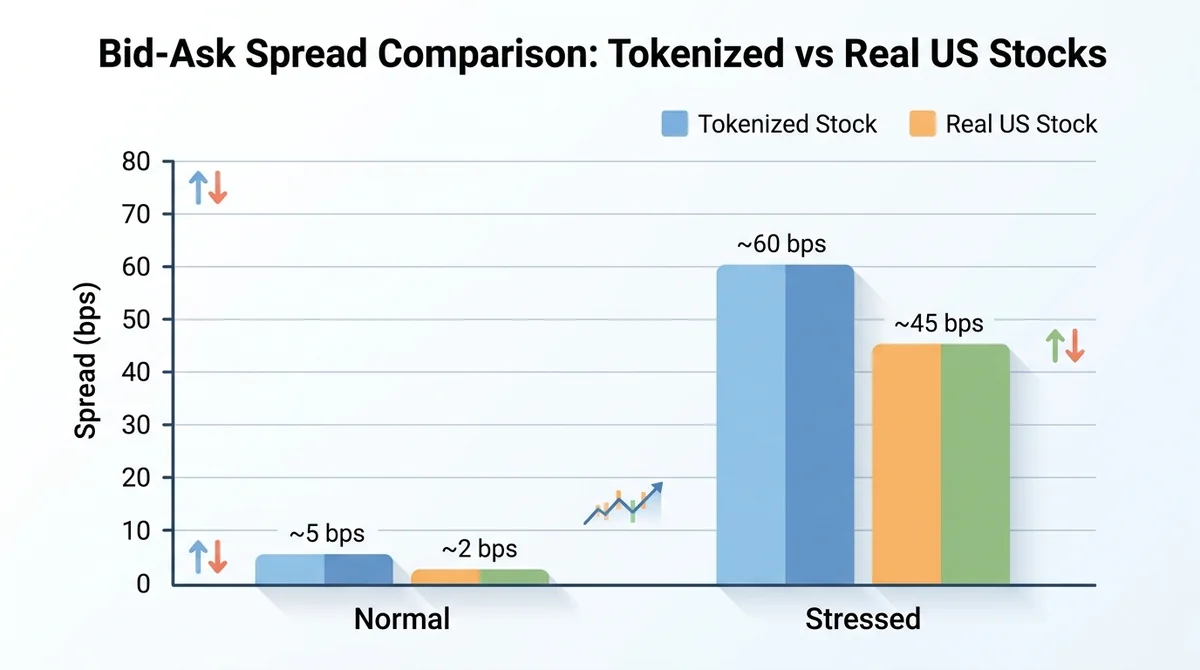
#How are spread indicators used to measure tokenized stock liquidity risk?
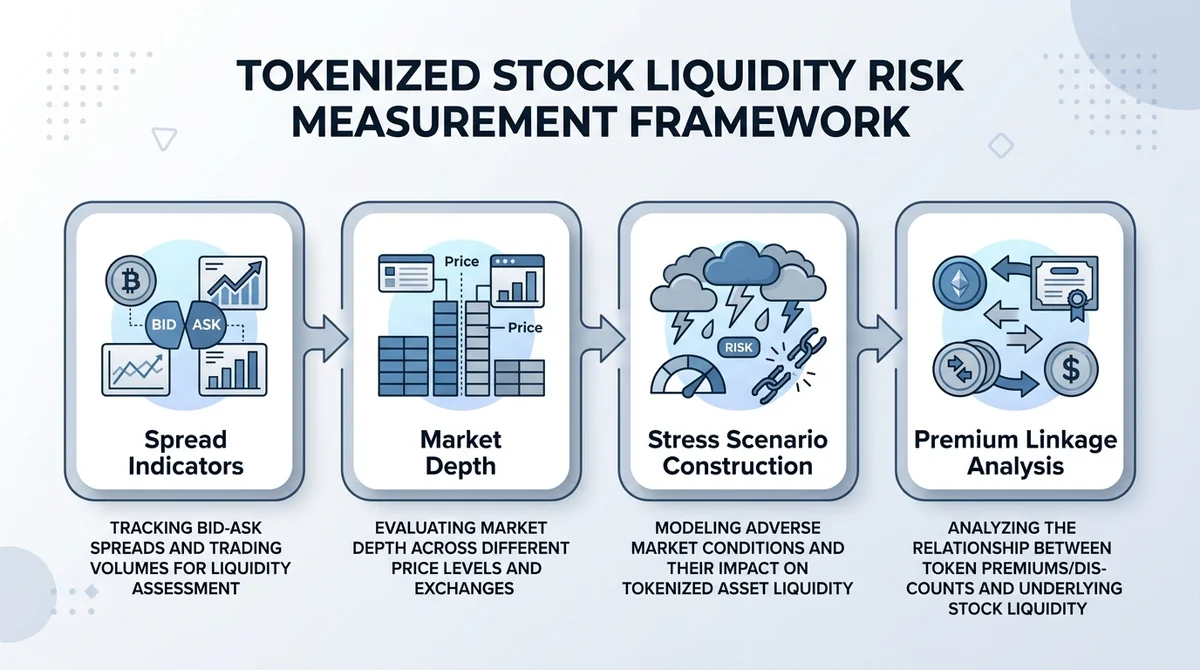
The bid-ask spread is one of the immediate cost indicators of liquidity risk. On some platforms or during certain periods, tokenized stock spreads may be significantly wider than those of the corresponding US stocks, and may widen further under stressed market conditions. Widening spreads are generally viewed as a signal of deteriorating liquidity, but should be confirmed by comparing with real US stock spreads during the same period. High-frequency spread data helps capture short-term stress, but data quality varies greatly across platforms.
#How does market depth reflect tokenized stock liquidity risk?
Order book depth represents the executable size without significantly affecting price. Insufficient depth amplifies impact cost, making large trades more prone to slippage, especially when other conditions are equal. Depth quantile monitoring thresholds can be set; when depth falls below a specific quantile, it indicates liquidity risk. Threshold setting should consider platform size and underlying liquidity differences.
#How does stress scenario construction test tokenized stock liquidity?
Stress scenario construction sets extreme parameters such as spread widening and depth collapse, combining historical extreme market conditions with forward-looking scenarios to assess impact cost and executable size, providing threshold references for risk control. Test results can be used for position sizing and stop-loss settings, but stress scenario assumptions may carry model risk and cannot cover all tail events.
#How does the tokenized stock premium mechanism affect liquidity risk measurement?
Tokenized stock premium mechanism may amplify liquidity risk. High premiums often accompany tightened liquidity, and spread widening and depth decline may be more pronounced. The measurement framework should include premium linkage analysis, distinguishing premium sources (such as demand-driven, arbitrage friction, or market manipulation), and avoid equating the premium itself with liquidity risk.
#Tokenized stocks vs real US stocks: Where do liquidity risk measurement differences lie?
Some tokenized stock markets may have longer trading hours, but market depth is often shallower; real US stocks have exchange-level quotes and disclosure data, while token platforms have varying degrees of disclosure. Measurement indicators need adjusted thresholds and supplementary stress tests, usually requiring more conservative assumptions. For example, spread and depth thresholds may need to be calibrated according to platform order book quality.
#Core Drivers
- Platform custody and trading mechanisms: Cross-platform custody and settlement methods may affect liquidity and data availability.
- Non-standardized data disclosure: Lack of unified order book and trade data standards makes horizontal comparison difficult.
- Arbitrage and market-making behavior: Arbitrageurs and market makers may improve or worsen liquidity, depending on incentives and competition.
- Regulatory uncertainty: Compliance requirements may affect market maker participation, thereby affecting liquidity.
#Key Participants
- Tokenization platforms: Including some platforms offering on-chain tokenized stock trading (platform names not independently verified one by one, for illustration only).
- Market makers: Provide two-sided quotes, directly affecting depth and spreads.
- Arbitrageurs: Exploit price differences between tokenized stocks and real US stocks or other markets for arbitrage.
- Data and quote providers: Provide price and depth data, but standardization levels vary.
#Risks and Divergences
- Bearish views argue that liquidity risk may be underestimated, especially the depth collapse under stressed market conditions.
- The premium mechanism may amplify liquidity risk, but some argue that premium is a manifestation of market segmentation and arbitrage inefficiency.
- Stress scenario assumptions may be insufficient and cannot cover extreme tail events.
- The measurement framework is not yet standardized; data from different platforms are not comparable, which may lead to misjudgment.
#What to Watch Next
- Improvement in order book depth and spread disclosure across various tokenized stock platforms.
- Impact of regulatory policies on market makers for tokenized securities.
- Changes in spreads and depth between tokenized stocks and real US stocks under extreme market conditions.
- Liquidity performance of newly added tokenized stock underlyings.
#FAQ
Q: Why does tokenized stock liquidity risk need independent measurement? A: Tokenized stock markets may feature shallow depth, wide spreads, and non-standardized data disclosure. Real US stock indicators may not be applicable and need recalibration.
Q: Does a wider spread mean higher liquidity risk? A: Generally, when spreads are wide and depth is shallow, liquidity risk is higher, but a comprehensive judgment should combine depth and real US stock spreads during the same period.
Q: What parameters are mainly included in stress scenario construction? A: It mainly includes spread widening multiples, depth decline ratios, impact costs, etc., combined with historical extreme market conditions and forward-looking assumptions.
Q: What is the relationship between tokenized stock premium and liquidity risk? A: High premiums may accompany tightened liquidity, but premium sources are diverse; the premium itself should not be equated with liquidity risk.
Q: How can investors use these indicators? A: They can be used to set position limits, stop-losses, and risk control thresholds, but should not be the sole basis; they need to be combined with platform mechanisms and real-time data.
FAQ
Why does tokenized stock liquidity risk need independent measurement?
Tokenized stock markets may feature shallow depth, wide spreads, and non-standardized data disclosure. Real US stock indicators may not be applicable and need recalibration.
Does a wider spread mean higher liquidity risk?
Generally, when spreads are wide and depth is shallow, liquidity risk is higher, but a comprehensive judgment should combine depth and real US stock spreads during the same period.
What parameters are mainly included in stress scenario construction?
It mainly includes spread widening multiples, depth decline ratios, impact costs, etc., combined with historical extreme market conditions and forward-looking assumptions.
What is the relationship between tokenized stock premium and liquidity risk?
High premiums may accompany tightened liquidity, but premium sources are diverse; the premium itself should not be equated with liquidity risk.
How can investors use these indicators?
They can be used to set position limits, stop-losses, and risk control thresholds, but should not be the sole basis; they need to be combined with platform mechanisms and real-time data.
Related Terms
Ready to try? Test the strategy on MSX with small positions. Educational content only — not investment advice.