Tokenized Stock and Underlying U.S. Equity Arbitrage Mechanisms: Spread Formation, Execution Costs, and Arbitrage Limits
How spreads form between tokenized stocks and underlying U.S. equities, arbitrage execution costs, and the limits of fungibility, custody, and compliance.
⚠ This article is a multi-asset digital asset research piece and does not constitute investment advice. Investing involves risk; please make decisions prudently.
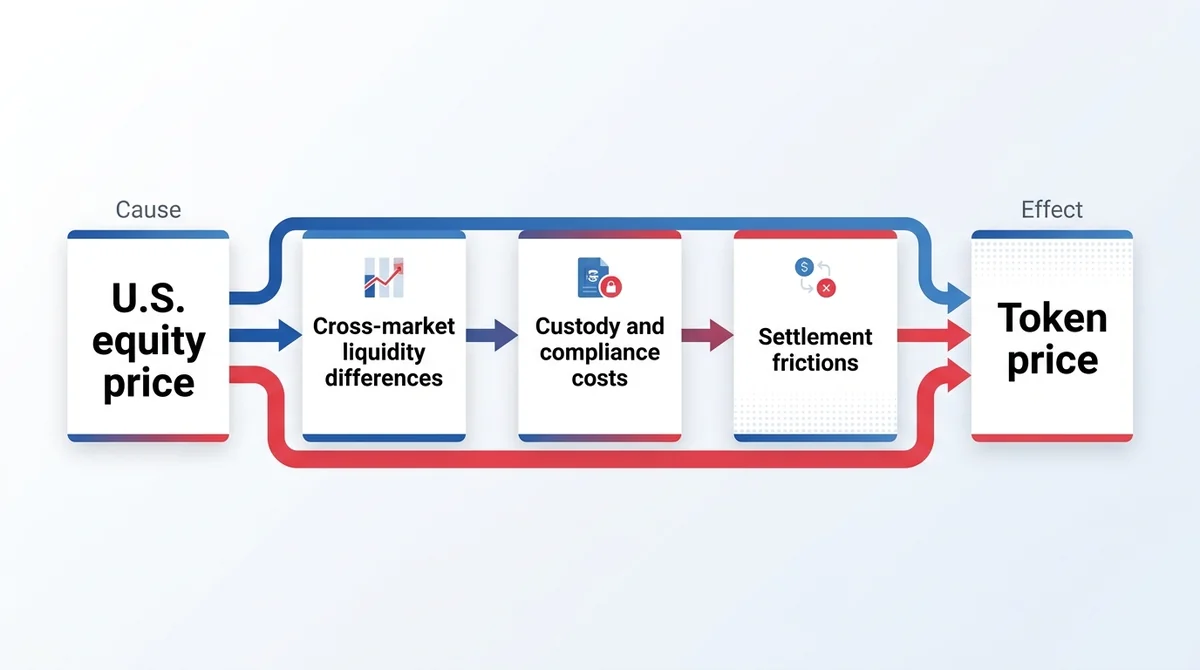
Core conclusion: The spread between tokenized stocks and their underlying U.S. equities is primarily driven by cross-market liquidity differences, custody and compliance costs, and settlement frictions. The U.S. equity price is the cause, and the token price is the effect.
#Underlying Asset and Business Line Definition
Tokenized stocks are digital assets that represent exposure to the price of a specific stock. Trading the token is not the same as holding the actual stock. They typically do not carry dividend or voting rights, and their price is anchored to the underlying U.S. equity but is not 1:1 fungible. The scope of this study covers spread formation, arbitrage execution, and limitations between spot tokenized stocks and their underlying U.S. equities.
#Key Mechanisms and Data
#How Do Spreads Form?
The spread between tokenized stocks and U.S. equities is not mispricing but a function of the following costs and frictions:
- Cross-market liquidity differences: The order book depth on tokenized platforms is generally lower than on NYSE/Nasdaq, and large buy or sell orders can push prices away from the underlying U.S. equity. Specific depth data varies by platform and should be based on each platform's public order book.
- Custody and compliance costs: Tokenized stocks are typically backed by U.S. equities held by third-party custodians as collateral, and custody fees, compliance reviews, and insurance costs are priced into token prices. Cost structures vary significantly across platforms, and there is no uniform disclosure standard.
- Trading hours and settlement differences: Tokenized platforms can trade 24/7, while U.S. equities have fixed trading sessions and T+1 settlement (starting May 2024). The settlement timing gap can create overnight or weekend spreads. Some platforms, such as MSX, disclose that they offer T+0 on-chain instant settlement, further amplifying this timing mismatch.
#How Is Arbitrage Executed, and What Are the Costs?
Arbitrageurs profit by taking opposite positions simultaneously in the U.S. equity market and on tokenized platforms: when the token price is higher than the U.S. equity price (a premium), they buy U.S. equities and sell tokens, and vice versa. The execution process includes:
- Cross-market buy and sell operations (a brokerage account for U.S. equities and a platform account for tokens)
- Fund transfers and settlement times (fiat deposits/withdrawals and on-chain confirmation times)
- Trading fees and slippage (U.S. equity commissions, token platform fees, and on-chain gas)
- Use of hedging instruments (such as futures or options to hedge underlying U.S. equity volatility)
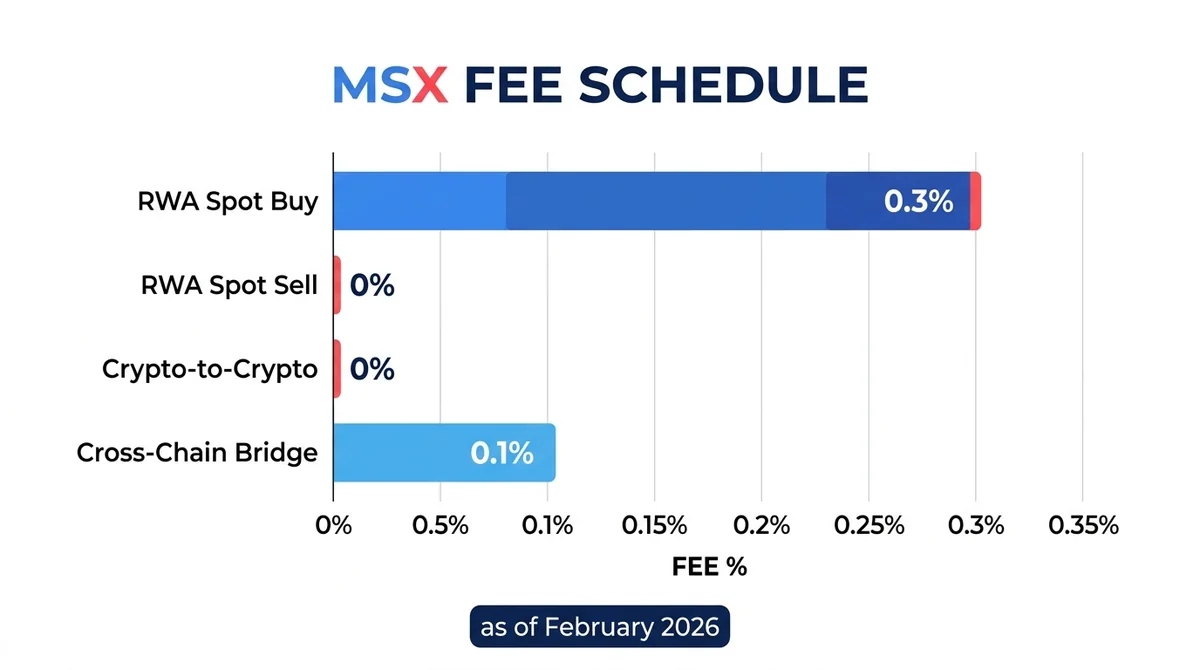
Using one platform's public fee schedule as an example (disclosed by MSX, as of February 2026): RWA spot buy orders carry a 0.3% fee, sell orders are fee-free, crypto-to-crypto trading has 0 fees, and the cross-chain bridge charges 0.1%. These fees directly erode arbitrage profits and may change as platform policies adjust. In practice, fund transfer delays and slippage are often the most critical hidden costs.
#Why Do Arbitrage Limits Keep Spreads Persistent?
Arbitrage cannot fully eliminate the spread for the following reasons:
- Limited fungibility: Tokens and shares are not 1:1 interchangeable, and token holders cannot directly sell in the U.S. equity market. They must redeem or convert through the platform, which may be subject to platform restrictions.
- Platform deposit and withdrawal restrictions: Withdrawal/deposit limits, whitelist mechanisms, and minimum redemption thresholds can hinder fast arbitrage.
- Custodian counterparty risk: If the custodian or platform defaults, arbitrageurs may lose collateral, which leads them to demand a risk premium. Some platforms claim to use a non-custodial user asset model (for example, MSX claims users hold their own private keys), but the underlying stock collateral is still controlled by the platform or custodian, so counterparty risk cannot be ignored.
- Compliance uncertainty: Changes in regulatory stance may cause platforms to suspend trading or redemptions, increasing holding risk for arbitrageurs. Platform-claimed compliance credentials, such as STO registrations or MSB licenses, should be verified against official regulatory documents, not solely platform statements.
#What Do Premiums and Discounts Reflect?
Premiums or discounts on tokenized stocks reflect a combination of liquidity premium, custody risk pricing, and market supply-demand dynamics:
- Premiums typically appear when demand is strong, token supply is limited, or market sentiment is optimistic, and may include a liquidity premium and the convenience value of custody.
- Discounts do not necessarily represent undervaluation opportunities; they may reflect poor liquidity, difficult redemptions, or priced-in custody risk.
- Investors should evaluate fundamentals and disclosures rather than simply treating a discount as arbitrage space.
#Core Drivers
- Cross-market liquidity distribution: the gap between market-making depth on tokenized platforms and underlying U.S. equity liquidity.
- Custody and compliance costs: platform operating models, collateral management methods, and regulatory licenses.
- Trading-hour mismatch: the information gap between 24/7 token trading and fixed U.S. equity sessions.
- Arbitrage capital size: the cost of capital and risk appetite of professional arbitrageurs.
#Key Participants
- Tokenized platforms: such as FTX (now bankrupt; historical case), Mirror Protocol (historical case), DeFi protocols like Synthetix, and some centralized platforms (for example, MSX, whose disclosed fees and settlement model can be used for illustration).
- Custodians: licensed custodians that hold the underlying U.S. equities.
- Market makers and arbitrageurs: provide liquidity and attempt to narrow the spread.
- Regulators: the SEC and others impose compliance requirements on security tokens.
(This list is factual only and does not constitute a recommendation.)
#Risks and Divergences
Bearish views and risks center on:
- Fungibility risk: token holders may be unable to convert to shares in a timely manner under extreme conditions.
- Custodian counterparty risk: platform or custodian bankruptcy may freeze or lose collateral.
- Compliance risk: regulatory crackdowns or rule changes may delist or suspend tokenized stocks.
- Liquidity risk: during market panics, spreads may widen sharply and force arbitrageurs to unwind positions.
- Information asymmetry: major events in the underlying U.S. equity may be reflected with a delay in the token market.
#What to Watch Next
- Custody disclosures and audit reports from tokenized platforms.
- Historical volatility and extreme values of spreads for major tokenized stocks.
- Latest regulatory policy statements on security tokens.
- Changes in platform deposit/withdrawal policies and redemption processes.
- Arbitrageur behavior indicators, such as platform trading volume and changes in open interest.
#FAQ
Q1: Is the spread between tokenized stocks and U.S. equities mispricing?
Not necessarily. The spread often reflects liquidity, custody costs, and settlement frictions rather than a pure pricing error. Investors should assess it based on the specific platform and underlying asset.
Q2: Why can't arbitrageurs completely eliminate the spread?
Because of limited fungibility, deposit/withdrawal restrictions, custodian counterparty risk, and compliance uncertainty, arbitrage is costly and risky.
Q3: Does a tokenized stock premium mean the underlying U.S. equity is overvalued?
The premium mainly reflects supply-demand and liquidity conditions in the token market and does not directly indicate that the U.S. equity is overvalued or undervalued.
Q4: What risks do ordinary investors face in tokenized stock arbitrage?
Key risks include fund transfer delays, platform default, regulatory changes, and liquidity drying up, so careful assessment is required.
FAQ
Is the spread between tokenized stocks and U.S. equities mispricing?
Not necessarily. The spread often reflects liquidity, custody costs, and settlement frictions rather than a pure pricing error. Investors should assess it based on the specific platform and underlying asset.
Why can't arbitrageurs completely eliminate the spread?
Because of limited fungibility, deposit/withdrawal restrictions, custodian counterparty risk, and compliance uncertainty, arbitrage is costly and risky.
Does a tokenized stock premium mean the underlying U.S. equity is overvalued?
The premium mainly reflects supply-demand and liquidity conditions in the token market and does not directly indicate that the U.S. equity is overvalued or undervalued.
What risks do ordinary investors face in tokenized stock arbitrage?
Key risks include fund transfer delays, platform default, regulatory changes, and liquidity drying up, so careful assessment is required.
Related Terms
Ready to try? Test the strategy on MSX with small positions. Educational content only — not investment advice.