Q4 2026 Earnings Season Tokenized US Stock Cross-Time-Zone After-Hours Spread Arbitrage: Liquidity Gaps and Event-Driven Returns
Explore tokenized US stock after-hours spread arbitrage during earnings: liquidity gaps, oracle latency, execution risk control, and failure boundaries.
⚠ This article is a digital asset multi-asset research study and does not constitute investment advice. Investing involves risk; please exercise caution.
Tokenized US stock after-hours spread arbitrage is essentially an event-driven strategy that captures spread convergence during earnings releases by exploiting the pricing lag between traditional after-hours liquidity gaps and 24/7 continuous crypto markets.
#What Is the Underlying Mechanism of Tokenized US Stock Cross-Time-Zone After-Hours Spread Arbitrage?
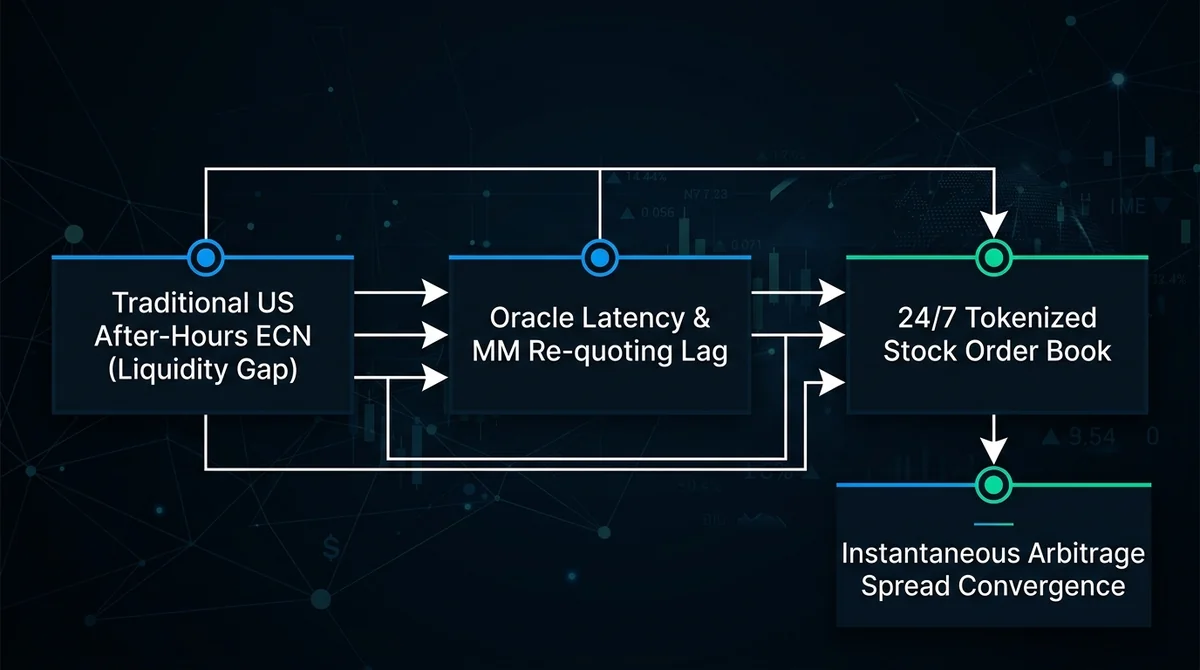
Tokenized US stock after-hours spread arbitrage is an event-driven methodology designed to capture spread convergence at the moment of an earnings announcement, exploiting update latency and liquidity depth disparities between traditional after-hours quotations and crypto tokenized markets.
传统美股市场 (盘后电子交易断层/低深度)
          │ (财报突发冲击)
          ▼
跨市场价差放大 (Spread Gap) ◄── 预言机喂价延迟 / 做市商调价时滞
          ▲
          │ (高频监控与毫秒级吃单)
代币化美股市场 (24/7连续交易/链上或撮合池)
#What Is the Pricing Logic and Transmission Pathway Between US After-Hours and Tokenized Markets?
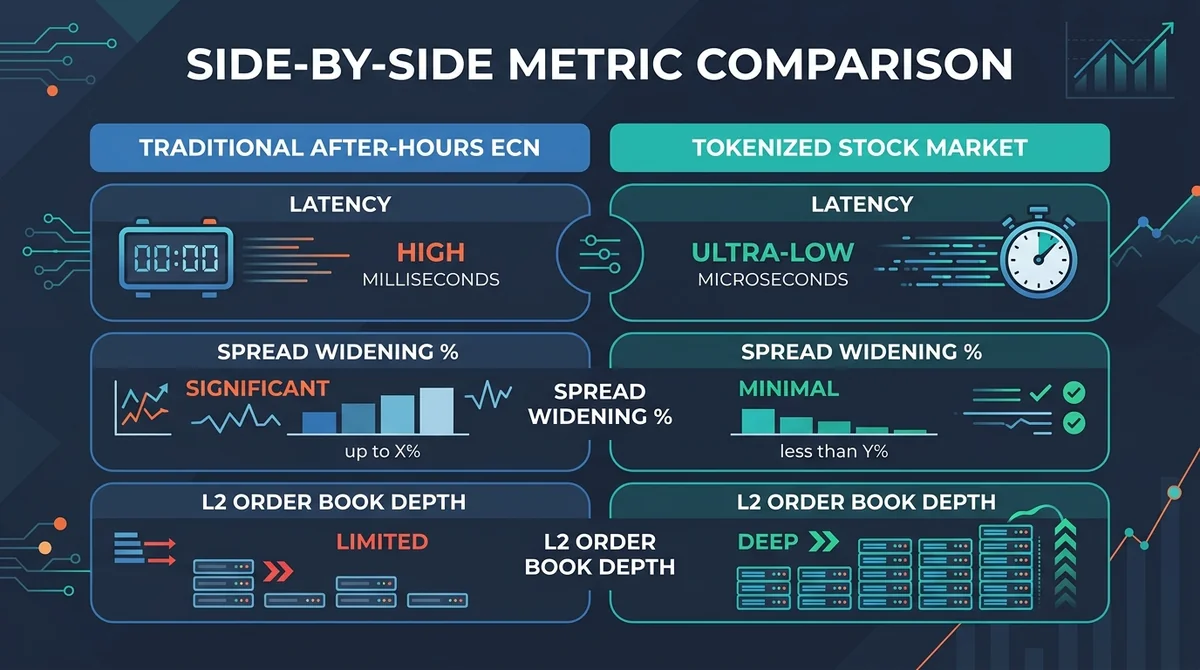
Tokenized Stocks: Tokenized stocks are digital assets representing price exposure to underlying equities; trading tokens is not equivalent to holding real stock, and price exposure does not equal true equity ownership—they typically carry no dividends or voting rights. In traditional US equity markets, after regular trading hours close, after-hours trading is matched via Electronic Communication Networks (ECNs), where trading volume and liquidity depth drop significantly compared to regular sessions.
In contrast, crypto derivatives or tokenized asset platforms generally operate continuously 24/7. When major earnings break in US after-hours sessions, price discovery initially takes place on ECN matching systems and is subsequently transmitted to tokenized trading markets via market-maker algorithms and on-chain oracles. Due to differences in network latency, risk control thresholds, and market-making strategies across the two infrastructures, pricing divergence and liquidity gaps frequently emerge within tight windows, creating theoretical arbitrage opportunities.
#How Do Post-Earnings Liquidity Gaps Create Actionable Spreads?
At the exact moment of an earnings release, bid-ask spreads in traditional after-hours markets widen abruptly as market makers pull quotes to protect against adverse selection. Meanwhile, liquidity in the tokenized market may still consist of passive liquidity pools or limit orders with unadjusted parameters. When oracle price feeds feature update intervals of several seconds to minutes, the external underlying asset price has already gapped, while tokenized asset price adjustments lag behind, forming an actionable cross-market instantaneous basis.
#Under What Market Environments Is This Cross-Time-Zone Spread Arbitrage Most Effective?
This strategy is most effective during windows where earnings surprises trigger severe underlying asset volatility, and tokenized markets maintain sufficient depth to allow rapid order taking and hedging.
#How Do Volatility Surprises and Earnings Outperformance Resonate?
When reported financial metrics (e.g., EPS, revenue guidance) deviate significantly from consensus expectations, after-hours asset prices typically undergo sharp, one-sided price gaps in short intervals. In such high-volatility environments, information transmission bottlenecks become magnified. Because tokenized markets feature fragmented participants and rely on oracle aggregation or MM requoting, the time required for token prices to converge to a new equilibrium is noticeably longer than during regular trading hours.
#What Prerequisites Must Liquidity Depth and Order Book Spreads Meet?
- Two-Sided Order Book Depth: The top five levels of the tokenized order book must hold sufficient absorption capital to prevent fatal market impact costs upon arbitrage execution.
- Unimpeded Hedging Channels: Trading desks must maintain sufficient credit lines or spot collateral across both traditional broker accounts (ECN trading accounts) and crypto venues to avoid unhedged, one-sided exposure.
- Spreads Exceeding Frictional Costs: The expected instantaneous basis must significantly exceed the combined sum of two-legged trading fees, borrow costs, and estimated slippage.
#In What Anomalous Scenarios Does This Arbitrage Framework Break Down?
The arbitrage model fails outright and can induce heavy losses when encountering oracle depegs, one-sided liquidity exhaustion on tokenized platforms leading to massive slippage, or failed fills on cross-market hedging legs.
#What Unhedged Risks Arise from Oracle Freezes or Price Depegging?
If a tokenized platform relies on aggregated oracles, sudden after-hours gaps may trigger outlier filter thresholds in certain data feeds, causing oracle updates to pause. In this scenario, platforms may halt trading or match orders at stale prices. As a result, after an arbitrageur establishes a token position, the external hedge price may drift further, creating severe unhedged exposure.
#How Do Liquidity Drains and Excessive Slippage Erode Expected Theoretical Yields?
During extreme market swings, decentralized liquidity pools (AMMs) or central limit order books (CLOBs) within tokenized trading protocols often experience rapid quote withdrawals by liquidity providers seeking shelter. Actual execution slippage can surge dramatically, instantly devouring the narrow theoretical arbitrage basis and turning a "theoretical profit" into an actual trading loss.
#How to Build a Step-by-Step Execution and Risk Management Framework for After-Hours Arbitrage?
Building this strategy requires a complete closed-loop framework covering pre-event fund allocation and monitoring, in-event millisecond spread triggering and dual-leg lock-in hedging, and post-event mandatory stop-losses with hard slippage constraints.
| Stage | Core Task | Key Risk Control Metrics |
|---|---|---|
| Pre-Event Preparation (T-24h to T-1h) | Deploy API data feeds; pre-fund dual accounts | Strict collateral utilization cap per single underlying asset |
| In-Event Execution (Earnings Window) | Calculate real-time spread thresholds; concurrent dual-leg execution | Hard slippage circuit breaker (abort immediately if exceeded) |
| Post-Event Balancing (Immediately Post-Execution) | Unwind hedges, rebalance capital, neutralize risk exposure | Strict limits on exposure duration (millisecond-to-second convergence) |
#How to Deploy Data Feeds and Capital Positions Ahead of the Event?
Prior to earnings announcements, quantitative systems must configure multi-node market access (including traditional after-hours data streams and crypto exchange WebSocket endpoints). On the capital side, symmetric liquidity must be pre-allocated across traditional brokerage ECN accounts and crypto custodial accounts, preventing missed execution windows caused by transfer delays during volatility spikes.
#What Are the Spread Triggers, Execution Sequence, and Hedge Unwinding Rules?
- Spread Trigger: When
|Tokenized Price - US After-Hours Fill Price| / Underlying Price > Dynamic Friction Threshold, the system fires an arbitrage signal. - Concurrent Execution: Utilizing a concurrent legging mechanism, the system consumes liquidity on the tokenized side while simultaneously routing limit hedge orders to the traditional after-hours market.
- Zeroing Exposure: Once both legs are matched, arbitrageurs rapidly close their hedge positions according to basis convergence speed to revert to a market-neutral stance.
#What Hard Stop-Losses and Single-Trade Exposure Caps Must Be Established?
- Single-Execution Slippage Threshold: Establish an absolute slippage circuit breaker; if token-side slippage exceeds pre-set limits, pending hedge orders must be canceled immediately.
- Single-Leg Fill Timeout Liquidation: If the hedge leg fails to fill within a specified time window (e.g., hundreds of milliseconds) after the token leg executes, trigger a forced liquidation stop-loss.
- Hard Drawdown Constraint: Maximum permissible drawdown for a single earnings event must be strictly locked within a defined safety margin.
#What Common Cognitive and Operational Pitfalls Do Investors Encounter in Tokenized Stock Arbitrage?
Common pitfalls include mistakenly assuming tokenized stocks grant full shareholder rights—leading to naked, long-term unhedged holding—and overlooking high slippage, borrowing interest, and counterparty platform risks when calculating expected yields.
#What Are the Potential Dangers of Equating Tokenized Stocks with Real US Equities?
Some traders mistake tokenized stocks for actual underlying securities. In reality, tokenized stocks offer synthetic price exposure only; holders do not possess voting rights, direct corporate dividend claims, or liquidation claims in bankruptcy. Holding tokenized positions long-term due to stuck single-legged arbitrage trades exposes capital to platform counterparty credit risk and smart contract vulnerabilities.
#What Are the Consequences of Ignoring Hidden Trading Costs and Funding Rates?
Cross-market arbitrage is never frictionless. During high-volatility events such as earnings releases, borrowing rates spike and traders must understand how does perpetual futures funding rate work to avoid unexpected costs. If arbitrageurs cannot close positions quickly, ongoing capital holding costs, execution fees, and network gas fees will rapidly erode all excess alpha.
FAQ
Can tokenized US stock arbitrage be completely risk-free?
No. Cross-market arbitrage carries execution latency risk, single-leg fill execution risk, oracle depegging, platform counterparty credit risk, and slippage expansion from network congestion, making it a risk-bearing statistical and event-driven strategy.
What are the primary differences between US after-hours trading and regular trading sessions?
After-hours trading is mainly matched through Electronic Communication Networks (ECNs) with significantly thinner liquidity depth, wider bid-ask spreads, higher volatility, and a higher propensity for brief price gaps around earnings events.
Does holding tokenized US stocks entitle an investor to corporate dividends?
Tokenized stocks only track specific stock price exposure; trading tokens is not equivalent to owning real equity and typically does not confer statutory dividend or voting rights, depending entirely on the issuer's terms.
Related Terms
Ready to try? Test the strategy on MSX with small positions. Educational content only — not investment advice.