Tokenized Stock Premium Convergence Speed: Event-Driven Spread Decay Path and Arbitrage Capital Constraints
Tokenized stock premium stems from price exposure demand and arbitrage limits. We study post-event spread decay and arbitrage capital constraints on convergence speed.
⚠ This article is digital asset multi-asset research, not investment advice. Investing involves risk; please make decisions prudently.
The convergence pace of tokenized stock premium is not a constant; it is constrained by both the nature of the shock event and arbitrage capital limits. After an event, the spread often compresses rapidly at first, then enters a slow reversion phase, but the relevant decay parameters are not publicly disclosed.
#Core Conclusions
After a shock event, tokenized stock premium typically follows a path of "fast narrowing in the front segment, gradual regression in the back segment." However, arbitrage costs, custody barriers, and compliance frictions significantly drag down the regression pace, and in some cases even prevent the premium from being eliminated for a long time.
#Underlying/Business Line Definition
Tokenized stocks are digital assets that map the price exposure of specific US stocks. Holding tokens does not equate to owning real stocks, and generally does not carry dividend or voting rights. The research scope includes spot, perpetual contracts, and tokenized stocks—asset types centered on price exposure.
#Key Mechanisms and Data
- Premium source: The trading price of tokenized stocks is higher than the corresponding US stock price, driven mainly by concentrated demand release and insufficient liquidity. Data are taken from public disclosures and market information, as of 2025-06.
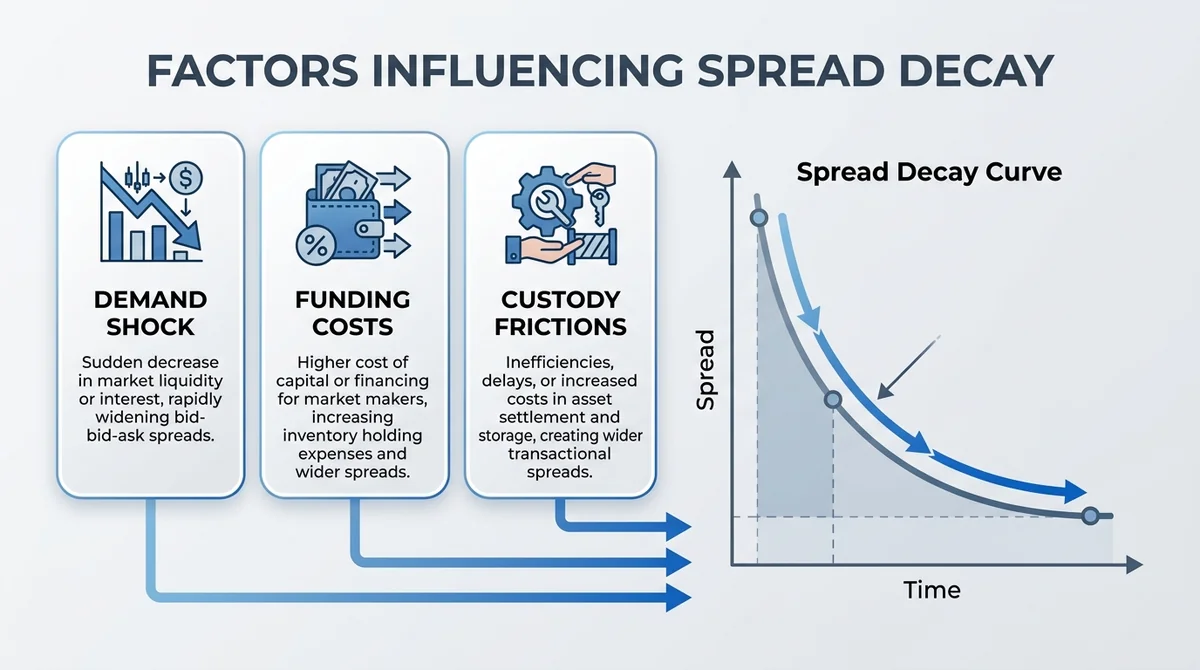
- Spread decay: After a shock event, the spread usually undergoes a rapid contraction first, then transitions to slow regression; the decay trajectory may exhibit exponential or power-law characteristics, but specific parameters are not publicly available.
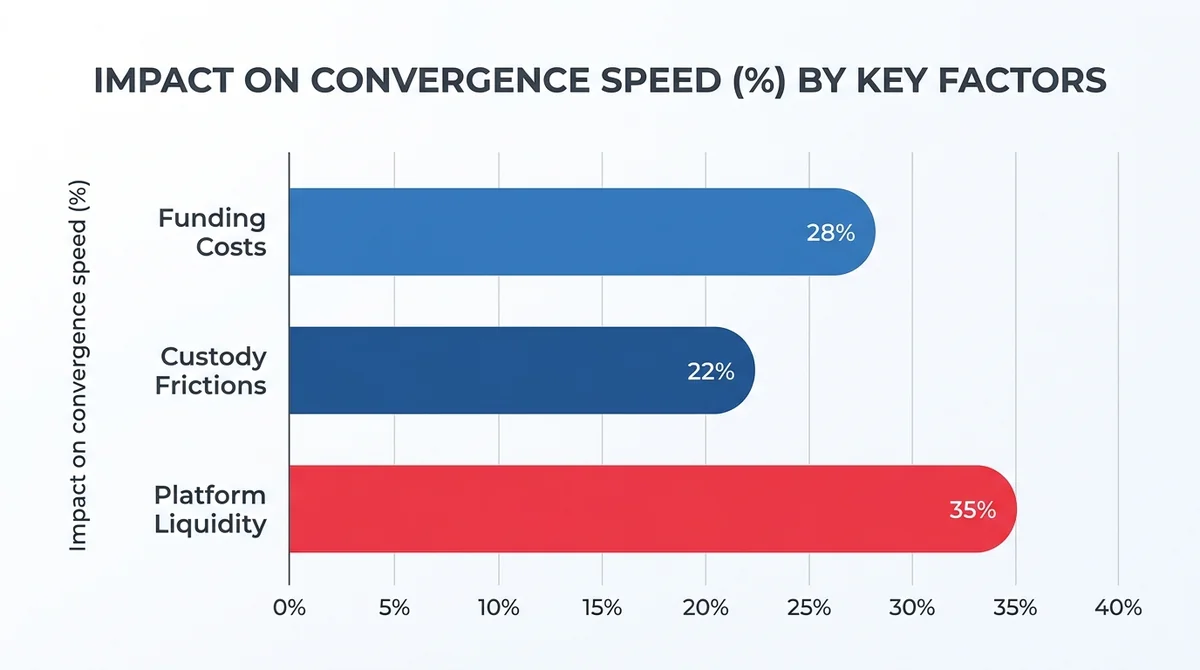
- Arbitrage constraints: Funding costs such as borrowing rates and funding rates, combined with custody restrictions and compliance requirements, raise the barrier to arbitrage operations; when arbitrage capacity is limited, the premium may persist.
#Core Drivers
- Demand shock intensity: Events such as earnings releases and regulatory changes trigger concentrated pursuit of tokenized stock exposure, widening the premium.
- Arbitrage funding costs: Rising borrowing rates and funding rates increase entry costs for arbitrageurs, slowing spread convergence.
- Custody and compliance frictions: Restricted conversion processes between tokenized stocks and real stocks make arbitrage more difficult.
- Platform liquidity: When tokenized stocks have insufficient trading depth, the speed of spread regression also slows accordingly.
#Key Participants
- Tokenized stock issuance platforms: Responsible for providing US stock price exposure tokens, such as COIN tokenized stocks.
- Arbitrageurs: Attempt to hedge between tokenized stocks and underlying US stocks to earn profits, but are constrained by capital and compliance conditions.
- Underlying US stock market: Serves as the price benchmark, but trading session and liquidity differences affect the actual efficiency of arbitrage.
#Risks and Divergences
Bearish view: The premium may persist for a long time, with arbitrageurs staying on the sidelines due to high costs; tokenized stocks lack real equity backing, and prices may deviate from fundamentals. Risks: Undisclosed data lead to uncertainty in research conclusions; differences in custody mechanisms across platforms may weaken comparability of results; limited historical event sample size reduces statistical significance.
#What to Watch Next
- Premium rate time series: Track the decay half-life of the spread between tokenized stocks and underlying US stocks.
- Major events: US stock earnings, regulatory developments, and liquidity shocks may trigger the next spread anomaly.
- Arbitrage cost changes: Monitor adjustments in borrowing rates, funding rates, and platform custody policies.
#FAQ
Q1: Why does tokenized stock premium occur?
A1: The root of the premium lies in the mismatch between price exposure demand and arbitrage capital constraints. Tokenized stocks provide US stock price exposure but do not represent real equity; when a demand shock occurs, insufficient liquidity combined with high arbitrage costs pushes token prices above underlying US stock prices.
Q2: Is post-event spread convergence instantaneous or gradual decay?
A2: In most cases it is not instantaneous. After a shock event, the spread often narrows rapidly first, then enters a slow regression phase; the decay trajectory may follow exponential or power-law patterns, but specific parameter data are not publicly available.
Q3: How do arbitrage capital constraints affect premium convergence speed?
A3: Funding costs such as borrowing rates and funding rates raise the convergence threshold; custody restrictions and compliance requirements increase arbitrage frictions; when arbitrage capacity is insufficient, the premium may persist for a long time.
Q4: What data gaps and uncertainties exist in the research?
A4: Specific decay coefficients, half-life, and other parameters are not publicly available; differences in custody mechanisms and liquidity across platforms may make results difficult to compare directly; limited historical event samples also restrict statistical significance.
Q5: What indicators and events should be monitored next?
A5: Focus on tracking the premium rate time series and decay half-life, US stock earnings and regulatory developments, arbitrage funding costs, and changes in platform custody policies.
FAQ
Why does tokenized stock premium occur?
The premium mainly stems from price exposure demand and arbitrage capital constraints. Tokenized stocks provide US stock price exposure but do not represent real equity; when a demand shock occurs, insufficient liquidity and high arbitrage costs push token prices above underlying US stock prices.
Is post-event spread convergence instantaneous or gradual decay?
It is usually not instantaneous. After a shock event, the spread often narrows rapidly first, then slowly regresses; the decay path may follow exponential or power-law decay, but specific parameter data are not publicly available.
How do arbitrage capital constraints affect premium convergence speed?
Arbitrage funding costs (such as borrowing rates and funding rates) raise the convergence threshold; custody restrictions and compliance requirements increase arbitrage frictions; when arbitrage capacity is limited, the premium may persist for a long time.
What data gaps and uncertainties exist in the research?
Specific decay coefficients, half-life, and other parameters are not publicly available; differences in custody mechanisms and liquidity across platforms may make results incomparable; insufficient historical event samples limit statistical significance.
What indicators and events should be monitored next?
Monitor the premium rate time series and decay half-life, US stock earnings and regulatory developments, arbitrage funding costs, and changes in platform custody policies.
Related Terms
Ready to try? Test the strategy on MSX with small positions. Educational content only — not investment advice.